
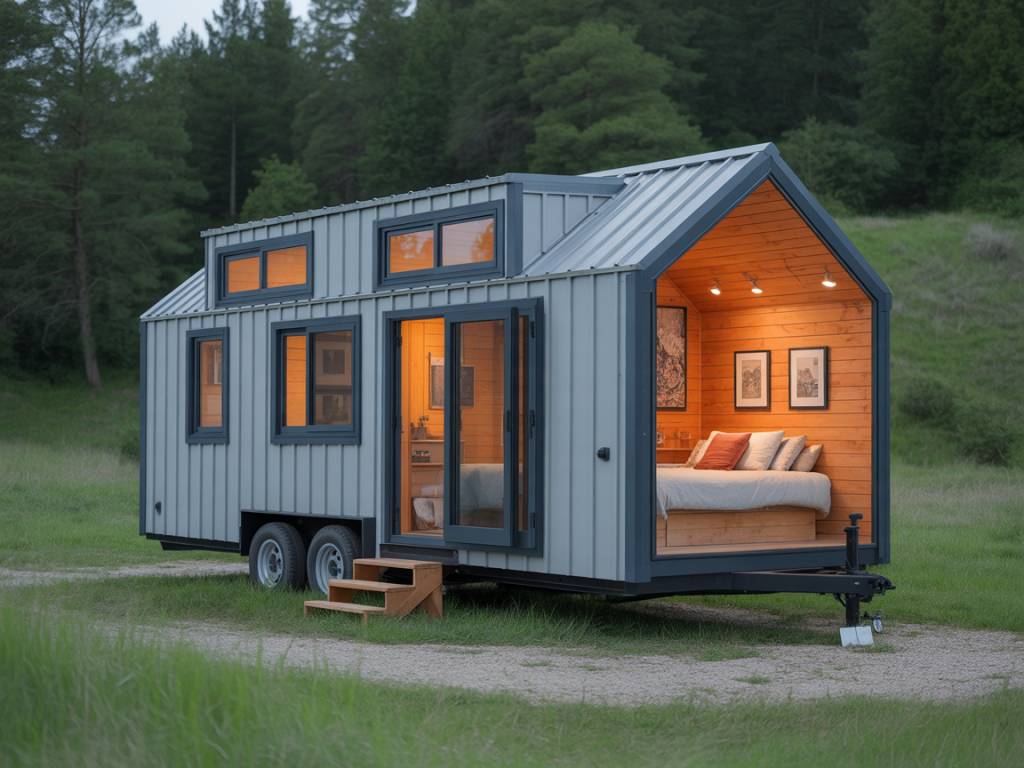
Some evenings, when the light slants low through a small window and dust motes hover like tiny planets, a modest room can feel like an entire universe. That is the quiet magic of a well-designed tiny house: it expands not by square metres, but by intention.
Designing a two-bedroom tiny house is a particular kind of alchemy. You’re not just squeezing in extra beds; you’re choreographing privacy, togetherness, and low-impact living inside a footprint that might fit neatly on a city driveway. It’s a challenge—and a deeply rewarding one.
Why a Two-Bed Tiny House Can Feel Bigger Than It Is
Two bedrooms in a small footprint invite a simple but powerful question: what do you really need to live well?
For many, the second bedroom serves as:
- a child’s room, softly lit and cocoon-like;
- a micro guest suite for visiting friends or grandparents;
- a flexible space that shifts between office, studio, and sleeping loft.
Instead of treating that extra room as a problem to solve ("How will it all fit?"), think of it as an anchor. Your layout will revolve around how these two sleeping spaces support your daily rhythms: early risers vs. night owls, remote work vs. family time, moments of solitude vs. shared meals.
The goal isn’t just to fit in two beds. It’s to create a layout where:
- movement is fluid and intuitive,
- privacy feels generous, not begrudged,
- and every square metre works harder than it would in a conventional home.
Clarify Your Tiny-House Priorities Before You Draw a Single Line
Before sketching floor plans on napkins (it will happen), pause for a quiet inventory. In a two-bedroom tiny house, your priorities are your blueprint.
Ask yourself:
- Who is sleeping where? Two adults and a child? A couple plus frequent guests? Two flatmates?
- Who wakes early, who works late? You’ll want doors and acoustic separation between conflicting schedules.
- Do you work from home? One bedroom might need to double as a daytime office with good natural light and a proper desk.
- How much cooking really happens? An avid cook might trade a larger living area for more counter space and smart storage.
- Indoor vs. outdoor living? In a mild climate, a generous deck can substitute for a bigger interior lounge.
Once you name what truly matters, design becomes less about sacrifice and more about precision. You’re not giving things up; you’re carving away everything that doesn’t serve you.
Smart Layout Strategies for a Two-Bed Tiny House
Two-bed tiny houses often fall into a few clever layout families. Each has its own character, like different paths up the same mountain.
The Classic Loft + Main-Floor Bedroom
This is a favourite for good reason. One bedroom lives on the ground floor; the second floats above, in a loft.
Best for: couples with a child, remote workers, or anyone who prefers sleeping on the main level.
Typical arrangement:
- Entry & living area at one end, often under the loft;
- Kitchen & bathroom clustered in the middle to simplify plumbing;
- Main-floor bedroom at the opposite end with a sliding door or pocket door;
- Loft bedroom above kitchen/bath or above the ground-floor bedroom.
Why it works efficiently:
- The loft "borrows" vertical space instead of increasing footprint.
- You gain separation between rooms: kids (or guests) tucked up high, adults with easier access below.
- Daytime activity can happen largely at one level, with the loft reserved as a quieter retreat.
To keep things feeling airy, resist the temptation to make the loft too deep. A loft that covers only half to two-thirds of the length allows daylight to pour into the main living area.
The Dual-Loft Refuge
If you’re comfortable with stairs or ladders, two lofted bedrooms can be remarkably efficient.
Best for: siblings, friends sharing a tiny house, or anyone needing equal, separate sleeping spaces.
Typical arrangement:
- Central living area & kitchen forming the heart of the home;
- Bathroom tucked to one side;
- Two sleeping lofts at opposite ends, sometimes with different stair styles (a ship’s ladder on one side, storage stairs on the other).
Benefits:
- Both bedrooms get privacy and, ideally, a window each.
- The ground floor becomes a generous, open common space for cooking, eating, and conversation.
- Perfect for tiny-house villages or off-grid communities where shared outdoor spaces further expand the living area.
To soften the "cabin in a treehouse" feeling, choose low-profile mattresses and maximize headroom with a slightly higher roof pitch or a dropped "cathedral" ceiling over each loft.
The Two Ground-Floor Bedroom Layout
For those who prefer to keep feet on solid ground—or plan to age in place—two ground-floor bedrooms can be worth the extra design acrobatics.
Best for: mobility-conscious occupants, multigenerational living, or anyone who wants to avoid nightly climbs.
Key strategies:
- Shared wet core: Place bathroom and kitchen back-to-back to save on plumbing and create a compact central service zone.
- Sliding partitions: Use pocket or sliding barn doors instead of swinging doors to reduce wasted clearance space.
- Convertible living space: One bedroom can double as an office or snug if fitted with a wall-bed or high-quality sofa bed.
This layout often suits slightly wider tiny homes—think park model width—where you can place two compact bedrooms at the rear with a central hallway, much like the cozy cabins of old trains.
Designing for Privacy Without Losing Light
In a tiny footprint, privacy is both precious and fragile. Thin walls share everything: whispers, kettle whistles, midnight emails. Yet you also crave openness and light. The trick is to separate functions, not people.
Practical ideas:
- Staggered doors: Avoid placing bedroom doors directly opposite each other; offset them along the corridor or living area.
- Transom windows: Add small windows above bedroom doors to let borrowed light in while maintaining privacy.
- Soft sound control: Use natural wool insulation in interior walls and thick curtains over bedroom doors or loft openings.
- Visual layers: Slatted timber screens or half-height partitions create subtle separations without closing spaces off completely.
Sometimes, privacy is as simple as the sound of the wind in the trees outside, or the murmur of a rainwater system. Your design can complement that natural soundscape rather than fighting it.
Let Vertical Space Do the Heavy Lifting
In a two-bedroom tiny house, floor area is stubbornly finite; height, however, is your quiet ally.
Use height intentionally:
- Storage stairs: Turn each step into a drawer or cupboard. Shoes, linens, even pantry items can disappear into this rising grid.
- Ceiling-hung elements: Pot racks, hanging planters, or fold-down drying racks keep valuable surfaces clear.
- High-level shelving: Run a continuous shelf around the perimeter of the living space near the ceiling for books, baskets, or seldom-used items.
- Loft edge functions: Build shelving or a slim desk into the edge of a loft, turning a boundary into useful surface.
The aim isn’t to clutter every centimetre, but to curate vertical features that feel built-in and intentional. When done well, the eye travels upward along clean lines of timber and light, and the space feels taller than it measures.
Furniture That Works as Hard as You Do
In most tiny homes, furniture is the difference between a cramped caravan and a serene retreat. In a two-bedroom layout, it becomes infrastructure.
High-value pieces include:
- Lift-top or extendable table: Coffee table by day, dining or work surface by night.
- Built-in banquette seating: With storage beneath, it replaces bulky chairs and doubles as a lounging nook.
- Wall bed (Murphy bed): Allows one bedroom to become a full workspace, playroom, or yoga area when folded up.
- Modular sofa: Sections that reconfigure into a guest bed give you a third "bedroom" when needed.
Whenever possible, build furniture into the structure: a window seat over the wheel well, a desk that folds into the wall, a headboard that hides shelves. Built-ins waste less space and feel calmer than a crowd of freestanding pieces.
Extending the House Into the Landscape
A two-bedroom tiny house comes into its own when it can lean on the outdoors. The plot becomes an extension of the floor plan, a seasonal living room painted in weather and birdsong.
Thoughtful exterior design can transform the way the house is used:
- Deck as living room: Align large sliding or French doors from the main living area onto a deck. Add a simple overhead pergola for shade and rain protection.
- Outdoor kitchen corner: A small counter, power outlet, and grill point can shift messy cooking outside in warmer months.
- Separate sleeping hut or "micro pod": If local rules allow, a detached tiny sleeping pod can serve as the second bedroom with even greater privacy.
- Green buffer zones: Planting hedges, tall grasses, or bamboo walls creates quiet, sheltered outdoor "rooms" for reading or working.
For off-grid or low-impact settings, choose permeable surfaces, native plants, and rain gardens that sip rather than gulp water.
Low-Impact Materials for a Gentle Footprint
Designing small is already a step toward low-impact living; there’s less to heat, cool, and fill with things. But the materials you choose for your two-bed tiny house can deepen that commitment.
Envelope and structure:
- FSC-certified timber or engineered wood for framing and cladding—renewable, warm, and relatively light.
- Wood fibre, sheep’s wool, or cellulose insulation for breathable walls that regulate moisture and reduce VOCs.
- Metal roofing with high recycled content and rainwater harvesting potential.
Interior finishes:
- Natural oil finishes instead of synthetic varnishes for floors and joinery.
- Lime or clay plasters on selected walls for thermal mass and a tactile, hand-finished texture.
- Formaldehyde-free plywood for built-ins and cabinetry.
Imagine a child lying awake in the loft, breathing in faint scents of timber and beeswax rather than chemical fumes. Materials shape not just energy performance, but the quiet, daily experience of living in the house.
Energy Systems Scaled to a Small Life
A two-bedroom tiny house can be wonderfully frugal with energy, especially if you design systems to match your real needs rather than the average home’s excess.
Simple, low-impact choices:
- Modest solar array: Sized for LED lighting, efficient appliances, laptops, and perhaps a small induction hob.
- Battery storage to smooth out cloudy days and evening usage, with careful monitoring of loads.
- High-performance windows and airtightness to reduce heating and cooling demand.
- Small, efficient heater such as a compact wood stove, infrared panel, or mini-split heat pump.
- On-demand water heater instead of a bulky hot water cylinder.
Place bedrooms where they benefit from passive strategies: a loft that captures rising heat in winter, or a cross-ventilated ground-floor bedroom that breathes cool night air in summer.
Three Example Layout Stories
To bring all this theory down to earth, imagine three different lives unfolding inside three two-bedroom tiny houses.
The Young Family’s Lofted Nest
A couple with a toddler choose a main-floor bedroom at the far end, with a sliding door and a small built-in wardrobe. Above the kitchen, a compact loft holds a child’s bed, low shelves for storybooks, and a circular window that frames the evening sky.
Storage stairs double as a library. The dining table folds against the wall when the toddler’s toys take over the floor. At night, after teeth are brushed and a last story is read, one parent climbs to tuck the little one into the loft while the other boils water for tea below. Voices travel softly through the house, but everyone feels they have their own nook.
The Remote-Working Couple
Here, the second bedroom is more studio than sleeping area. A wall bed folds up to reveal a full-width desk under a generous window. There’s space for a second monitor, sketchbooks, and a plant that leans lazily towards the light.
The main bedroom claims the loft, accessed by storage stairs lined with books. Mornings begin with emails at the desk; afternoons spill onto the deck beneath a simple canvas awning. When friends visit, the wall bed folds down, and the room becomes a guest retreat, complete with built-in reading lights and a small shelf for a glass of water and a novel.
The Multigenerational Retreat
An older parent and an adult child share a slightly wider tiny house. Both bedrooms sit on the ground floor, separated by a compact bathroom with a sliding pocket door. The parent’s room opens directly onto the deck, making sunrise and fresh air part of the daily ritual.
The shared living space flows from kitchen to a built-in window seat overlooking a garden of herbs and wildflowers. A small wood stove anchors the living area; winter evenings become a slow ritual of kindling, tea, and conversation, each retreating to their room at day’s end with a comfortable sense of having both company and solitude.
Practical Tips Before You Build
Before plans harden into plywood and screws, a few grounded steps can save headaches later:
- Mock up with tape: Mark out your proposed layout on a driveway or in a large room. Walk it. Pretend to cook, to get dressed, to carry a laundry basket.
- Test ladder vs. stairs: If one bedroom is in a loft, be brutally honest about how you’ll feel climbing at midnight or with sleepy knees.
- Invest in windows: Good natural light will make even the smallest bedrooms feel expansive and uplifting.
- Plan storage early: Decide where winter clothes, tools, and hobbies will live. Vague "we’ll figure it out" storage becomes future clutter.
- Check local rules: Planning regulations, minimum room sizes, and mobility access requirements can shape your design more than you think.
In the end, a two-bedroom tiny house is less about mastering clever tricks and more about aligning space with values. It invites you to ask, gently but persistently: What deserves room in your life? What can be left outside, in the wide world, where it belongs?
On a quiet night, with the last light fading and the small structure humming with its own stored warmth, a 2-bed tiny house can feel not like a compromise, but like a distilled version of home: simple, deliberate, and deeply enough.