There is a particular silence that falls on a city roof when it’s been turned green. The wind sounds softer. Bees arrive before the traffic. From street level, nothing seems to have changed. But up there, above the double glazing and the satellite dishes, a different kind of home is taking shape — not just for you, but for everything that flies, crawls and hums.
Green roofs and living walls are no longer just architectural curiosities on glossy eco-builds in Scandinavia. They are quietly spreading across British terraces, flats and semi-detached houses. Whether you live under the drizzle of Manchester, the sea breeze of Brighton or the soot-tinged skies of London, a planted roof or vertical garden can radically change how your home feels — and how wildlife experiences your patch of the UK.
Why green roofs and living walls belong on UK homes
At first glance, the UK doesn’t look like an obvious candidate for rooftop meadows and vertical jungles. Our weather is famously indecisive, our houses often draughty, and our gardens — when we have them — are usually small. Yet those are precisely the reasons these systems make sense here.
Green roofs and living walls help to:
- Insulate old and new homes — reducing heat loss in winter and overheating in summer.
- Manage rainwater — slowing runoff, easing the burden on our ageing drainage systems.
- Support biodiversity — offering nectar, shelter and nesting spaces in even the densest urban streets.
- Improve air quality — especially in towns and cities laced with traffic.
- Lift your mood — there is a quiet but real mental shift when your view becomes leaves rather than felt and flashing.
For many UK homeowners, transforming a bare roof or blank wall is one of the most effective ways to re-wild their property without sacrificing precious ground space.
How a green roof changes your home
Imagine stepping into an upstairs room on a hot July afternoon. Under a standard dark roof, the air often feels thick and stale. Under a planted roof, it is usually cooler, quieter, and somehow less aggressive.
That difference is not just romanticism; it’s physics and plant biology at work.
Key benefits for UK homes include:
- Thermal comfort — The soil and plants act as a buffer, absorbing heat during the day and releasing it more slowly at night. In winter, they help keep warmth inside, reducing heat loss through the roof.
- Lower energy bills — Studies across Europe have shown reduced demand for heating and air conditioning in buildings with well-designed green roofs. In a UK context, that usually translates to smaller gas or electricity bills — and a gentler carbon footprint.
- Longer roof lifespan — The layers of a green roof protect the waterproofing membrane from UV, frost and thermal expansion, often extending its life significantly.
- Noise reduction — If you live under a flight path, beside a main road, or near a lively pub, the extra layers on the roof can help dampen noise.
On a more personal note, there is an intangible comfort in knowing that the most exposed surface of your home is no longer a dead zone, but a thin, persistent strip of life.
Living walls: when your façade turns into a habitat
If green roofs are the quiet introverts of eco-design, living walls are their expressive cousins. Whether subtle or spectacular, vertical planting systems can be tailored to almost any home.
For UK properties, they offer some distinctive advantages:
- Space-efficient greening — Perfect for small courtyards, balconies, and narrow Victorian terraces where horizontal garden space is scarce.
- Urban cooling — Plants cool the air around them through shade and transpiration, making brick and concrete façades less heat-absorbing in summer.
- Visual screening — A living wall can soften a harsh boundary, obscure an unattractive surface, or create privacy where a traditional hedge would be impossible.
- Air filtration — Leaves can help capture particulate pollution from nearby roads, giving you a slightly cleaner pocket of air at window level.
Inside the home, a living wall viewed from a kitchen window or bedroom can become a shifting artwork: dampened by rain, glowing in low evening light, visited by robins in January and hoverflies in June.
Why wildlife needs your roof and walls
Spend a moment looking at your neighbourhood from above — in your mind’s eye or on a satellite map. How many continuous green spaces can you see? For many British streets, the answer is: not many. Paving, extensions and artificial turf have quietly gnawed away at gardens over the past decades.
For wildlife, that means fewer stepping stones. A single green roof or living wall will not repair Britain’s biodiversity crisis. But it can be one small, vital link in a chain of habitats stretching across a town.
Green roofs and living walls can help:
- Pollinators — Sedums, thyme, heather, and other nectar-rich plants support bees, butterflies and hoverflies, especially when chosen to flower at different times of year.
- Birds — Low-growing plants attract insects, which in turn feed birds. Crevices and deeper substrates can sometimes provide nesting spots, especially when combined with nest boxes.
- Invertebrates — Beetles, spiders and solitary bees all benefit from the mosaic of micro-habitats created by stones, logs, and varying plant cover.
- Urban ecosystems — Each small habitat patch adds resilience. When one garden is relandscaped or one tree is felled, other green pockets help the local ecosystem absorb the change.
If you choose native or wildlife-friendly species and avoid pesticides, your roof or wall can be more than decorative. It can be a tiny sanctuary in a landscape that is increasingly difficult for non-human residents to navigate.
Understanding the main types of green roofs
Before you start imagining sheep grazing above your loft conversion, it helps to understand that not all green roofs are created equal. For UK homes, the two most relevant types are:
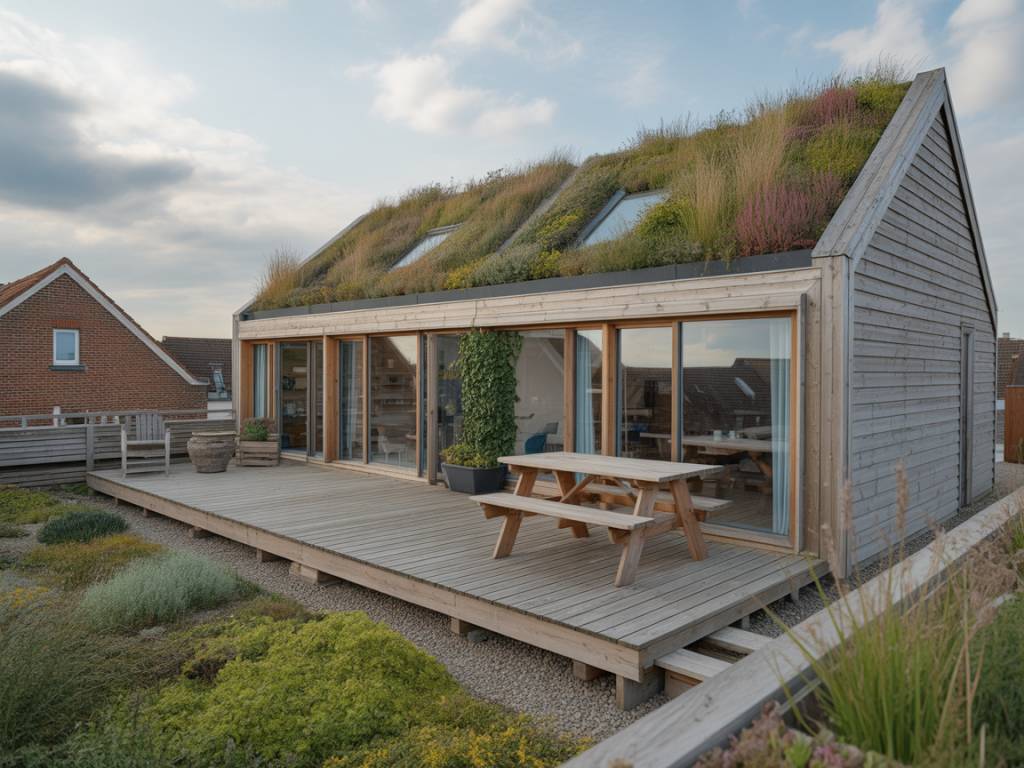
- Extensive green roofs — Lightweight, shallow (typically 6–15 cm of substrate), and generally planted with low-maintenance species such as sedums, mosses and hardy herbs. They are ideal for most retrofits, garages, garden offices and modest house roofs, especially where structural capacity is limited.
- Intensive green roofs — Deeper substrates (often 20 cm and more), able to support shrubs, perennials and sometimes small trees. These are effectively roof gardens and usually require stronger structures, careful design, and regular maintenance.
For most UK homeowners interested in sustainability rather than showpiece landscaping, an extensive green roof is the most practical starting point.
What about living wall systems?
Living walls also come in several flavours, depending on your budget, time and appetite for DIY.
- Modular pocket systems — Panels or pockets fixed to a wall and filled with compost and plants. Widely available, relatively affordable, and good for small domestic applications.
- Tray-based systems — Pre-grown modules that clip onto a support frame, often used by professional installers. They offer a very green result from day one, but at a higher cost.
- Climber-based green façades — The simplest option: trellises, wires or mesh supporting climbing plants like clematis, jasmine or native honeysuckle. Slower to establish, but usually the most affordable and wildlife-friendly.
In the UK climate, evergreen or semi-evergreen species keep a wall visually alive in winter, while seasonal climbers bring drama in spring and summer. The key is to match species to aspect: shade-tolerant ferns and ivy for north-facing walls, sun-loving herbs and flowering plants for south or west aspects.
Key considerations before you start
The romance of a rooftop meadow is alluring, but gravity and water have a way of ignoring our dreams. Before adding soil and plants to any structure, consider a few essential questions.
For green roofs:
- Structural capacity — Can your roof safely support the additional weight of the green roof system when saturated with water? A structural engineer’s opinion is strongly recommended for house roofs and large extensions.
- Waterproofing — Your existing roof covering needs to be sound. Green roofs require a high-quality waterproof membrane and a root barrier to prevent damage.
- Access and safety — How will you install and maintain it? Even low-maintenance roofs need occasional checks for drains, vegetation health and wind damage.
- Planning permission — In most domestic cases in the UK, a green roof does not require specific planning permission, but it is worth checking if you are in a conservation area or on a listed building.
For living walls:
- Wall condition — The surface should be structurally sound and, ideally, protected by a waterproof layer behind the planting system.
- Irrigation — Will you hand-water, or use a drip system? Pocket and tray systems dry out quickly in wind and sun.
- Aspect and exposure — Sun, wind and rain will all shape which plants will thrive and how much maintenance is required.
- Neighbours and boundaries — If you are greening a shared wall or boundary, it is wise to agree plans in advance.
Practical steps to create a simple green roof
For a first project, many UK homeowners start with something manageable: a shed, bin store, porch or garden office. The principles are the same as for larger roofs, but the stakes (and costs) are lower.
A typical sequence for a small extensive green roof might look like this:
- Check or upgrade the roof structure to ensure it can carry the additional weight.
- Install or verify a high-quality waterproof membrane.
- Add a root barrier layer if the membrane is not root-resistant.
- Install an edge retaining profile to hold the green roof layers and allow for drainage.
- Add a drainage layer (often a studded plastic or gravel system) to help water flow where it should.
- Place a filter fleece to stop fine particles clogging the drainage.
- Add lightweight substrate (specifically formulated green roof growing medium rather than standard garden soil).
- Plant with sedum mats, plug plants, seeds, or a mixture, choosing species adapted to your location.
Within a season or two, what was once a bare expanse of felt or EPDM becomes a shifting patchwork of greens, reds and flowers. Frost will paint it one way, drought another; the year’s weather will write itself onto your roof in colour and texture.
Setting up a living wall at home
If heights make you uneasy, starting with a living wall at eye-level can be far less intimidating. The basic steps are similar, whether you choose a modular system or a simple trellis-based design.
- Assess the wall: check for structural issues, damp problems and orientation (north, south, east, west).
- Install any required waterproofing or battens to create an air gap between the wall and the planting system.
- Fix your chosen system (pockets, trays, or supports for climbers) securely, following manufacturer guidelines for load and fixings.
- Plan irrigation: a drip line connected to an outdoor tap is often the easiest and most reliable option.
- Select plants suited to your aspect and microclimate, considering year-round interest and wildlife value.
- Plant densely to reduce bare patches and weed invasion, then monitor closely in the first few months as roots establish.
On some winter mornings, you may spot frost held delicately on the leaves of your vertical garden, while the brick around it remains raw and hard. It is a subtle reminder that the wall has become more than just a barrier; it is participating in the local climate.
Costs, maintenance and realistic expectations
Both green roofs and living walls demand a certain honesty. They are not maintenance-free, and they are rarely the cheapest way to cover a roof or wall in the short term. Their value unfolds over years, not weeks.
In the UK, you can expect:
- Upfront costs — Higher than conventional felt or tile finishes, especially if structural upgrades or professional installation are needed. Simple shed green roofs or DIY living walls can be more affordable entry points.
- Ongoing care — Extensive roofs typically need periodic weeding, checks on drainage outlets, and occasional replanting in bare spots. Living walls may need more regular pruning, feeding and irrigation checks.
- Long-term savings — Potential reductions in energy bills, extended roof membrane life, and (in some cases) enhanced property value and kerb appeal.
It helps to think of these systems not as decorative finishes, but as long-lived garden spaces. A garden is never “done”; it is tended, adjusted, observed. Roofs and walls are no different — only the access and tools change.
Starting small: ideas for every kind of home
You do not need a flat roof and a generous budget to start adding vertical habitat to your home. Some starting points that work particularly well in the UK include:
- A green roof on a bin store or bike shed, visible from your kitchen window.
- A climber-covered façade using native honeysuckle or clematis on a small terrace house.
- A series of herb-filled pockets on a sunny courtyard wall, doubling as a vertical kitchen garden.
- A modest sedum roof on a garden office, paired with nest boxes and insect hotels nearby.
- A balcony balustrade transformed with planters and trellises, providing food for bees and screening for you.
Each of these is a small act of defiance against the idea that city life must be sealed in tarmac and brick. Each one offers a slightly kinder edge where built form meets sky.
A different relationship with your home
When you plant a roof or wall, you subtly change your role as a homeowner. You are no longer just the custodian of bricks, mortar and mortgage payments. You become a caretaker of a thin, fragile strip of urban ecosystem.
On some evenings, the shift is almost imperceptible: a moth lingering on the living room window drawn by flowers just beyond; a blackbird investigating your green roof for insects; a neighbour pausing to ask, “What on earth is growing up there?”
In a country where weather is our favourite conversation and gardens our quiet obsession, turning the blank parts of our houses into living surfaces feels strangely natural. Green roofs and living walls are not just design choices; they are invitations — to wildlife, to cooler summers, to softer city soundscapes, and to a future where our homes are less fortress and more companion to the landscapes they occupy.