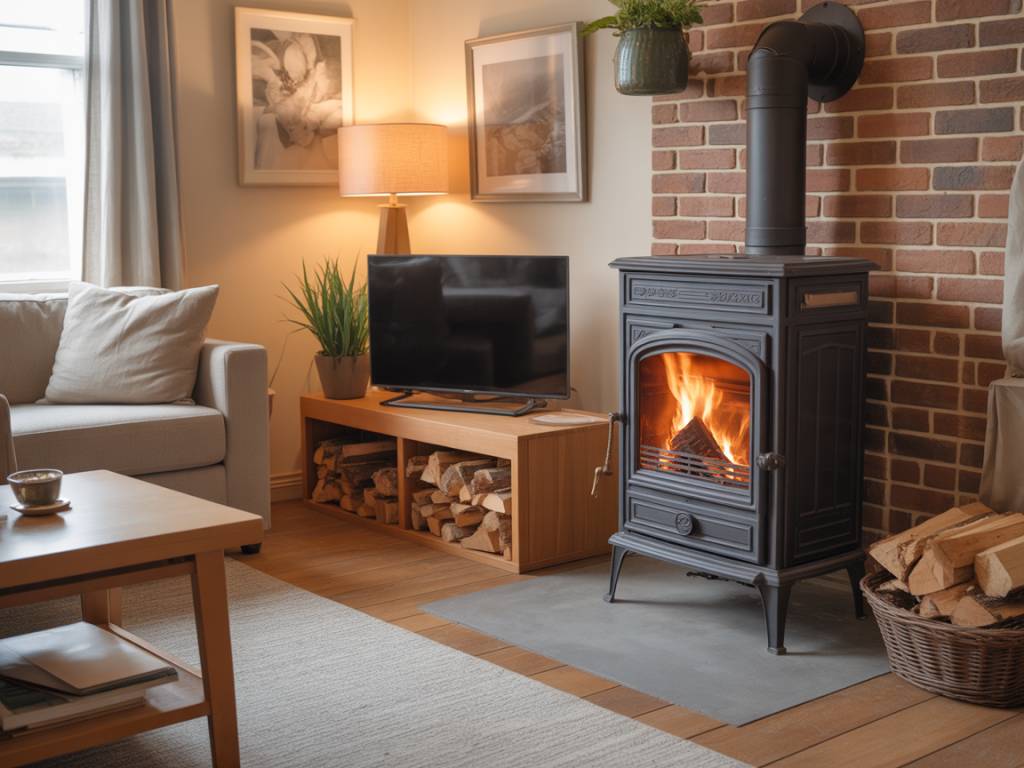
On some evenings, the light in a modern home feels almost too clean. LEDs hum quietly, triple-glazed windows hold back the weather, and the air is as still as a library. Then someone opens the door of a wood-burning stove, and the room changes: flames twist, shadows move, and suddenly this efficient box of insulation feels like a place to inhabit, not just to heat.
But here’s the uncomfortable question many of us are now asking: in a modern, well-insulated home, can a wood-burning stove still be called “eco-friendly” – or is it just a beautifully packaged contradiction?
Let’s take the romance of the crackling fire, place it gently to one side, and look at what really happens when we burn wood in homes that barely leak a whisper of heat.
The quiet seduction of flame in an airtight house
There’s a reason the wood stove refuses to leave our imagination, even as heat pumps and smart thermostats steal the headlines. Fire feels ancient, human, grounding. A heat pump is efficient; a flame is alive.
In a modern, well-insulated home, that allure can be even stronger. You may hardly need heating at all for most of the year – which makes the idea of one small, focal, occasional source of warmth strangely appealing. A stove seems less like “heating system” and more like “ritual”.
Yet this is exactly where the tension begins. If your house is built or renovated to a high standard – think thick insulation, airtight membranes, mechanical ventilation, high-performance windows – the relationship between a wood stove and the wider environment becomes complicated.
To understand why, we have to step away from the glow of the glass door and into the numbers: carbon, particulates, efficiency, and the way modern homes actually behave thermally.
How eco-friendly is a wood-burning stove, really?
Eco-friendliness isn’t a single metric. A stove can be “good” on one dimension and deeply problematic on another. Three big questions matter most:
1. How much fuel do you actually need?
A well-insulated home has low heat demand. That’s excellent news for the planet. But it also means that a typical wood stove, designed with older, leakier houses in mind, can be oversized. You don’t need its full output – so you burn smaller loads, or run it “slumbering” with less air, which is exactly how pollution increases and efficiency drops.
2. How cleanly does the stove burn?
Modern “Ecodesign” or DEFRA-approved stoves (in the UK context) can be far cleaner than older models – sometimes emitting 80–90% fewer particulates than an open fire. Yet even the best modern stoves still release more fine particles (PM2.5) per unit of heat than most alternatives like heat pumps or gas boilers.
3. What is the alternative in your specific home?
If your choice is truly between a new, efficient wood stove burning local, sustainably managed wood and, say, an ancient oil boiler that wheezes out both CO₂ and pollution, the calculus is different than if you’re comparing wood to a well-sized heat pump powered by an increasingly decarbonised grid.
So, are wood-burning stoves eco-friendly? In isolation, not particularly. In certain contexts, they can be part of a lower-carbon, resilient heating strategy. But context is everything – and modern, super-insulated homes are very specific contexts.
Modern, well-insulated homes: game changer or red flag?
Imagine putting a bonfire in a Thermos flask. That’s roughly what happens when you place a traditional-sized stove into a modern, highly insulated living space.
Most well-insulated homes rarely need more than a few kilowatts of heat, even on cold days. Many wood stoves, however, begin at around 4–5 kW and go up from there. That leads to two issues:
Overheating. A short burn can send the room temperature soaring. You open windows to cool down, and the whole idea of “eco” starts to feel a bit ironic.
Dirty combustion from under-firing. To avoid overheating, people often “turn the stove down” – restricting the air supply so the fire burns slowly and gently. That slower, smouldering burn may feel cosy, but it usually produces more particulates, more smoke, and more creosote in the flue. In other words, less heat, more pollution.
Some manufacturers now offer low-output stoves designed for airtight or Passivhaus-standard buildings, often with:
- Outputs as low as 2–3 kW
- Dedicated external air supplies (so the stove doesn’t suck warm air out of the room)
- Very controlled combustion for cleaner burning
These are better suited to modern envelopes. But even then, you’re introducing a source of combustion – and therefore emissions – into a context that was largely designed to avoid them.
Wood, carbon and the question of “renewable”
Wood is often called “carbon neutral”. The logic is simple: the tree absorbed CO₂ while growing, and when you burn the wood, you merely release that same carbon back. In the long cycle of forests and centuries, there’s truth in that.
But in the short term – the decades in which we’re trying to stabilise the climate – the story is messier.
Timing matters. Burning wood releases carbon now; regrowth and re-absorption take years or decades. That creates a “carbon debt” during a period when we’re already over budget.
Sourcing matters. If your logs come from genuinely sustainable, well-managed local woodland (ideally as part of thinning or maintenance that supports biodiversity), the picture is much better than if they come from clear-cut forests or are transported long distances.
Alternatives matter. If you could heat the same space with a heat pump powered mostly by renewables, your carbon per unit of heat will generally be lower than even well-managed firewood – especially once you include particulate pollution in the accounting.
So wood can be a renewable resource, but whether it’s climate-friendly in your specific home depends on how much you burn, where it’s from, and what you’d use otherwise.
The invisible problem: particulates and indoor air
Much of the debate around wood-burning stoves is now shifting away from carbon to something more immediate: air quality.
When wood burns, it releases fine particles known as PM2.5 (particulate matter smaller than 2.5 micrometres). These particles can penetrate deep into the lungs and even enter the bloodstream, contributing to respiratory and cardiovascular problems.
Modern Ecodesign stoves dramatically reduce particulates compared to open fires and old stoves. But “dramatically less” doesn’t mean “negligible” – especially when many homes in a neighbourhood burn wood on still winter evenings under a low-pressure sky.
In a well-insulated, airtight home, you might assume at least the pollution stays outside. Unfortunately, that’s not guaranteed:
- Every time you open the stove door, a puff of smoke can escape into the room.
- Poorly fitted flues or gaskets can slowly leak combustion products.
- Mechanical ventilation systems (MVHR) must be carefully designed so pressure differences don’t interfere with stove draught.
This isn’t an argument against stoves as such, but it is a gentle reminder: in a modern home built for controlled, filtered air, adding an indoor fire is like bringing in a campfire to a recording studio. It can be done, but it requires precision, and the risks are different from those in a draughty cottage.
When a wood stove can still make sense
So, is there still a place for a wood-burning stove in a modern, well-insulated home? Possibly – in very specific circumstances, and with honest expectations.
A stove may be defensible, and even sensible, if:
- You live in a rural area with abundant, truly local, sustainably managed wood.
- Your primary heating is a low-carbon system (such as a heat pump), and the stove is a secondary, occasional source – not your main workhorse.
- The stove is sized appropriately for your low heat demand, with a very low nominal output.
- The installation is carefully integrated with your home’s ventilation and airtightness strategy.
- You value the stove not just as heat, but as emotional comfort and as a backup during grid outages.
In that sort of scenario, the environmental impact of a few carefully tended, clean-burning fires each winter can be modest – especially compared to regular, heavy use in older homes.
The key is to be honest with yourself: is the stove a tool, used sparingly and responsibly, or is it an identity, lit at every hint of frost because “that’s what we do”?
How to use a wood stove as responsibly as possible
If you already have, or are firmly set on installing, a wood-burning stove in a modern home, there are ways to reduce its impact without losing its charm.
- Choose a genuinely efficient, low-output model. Look for Ecodesign-compliant or better, with the lowest heat output that still makes sense for your space. Oversizing is the enemy of clean burning.
- Ensure a dedicated external air supply. Especially important in airtight homes, this prevents the stove from fighting with your ventilation or pulling cold air through unintended gaps.
- Use only very dry wood. Logs should be seasoned for at least 1–2 years, or kiln-dried, with moisture content below about 20%. Wet wood = smoke, creosote, and wasted energy.
- Burn bright, not slow. Aim for hot, lively fires with plenty of secondary combustion, rather than long, smouldering burns. It may mean shorter sessions with less fuel, but the air will thank you.
- Avoid treated or “mystery” wood. No painted offcuts, no pallets, no glossy paper. Only clean, untreated wood from known sources.
- Maintain the stove and chimney. Regular sweeping and servicing keep combustion efficient and reduce the risk of both pollution and chimney fires.
- Use it as a supplementary, not primary, heat source. Let your main system – ideally low-carbon – do the everyday work. Save the stove for the evenings when its presence adds more than just degrees Celsius.
These steps don’t magically turn a wood stove into a zero-impact solution. But they can shift it from “unquestioned habit” towards “mindful indulgence”.
Greener alternatives for the same cosy feeling
Sometimes the question isn’t “stove or no stove?” but “flame or warmth?”. If what you’re truly chasing is that sense of cocooning comfort, there are patterns of living – and technologies – that offer a similar emotional effect with less environmental compromise.
- Heat pumps paired with good design. A well-designed air-source or ground-source heat pump, combined with underfloor heating, warm materials, and layered lighting, can create a surprisingly enveloping sense of comfort, even without a flame.
- Infrared panels. Wall- or ceiling-mounted infrared heaters give a radiant, sunshine-on-your-skin feeling. In a super-insulated home, a few discreet panels, used sparingly, can be both efficient and pleasantly tactile.
- Bioethanol or electric “flame” features. These don’t provide much serious heat, and bioethanol still involves combustion, but they can scratch the aesthetic itch of a visible flame where a real log burner would be overkill.
- Designing for cosiness rather than heat. Thick curtains, heavy textiles, warm-toned lighting, natural materials and smaller “nooks” within open-plan spaces can all create emotional warmth without necessarily raising the thermostat.
Sometimes the nostalgia we project onto a wood stove is really a longing for slowness: an evening not dominated by screens, a shared focal point, a reason to gather in one place. You don’t always need smoke to have that.
Choosing with both heart and head
In the end, the question “Are wood-burning stoves eco friendly in modern, well-insulated homes?” resists a simple yes or no. In a purely technical sense, they are rarely the greenest option available to such homes. A carefully chosen heat pump, good design, and well-thought-out ventilation will almost always win on emissions, especially in urban or suburban settings.
Yet homes are not spreadsheets, and our decisions about them are rarely made in the language of kilowatt-hours alone. The glow of a stove can soften a long winter; a pile of logs can anchor us to a particular landscape and season. These things matter – but so does the air we all share beyond our windows.
If you already live in a well-insulated home and you are considering a stove, it may be helpful to frame the decision like this:
- Could you meet your heating needs comfortably with a low-carbon system and good design alone?
- If you added a stove, could you commit to using it rarely, well, and with the cleanest technology available?
- Does your location – rural, with excellent ventilation and truly sustainable wood – make a stove less impactful than it would be in a dense city street?
Some readers will emerge from that reflection and decide a stove no longer fits the kind of home, and the kind of future, they’re trying to build. Others will keep or install one, but use it more sparingly, more intentionally, and with better information than before.
Perhaps that is the real shift: moving from unquestioned romance to conscious relationship. The modern, well-insulated home asks us to think carefully about every small hole we punch in its envelope, every technology we invite into its quiet air. If we are going to keep the ancient companion of fire in such spaces, it should be as a respected guest – not as the unquestioned master of the room.