
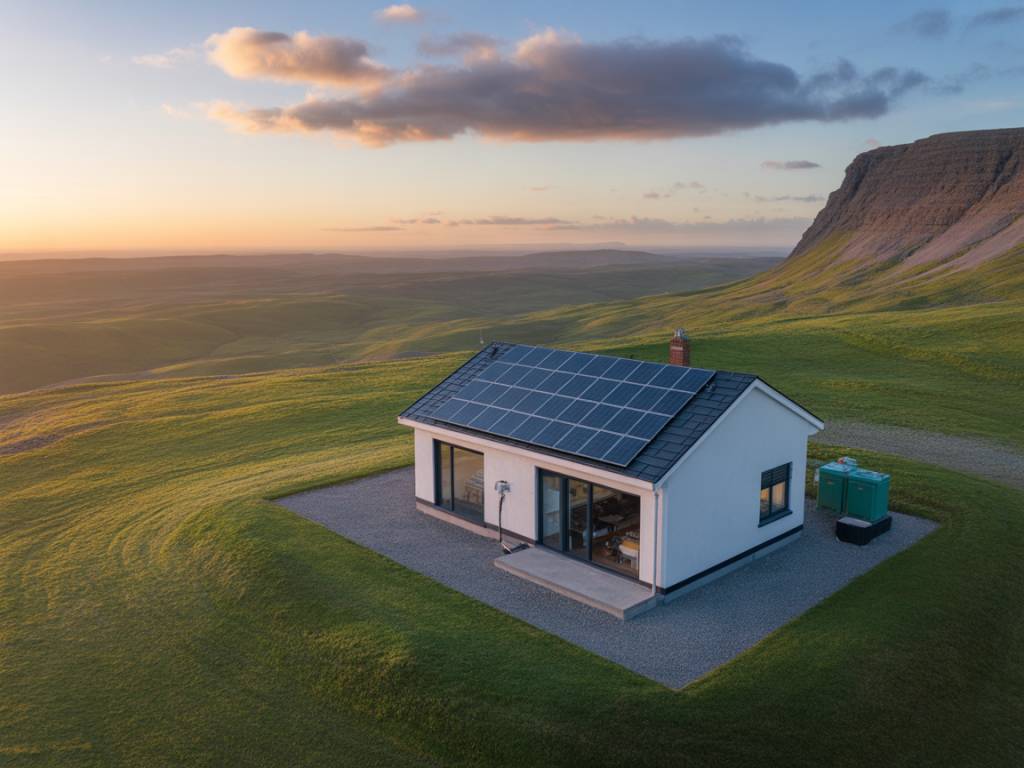
There is a quiet kind of magic that happens in a home just after sunset, when the last golden traces of daylight fade from the solar panels, and yet the lights inside stay warm and bright—powered not by the grid, but by the sun that has already slipped below the horizon.
This is the promise of home battery storage: capturing your own slice of daylight and learning how to spend it wisely.
If you already have solar panels—or you’re dreaming of them—adding a battery can feel like stepping into a new relationship with energy. No longer just a passive consumer, you become, in a modest way, a keeper of your own power. But as with any valuable resource, the real art lies not only in having it, but in managing it well.
Why store solar power at home in the first place?
On a bright summer day in Britain, your solar panels can be unexpectedly generous. Kettle, laptop, washing machine, maybe even an electric vehicle on charge—your roof quietly feeds them all. And still, there’s often surplus spilling back onto the grid, sold for pennies.
A home battery changes the story. Instead of exporting most of that surplus, you store it and use it later, when the sun is gone and electricity prices climb. The benefits are threefold:
- Greater self-consumption of your solar power: You use more of what you generate instead of “giving it away” cheaply.
- Protection against rising prices and grid instability: You shield a portion of your home from peak-time costs and occasional power cuts.
- A quieter, more resilient home: Lights that stay on, fridges that keep humming, and a sense that your house is just a little more self-reliant.
But simply installing a battery is only half the journey. To truly make the most of it, you need a little strategy, a touch of curiosity, and perhaps a willingness to rearrange a few habits.
How home battery storage actually works (without the jargon)
At its core, a home battery system does something very simple:
- When your panels produce more energy than your home is using, the surplus charges the battery.
- When your panels are producing less than you need—at night, on grey days, or during heavy use—the battery discharges to cover the gap.
In the background, an inverter acts as the interpreter, constantly translating between the DC electricity from the panels and battery, and the AC electricity used in your home. A small control unit, often app-connected, decides when to charge, when to discharge, and how much to keep “in reserve”.
Most modern systems are “smart”: they know when your panels are active, they track your consumption patterns, and some can even read tariffs and weather forecasts. In other words, your home slowly learns how you live—and, if you let it, how to power that life more intelligently.
Matching your battery to your life, not the other way round
Before thinking about advanced smart management, it’s worth pausing on a simple but often overlooked truth: the right battery is the one that fits your habits, not just your roof.
A rough guide used by many installers is:
- A typical UK home uses around 8–10 kWh of electricity per day.
- A common battery size is between 5 kWh and 10 kWh.
If your evenings are energy-heavy—electric oven, teenagers, multiple screens, maybe an induction hob—aiming for the higher end can make sense. If you live more simply, or are often away, a smaller battery may be enough.
What truly matters is understanding your own rhythm. When do you use the most electricity? Morning? Early evening? Weekends? Checking a few months of bills—or, better, a smart meter app—can give you a surprisingly clear picture. Battery storage works best when it’s tailored to this pattern, like a bespoke suit rather than something grabbed off the rack.
Smart management: treating your battery like a seasonal pantry
I often think of a home battery as a pantry at the edge of a small village. Some days you stock it; some days you draw from it. On rare occasions, you may even “trade” with the outside world.
To make the most of your solar and battery setup, think in terms of four intertwined strategies.
Shift what you can to daylight hours
Solar power is most abundant when the sun is highest, typically between late morning and mid-afternoon. If your battery is constantly having to pick up heavy loads in the evening, it will drain quickly. Instead, aim to use your sun in real-time whenever possible.
Some simple shifts can make a big difference:
- Run the washing machine or dishwasher late morning or early afternoon instead of after dinner.
- Pre-heat the home slightly in the late afternoon in winter if you have electric heating or a heat pump, so the evening demand is lower.
- Charge devices and laptops during the day rather than at night.
This approach leaves more of your midday surplus for the battery and means that when evening comes, you’re drawing on stored solar, not expensive grid power.
Use your battery to dodge peak-time tariffs
In many parts of the UK, electricity prices are highest in the early evening—just when people come home, cook, and switch on lights. A battery lets you sidestep that period with quiet elegance: you simply don’t need as much from the grid at the worst time.
If you’re on a time-of-use tariff (such as those offered for EV drivers or smart meters), this becomes even more powerful. Your battery strategy might look like this:
- Solar first: Let your panels charge the battery during the day.
- Battery in the evening: Use stored solar to cover the early evening peak.
- Off-peak top-ups: If your battery isn’t full and you expect a cloudy day tomorrow, you can optionally charge from the grid overnight using cheaper rates, ready for the next evening.
Suddenly, your home is not just “using less”. It’s playing a different game entirely—shifting its appetite away from the most expensive hours.
Embrace automation: let your system think for you
There is a certain romance in manually checking your solar app and deciding when to run the tumble dryer. For a few weeks, it feels like a curious new ritual. But life returns to its normal complexities, and we forget.
That’s where automation becomes your ally, quietly working in the background. Many modern battery systems, either natively or via third-party apps, can:
- Forecast solar production based on the weather.
- Predict your typical usage over the coming hours.
- Schedule charging and discharging to minimise costs and maximise self-consumption.
Some will even “learn” that you cook dinner every evening around 7 p.m. and that the kettle, oven, and lights all peak at once, then ensure there’s enough battery reserved for that period.
You don’t have to become an energy expert. You just have to set some preferences—how much backup you want, whether you prioritise bill savings or resilience—and then allow the system to handle the details.
Keep a little in reserve: the comfort of backup power
In certain corners of the countryside, where the grid still behaves like a capricious guest—appearing, disappearing, flickering at awkward moments—a battery offers more than savings. It offers calm.
Most systems let you reserve a portion of storage for emergency use: for example, always keeping 20–30% of the capacity ready in case the power cuts. That reserve can keep essentials running:
- Fridge and freezer
- Low-level lighting
- Wi-Fi and key devices
- Possibly a gas boiler controller or small circulation pumps
During a recent storm in Devon, a friend with a modest battery system told me his house felt strangely serene while the hamlet outside went dark. Inside, a single lamp glowed; the router blinked; the kettle purred. “It felt,” he said, “like living just half a step outside of everyone else’s panic.”
That, too, is part of making the most of your solar power: not just in pounds saved, but in moments of quiet independence when the world wobbles.
Choosing between battery chemistries and brands (without losing your mind)
You don’t need a degree in electrochemistry to choose a sensible battery, but understanding a few basics can help you cut through the noise.
The most common modern home batteries are:
- Lithium-ion (NMC): Compact, widely used, slightly higher energy density.
- Lithium iron phosphate (LFP/LiFePO₄): Often longer lifespan, more stable chemistry, increasingly popular for home systems.
What actually matters for day-to-day life is:
- Usable capacity (kWh): Not just the headline size, but how much you can realistically use.
- Cycle life: How many charge/discharge cycles it’s rated for. Many now offer warranties for 10 years or a set number of cycles.
- Integration: Does it work smoothly with your existing or planned inverter, monitoring apps, and any tariff-based automation?
When comparing options, it’s often helpful to ask the installer to show you two or three real-life scenarios—“With this battery, here’s what your year might look like. With that one, here’s the difference.” Concrete examples tend to be far more revealing than datasheets.
When a home battery really shines—and when it might not
A battery is most valuable when three conditions meet:
- You have—or plan to have—a decent amount of solar (often 3–6 kWp for a typical home).
- Your evening or early morning use is substantial enough that you want to cover it with stored solar.
- Your tariff structure and local incentives make self-consumption and peak avoidance worthwhile.
In a small flat, with low energy use and limited sun, the maths may be less convincing. In a detached house with a busy family, heat pump, perhaps an EV, and plenty of roof space, the battery becomes a quietly hardworking member of the household.
There’s also an emotional component. For some, the idea of storing sunlight—literally holding it in the walls, then spending it again at midnight—has a satisfying poetry that no spreadsheet can capture. For others, the interest is purely practical, and that’s perfectly fine. The technology doesn’t require you to be romantic to be useful.
Everyday habits that amplify your battery’s impact
Once your system is installed and humming away, a few subtle habits can stretch its potential even further:
- Check your app occasionally: Not obsessively, just enough to understand your own patterns. Are you emptying the battery too early? Are there appliances that spike unexpectedly?
- Prioritise efficiency first: LED lighting, well-insulated hot water, and efficient appliances all make your stored solar go further.
- Think in sequences, not events: Instead of running the oven, washing machine, and tumble dryer all at once, stagger them during solar-rich hours.
- Seasonal awareness: Summer may allow for generous exporting or EV charging from solar; winter might call for more grid top-ups on off-peak tariffs.
Over time, these become less like “rules” and more like a gentle choreography between you, your home, and the shifting light outside.
A small step toward a different kind of home
Life off-grid has a way of sharpening the senses: the awareness of how much is in the battery, how long until the sun reappears, which appliances are truly essential. Most of us won’t move fully off-grid—and we don’t need to—but adding a battery to a solar home is a quiet nod in that direction. It brings a measure of that attentiveness into an ordinary suburban street or terraced row.
You begin to notice, perhaps for the first time since childhood, the character of your own daylight: how it pours in generously in June, how it hangs low and angled in January, how your roof quietly harvests it while you are busy with emails or errands. And tucked away in a cupboard or on a wall in the utility room, your battery waits patiently, a modest reservoir of that captured light.
Making the most of your solar power through smart battery management isn’t about perfection. It’s about gentle alignment: between your routines and the sun’s, between technology and intention, between the comfort of modern life and a quieter respect for the energy that sustains it.
In the end, a well-managed home battery is not just a box of electrons. It’s a modest act of stewardship—of your own home, your own power, and, in a small but tangible way, the shared grid and landscape beyond your front door.