
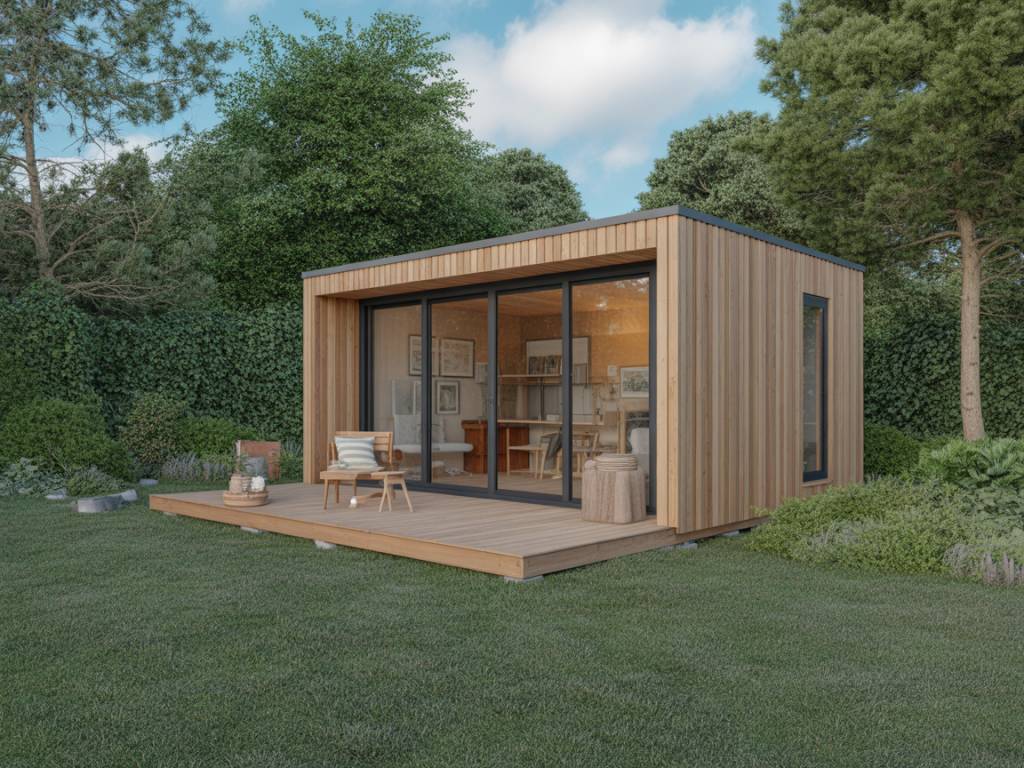
On quiet mornings, before emails begin to demand answers and notifications flutter across screens, a garden can feel like another country. The air is cooler, the light softer, and even the sound of a distant road seems to fade into the rustle of leaves. It is in ce petit pays, just a few steps from your back door, that a garden office can become more than a workspace. Done well, it’s a tiny sanctuary that balances productivity with calm – and if you build it with care, it can tread lightly on the earth that hosts it.
In this article, we’ll explore how to create a garden office using eco-friendly materials and thoughtful methods that minimise impact while maximising comfort. Think of it as designing a cabin for your future self: practical, beautiful, and quietly efficient.
Why a garden office is the perfect place to go green
A garden office is small by definition, which makes it the ideal candidate for sustainable design. Every choice – the insulation, the cladding, the windows – has a bigger impact on the overall performance than in a large house. That’s good news: with a modest footprint, you can invest a little more in quality, low-impact materials and truly feel the difference day to day.
There’s also the psychological aspect. Stepping into a separate, carefully designed space signals the start and end of your working day. If that space smells faintly of timber instead of solvents, holds a stable temperature without roaring heaters, and opens onto greenery rather than a hallway, it quietly reshapes your relationship to work and to home.
So where do we begin?
Choosing the right spot and orientation
Before you fall in love with any material, you need to decide where this little building will sit. The orientation of your garden office can either work with nature or fight it.
Key questions to ask yourself as you walk around the garden, coffee in hand:
For most temperate climates in the UK and northern Europe, a garden office that faces south or south-east tends to be a sweet spot: morning light, plenty of free solar gain in winter, and the possibility of shading in summer. West-facing can be glorious in spring and autumn, but may overheat in high summer without good shading and ventilation.
Try, if possible, to disturb the soil as little as you can. That leads us to the foundations.
Low-impact foundations and groundworks
The most invisible part of your garden office is also one of the most critical for sustainability. Large concrete slabs have a hefty carbon footprint. Fortunately, small buildings don’t always need them.
Eco-friendlier options include:
Whichever route you choose, aim to keep the building slightly raised, allowing air to circulate beneath the floor. This helps prevent damp, extends the life of the structure, and offers the satisfying feeling that your office is just lightly resting on the earth rather than claiming it.
Timber frames and responsible structure
For a small, insulated, comfortable garden office, a timber frame is almost always the star of the show. It’s comparatively low in embodied carbon, pleasant to work with, and, when sourced responsibly, can be a genuinely renewable structural material.
Look for:
Inside the walls, think of the build-up as a kind of layered clothing. You’ll need structural timber, sheathing, insulation, an airtight layer, and a breathable outer skin. A “fabric first” approach – focusing on insulation, airtightness and thermal bridges – will do more for comfort and energy use than any gadget.
Eco-friendly insulation that actually feels good
Insulation is the beating heart of comfort in a garden office. Without it, you have a glorified shed. With it, you have a four-season workspace that doesn’t demand constant heating or cooling.
Natural, low-toxicity insulation materials not only reduce environmental impact; they also help regulate moisture and temperature in a way that feels subtly different to petrochemical foams.
Whichever material you choose, pay attention to continuity. Small gaps, uninsulated corners, and poorly detailed junctions can create cold spots and condensation risks. A careful builder with a roll of tape and a patient mindset is worth more than a fancy product poorly installed.
Cladding and exterior finishes with character
The outer skin of your garden office is both armour and expression. It faces the rain, the sun and the occasional football, but also shapes how the building sits in the garden.
Low-impact options that age gracefully include:
In a garden, it can be beautiful to blur the edge where building meets planting. A trellis with climbers, a green roof over a porch, or a simple herb bed along the façade can make the office feel like it has grown from the garden rather than landed in it.
Windows, doors and the art of passive comfort
The placement and performance of your openings will do more for daily comfort than any smart thermostat. In a small space, a single well-placed window can shape your entire experience of working there.
Consider:
A simple rule: place your desk where you can see out without staring directly at a bright window all day. Side light is kinder on the eyes than a screen competing with a rectangle of intense sky.
Healthy interior finishes that invite you to stay
Inside, you’ll spend hours breathing whatever your walls, floor and furniture emit. Choosing low-toxicity finishes is as much about your own health as it is about ecology.
Thoughtful interior choices include:
Avoid the temptation to fill the space immediately. Live in your garden office for a week or two with the basics: desk, chair, lamp, perhaps a plant or two. You’ll quickly sense where a shelf wants to be, or where a reading corner could emerge.
Power, heating and staying off (or lightly on) the grid
Even the most romantic writer needs a laptop charger. A small, efficient garden office can be surprisingly light on energy use, especially if you combine a good envelope with sensible systems.
Options to explore:
Think carefully about whether you truly need a high-powered connection. Many garden offices run happily on a modest feed from the main house, protected with appropriate armoured cable and installed by a qualified electrician.
Ventilation, acoustics and the quiet luxury of fresh air
Fresh air might be the most undervalued ingredient in a comfortable workspace. On a breezy spring day, open windows can do the job. In winter, or in urban settings with noise and pollution, a more controlled approach helps.
Consider incorporating:
Remember that comfort is a duet between temperature and air quality. A slightly cooler room with crisp, fresh air is often far more pleasant than a warm, stuffy one.
Landscaping: stitching the office into the garden
The story of a garden office doesn’t end at its walls. The path you take to reach it, the planting that embraces it, and the way rainwater is handled all contribute to its environmental footprint and emotional feel.
Ideas to ground your office gently in place:
In time, the boundary between “garden” and “office” begins to blur. Moss appears on a shady step; a robin inspects the window box; ivy tests the edge of the cladding. This gentle colonisation is not a problem to be eradicated but a relationship to be managed with care.
Costs, compromises and starting small
Building green is often portrayed as an all-or-nothing pursuit. In reality, most garden offices are a tapestry of choices and compromises, woven around budget, time and existing site conditions.
If resources are limited, you might prioritise:
And you can phase things. Add solar later. Upgrade a heater when budgets allow. Plant trees that will cast shade in five or ten years. A garden office built with this long view in mind becomes not just a building, but a quiet project of stewardship.
In the end, an eco-friendly garden office is less about perfection and more about intent. It’s about walking out, each morning, along a path that crunches or softens underfoot, opening a timber door that fits beautifully in your hand, and stepping into a space that holds the day’s work with ease.
Some days you will write, design, code or daydream with fierce concentration. Other days, you’ll simply watch the rain bead on the window and feel quietly grateful that you chose, at the very edge of your garden, to build something small, kind and considered – for yourself, and for the piece of earth that hosts you both.