
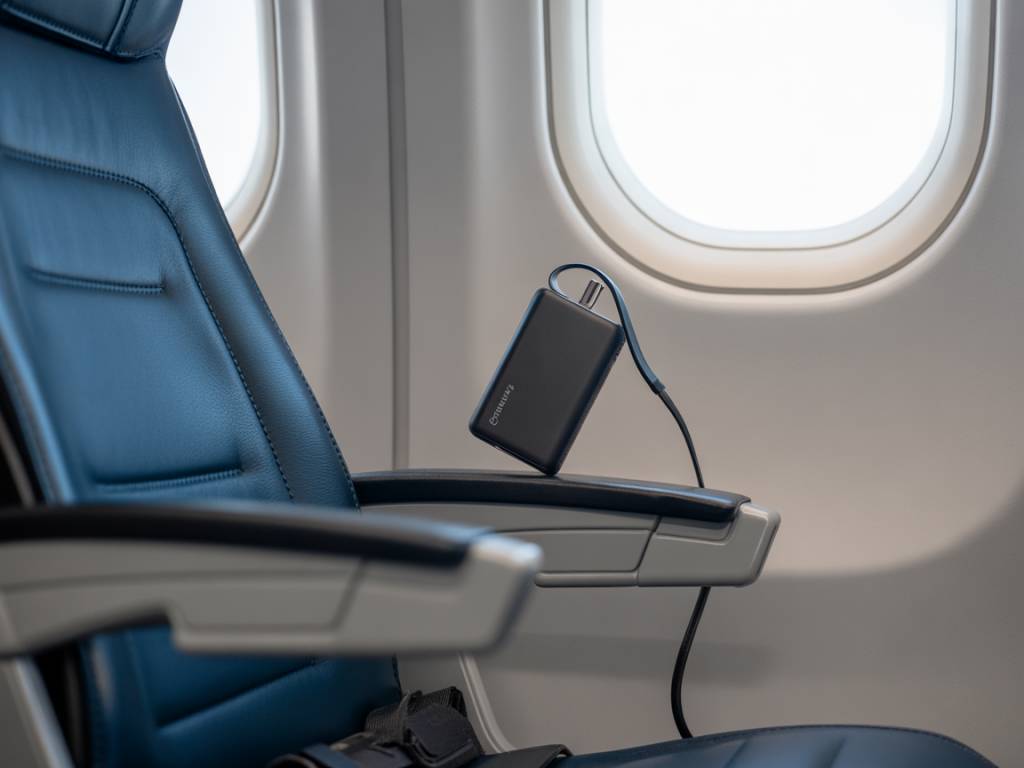
Every seasoned traveller knows the anxiety: you’re at the security tray, shoes already off, and a uniformed agent is eyeing the black rectangle you just pulled from your bag. Power banks have become as essential as a passport for many of us — but the rules around them are strict, and the environmental stakes of choosing the wrong one are quietly significant. So: can you bring a power bank on a plane, and if so, which one should you actually choose as an eco-conscious traveller?
Can I Bring a Power Bank on a Plane? The Core Rules Explained
Yes — with conditions. Across virtually all major airlines and international airports, power banks are permitted in carry-on luggage only. They are prohibited in checked baggage, without exception. The reasoning is straightforward: lithium batteries can overheat or ignite, and in a pressurised cabin, crew members can respond immediately. In the hold, there is no such option.
The regulatory framework is largely governed by IATA (International Air Transport Association) guidelines, adopted with minor variations by most national aviation authorities including the FAA (USA), CAA (UK), and EASA (Europe).
Here is what the rules typically look like in practice:
- Up to 100 Wh: Freely allowed in carry-on, usually up to 2–4 units per passenger depending on the airline.
- 100–160 Wh: Permitted in carry-on but requires prior airline approval. Generally limited to 1–2 units per person.
- Over 160 Wh: Banned from passenger cabins. These fall under specialised cargo regulations and are not suitable for travel.
The good news: the vast majority of everyday power banks fall comfortably below 100 Wh. A standard 10,000 mAh bank sits around 37 Wh. Even a large 26,800 mAh model typically comes in under 100 Wh — well within the limit.
How to Convert mAh to Wh (and Why It Matters at Security)
Most power banks display their capacity in milliampere-hours (mAh), not watt-hours. But airport security measures capacity in Wh. Knowing how to convert is genuinely useful — and quick.
The formula is:
Wh = (mAh × Voltage) ÷ 1,000
Most lithium cells operate at 3.7 V. So a 20,000 mAh power bank calculates as:
(20,000 × 3.7) ÷ 1,000 = 74 Wh — well under the 100 Wh threshold.
Many eco-focused and premium brands now print the Wh rating directly on the casing, which is both more honest and far more practical at a security checkpoint. If your power bank only shows mAh, note the Wh figure in a travel document or stick a small label on the unit itself.
Packing a Power Bank the Right Way
Getting the rules right is only half the job. How you pack your power bank also determines whether you sail through security or get pulled aside for an awkward conversation.
- Keep it accessible in your carry-on: Place it near the top of your bag or in an outer pocket, alongside your laptop. Security agents may ask you to remove it from your bag, just as with electronics.
- Protect exposed terminals: Use a dedicated pouch or a case. Loose coins or keys can short-circuit an unprotected port — a real fire risk, even at low probability.
- Never travel with a damaged unit: A swollen, cracked, or discoloured power bank should be recycled responsibly — not brought onto a plane. Ever.
- Label it clearly: If the Wh rating isn’t printed on the casing, add it. Security staff appreciate clarity, and it speeds up the process for everyone.
- Check your specific airline’s policy: While IATA sets the baseline, individual carriers can impose stricter limits. Budget airlines in particular sometimes cap the number of power banks at two per passenger.
Can I Bring a Power Bank on a Plane That Is Solar-Powered?
Solar-integrated power banks — those with a small photovoltaic panel built into the casing — follow the same rules as standard units. What matters to aviation authorities is the internal battery capacity in Wh, not the charging method. A solar power bank under 100 Wh travels just as freely as any other.
That said, solar panels on travel-sized banks are more symbolic than functional in most real-world conditions. They can trickle-charge in direct sunlight, but a full recharge via solar alone might take 40–60 hours. They are best treated as a supplement rather than a primary energy source — useful during long outdoor days, not a replacement for grid or USB-C charging.
Which Power Banks Suit Eco-Conscious Travellers?
Once you’ve confirmed your power bank can legally board the plane, a deeper question opens up: is this the right object to own? For travellers mindful of their environmental footprint, a power bank isn’t just a gadget — it’s a small energy decision made physical.
Longevity Over Everything
The single most sustainable thing a power bank can do is last a long time. A unit that serves you reliably for six or seven years is far greener than three cheap replacements over the same period, regardless of how eco-friendly the packaging claims to be.
Look for:
- High cycle life: Standard lithium-ion cells typically manage 300–500 charge cycles before noticeable capacity loss. LiFePO₄ (lithium iron phosphate) cells can reach 2,000–3,000 cycles — a transformative difference for longevity.
- Multi-year warranties: Brands that stand behind their product for 2–3 years tend to build better products. A 12-month warranty is a quiet warning sign.
- Honest capacity ratings: A power bank that advertises 10,000 mAh but delivers the equivalent of 6,000 mAh in real conditions is greenwashing by another name. Seek brands that publish independent test data.
Battery Chemistry and Safety
Most consumer power banks use lithium-ion (Li-ion) or lithium-polymer (LiPo) cells. Both are energy-dense and travel-friendly, but their performance degrades faster under heat, poor charging habits, or physical stress.
Eco-conscious travellers should consider models featuring:
- LiFePO₄ cells: Heavier and slightly bulkier, but dramatically safer, more thermally stable, and longer-lasting. Increasingly available in mid-size portable power stations, and beginning to appear in compact travel banks.
- Advanced Battery Management Systems (BMS): A quality BMS prevents overcharging, deep discharge, and short-circuit events — all of which shorten battery life. It’s invisible but critical.
Materials and Build Quality
The outer casing of a power bank is a small manifesto. Cheap glued plastic designed for two years of use tells you everything about a manufacturer’s priorities.
What to look for in a more considered product:
- Recycled aluminium or high-grade recycled plastics: More durable and easier to recycle at end of life.
- Screw-based construction: Hints at potential repairability and easier disassembly for recycling, unlike permanently bonded units.
- RoHS and CE certification: Ensures the product meets restrictions on hazardous substances — a baseline, not a luxury.
- Clear Wh labelling: A small but telling detail. Brands that label clearly tend to take transparency seriously across the board.
End-of-Life and Recycling
Lithium batteries are classified as hazardous waste in most countries and must never go into general household recycling. When your power bank eventually reaches the end of its life, take it to a designated WEEE (Waste Electrical and Electronic Equipment) drop-off point — widely available at electronics retailers and many local council facilities in the UK.
Some brands, particularly those positioned in the sustainable travel niche, now offer take-back schemes or recycling partnerships. This is worth checking before you buy, as it signals a genuine commitment beyond the product itself.
What Eco-Conscious Travellers Should Actually Prioritise
The market is awash with power banks wrapped in recycled cardboard and stamped with green logos. Real sustainability is quieter and more demanding. Here is a practical hierarchy for making a sound choice:
- Buy once, buy well. A durable, well-reviewed model from a reputable brand will almost always outlast and outperform three cheaper alternatives.
- Prioritise cycle life over raw capacity. A smaller bank you replace every two years has a worse environmental profile than a slightly larger one that lasts a decade.
- Match capacity to genuine need. A 30,000 mAh bank is overkill for most phone-charging travellers. Oversized batteries that sit at 20% most of their life degrade faster and represent unnecessary resource use.
- Choose USB-C bidirectional charging. Universal standards reduce the need for multiple cables and adapters — fewer accessories, less waste.
- Pair with clean energy at home. Charging your power bank from a solar-powered home setup or a green-tariff electricity supplier is the most impactful step you can take — one that no label on the device itself can replicate.
Travelling mindfully means asking more of the objects we carry. A power bank that boards the plane safely, lasts years, and charges from clean energy at home is not a small thing — it is exactly the kind of quiet, compounding choice that adds up across a lifetime of travel.