
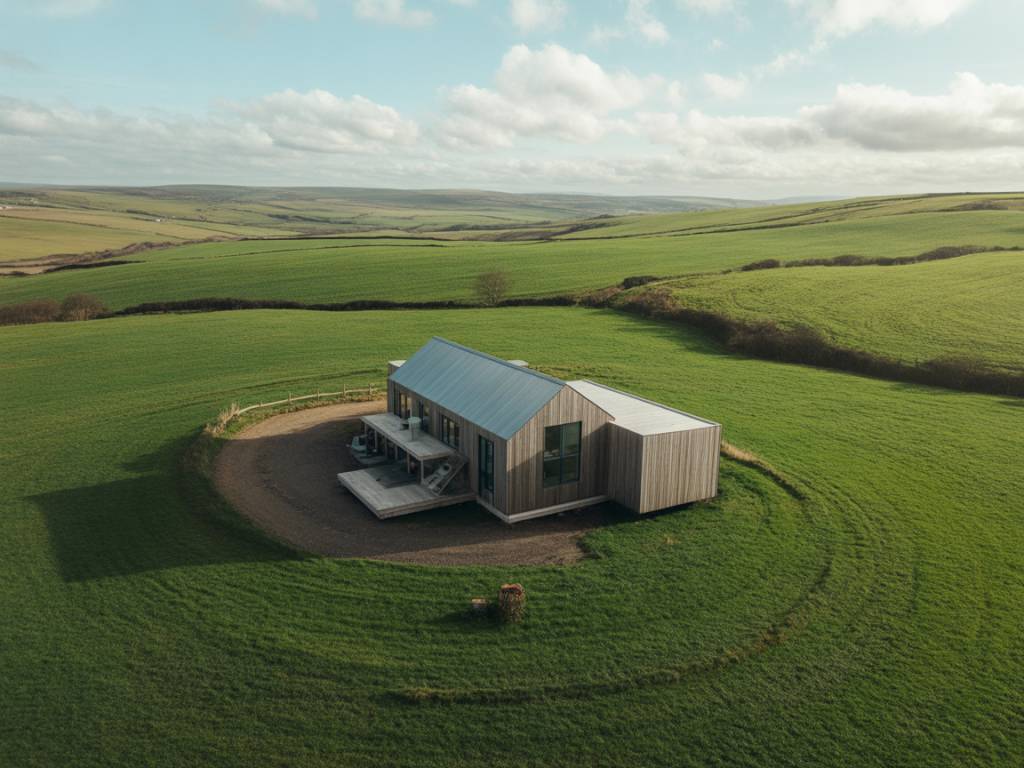
There is a particular kind of silence you only find in fields at dawn. A hush that hangs between the hedgerows, broken only by the wingbeat of a crow or the distant cough of a tractor. It’s often in moments like these that the idea appears: “What if I built here? A small, low-impact eco home, tucked into the landscape. Is it even possible?”
If you’ve ever found yourself scrolling through land listings, dreaming of a simple timber cabin on a piece of agricultural land somewhere in the UK, you’re not alone. But the romance of the idea quickly meets the hard edge of planning law. Can you build on agricultural land? Sometimes, yes. Easily? Very rarely.
This article walks through what’s realistically possible, where the law offers narrow but genuine openings, and how your low-impact, eco-minded ambitions can give your project a better chance of success.
Why agricultural land is not just “empty space”
From a distance, farmland can look like unused space waiting for a home. In planning terms, it’s the opposite. Agricultural land is strongly protected in the UK because it underpins food production, biodiversity, and rural character.
Local planning authorities start from a simple position: new homes should go where there are already homes (or allocated sites), not in open countryside. That doesn’t mean it’s impossible; it means the default answer to “Can I build a house on this field?” is “No, unless…”
For your eco home to have a chance on agricultural land, you’ll usually need to show at least one of the following:
- The home is essential for an existing agricultural or rural enterprise.
- The home meets strict “exceptional design” or “isolated home” policies (like Paragraph 80 in England).
- The home is part of a specific low-impact or rural policy framework (for example, in some parts of Wales).
- You’re converting an existing agricultural building under permitted development rules (Class Q in England).
Let’s unpack these one by one.
Building for agricultural or rural workers
Across the UK, there’s a long-standing pathway for housing on agricultural land: the agricultural worker’s dwelling. The idea is simple: if a farm or rural enterprise can’t operate safely or efficiently without someone living on-site, planning policy may allow a dwelling where you’d normally never get one.
Councils will typically look for:
- Functional need – Does someone genuinely need to live on the land? Examples might include:
- 24/7 care for livestock during lambing or calving season.
- Security for high-value crops or equipment.
- Intensive horticulture requiring constant attention.
- Financial soundness – Is there a real, viable business here, capable of sustaining someone’s livelihood?
- No suitable existing accommodation – Could the worker live in a nearby village, or is on-site presence truly essential?
Even where permission is granted, it often comes with an agricultural occupancy condition (ag tie). This legally restricts who can live in the house – generally someone employed in agriculture, forestry, or a related rural trade.
This route can work for people genuinely setting up a smallholding, regenerative farm, or market garden. But it’s not a back door to building your dream eco cabin and then quietly doing a few rows of kale.
If you’re serious about this path, expect to:
- Prepare a robust business plan.
- Demonstrate how your enterprise supports sustainable land management.
- Accept that the house may be modest, functional, and legally tied to the land use.
The “exceptional” design route: Paragraph 80 and its cousins
In England, one of the most talked-about possibilities for building in open countryside (including agricultural land) is the “isolated homes in the countryside” policy – currently Paragraph 80 of the National Planning Policy Framework (NPPF).
Under Paragraph 80, a new home may be allowed if it meets very strict criteria. The eco angle can be a real strength here, but design expectations are high. Many applications fail.
The tests vary slightly between policy updates, but typically include:
- Exceptional quality or innovative design – Not just a nice-looking timber house. You’re in the realm of:
- Genuinely pioneering environmental performance.
- Architecture that responds uniquely to its landscape.
- Design supported by respected professionals (architect, landscape architect, ecologist).
- Enhancement of immediate setting – Your home must not only “sit lightly” in the land; it should actively improve biodiversity, landscape character, or ecological connectivity.
- Sensitivity to local character – Materials, form, and scale should feel rooted in place, even if contemporary.
Similar “exceptional home” routes exist or can be mirrored through local policies in parts of Scotland, Wales and Northern Ireland, though details differ.
Is this realistic for a modest, low-impact eco home on a tight budget? Sometimes, but it often demands:
- A design-led approach with professional input.
- Rigorous energy and lifecycle modelling (Passivhaus, net zero carbon, or better).
- Substantial upfront spend on reports, drawings, and engagement with the planning authority.
On the plus side, this is one of the few policy doors that is explicitly sympathetic to genuine environmental innovation. If your dream includes earth-based materials, on-site renewables, and a building that almost disappears into the hedgerows, this route is worth exploring—if you’re ready for a marathon, not a sprint.
Turning barns into homes: the Class Q shortcut (England)
Sometimes the most sustainable building is the one that already exists. On agricultural land in England, Class Q permitted development rights allow certain agricultural buildings to be converted into homes without a full planning application.
The catch: not every barn qualifies, and the rules are detailed. Typically, councils will consider:
- Existing use – The building must have been in agricultural use on a qualifying date.
- Structure – It must be structurally capable of conversion without extensive rebuilding.
- Location – Buildings in Areas of Outstanding Natural Beauty (AONB), National Parks, SSSIs and other designations are often excluded or heavily restricted.
- Impact – Access, noise, flood risk, and design all still matter.
Although the process is simpler than full planning, it still requires prior approval. And while your eco ambitions might not be the deciding factor, they can help you steer the conversion into something genuinely low-impact:
- Retain as much of the existing structure as possible.
- Use natural or recycled materials internally.
- Incorporate renewables: solar PV, solar thermal, heat pumps, or biomass (where genuinely sustainable).
- Design for deep energy efficiency – insulation, airtightness, and passive solar gain.
Class Q doesn’t give you carte blanche—but if you find the right barn on the right piece of land, it can be one of the most realistic ways to live on agricultural land with a low-impact home.
Low-impact and “One Planet” style policies (especially Wales)
In recent years, Wales has been something of a quiet pioneer of low-impact rural living. Policies inspired by the “One Planet” concept have created limited openings for people who want to live simply and sustainably on agricultural or rural land.
Under these frameworks (which have evolved over time and vary by local authority), you might be able to gain permission if you can show that:
- Your lifestyle and land use will meet most of your basic needs (food, energy, waste, sometimes income) from the site.
- Your ecological footprint is at or below a defined “one planet” threshold.
- Your buildings are low-impact, demountable or easily restorable to nature, and made with sustainable materials.
- You’ve created a comprehensive management plan for the land, including biodiversity and soil health.
These policies aren’t an easy route; they’re often more demanding than conventional applications. But they align powerfully with the ethos of an off-grid, low-impact eco home. If your dream is less “country house with a view” and more “smallholding with coppice woodland and rainwater-fed garden,” Wales may deserve a closer look.
Scotland and parts of England have also seen small-scale, policy-led support for crofting, woodland living, or hutting – each with its own legal and cultural context. The detail differs, but the underlying idea is the same: linking your right to live on the land with your responsibility to care for it.
Green Belt, designations and other invisible fences
Not all agricultural land is equal. Two fields can look identical yet sit under very different policy clouds.
Key constraints to be aware of include:
- Green Belt – Designed to prevent urban sprawl. New homes are extremely tightly controlled, even if the land itself is in agricultural use.
- AONBs, National Parks, World Heritage Sites – Landscape and heritage protections can make new builds difficult, but sometimes encourage sensitive, high-quality eco design where development is justified.
- SSSIs, SACs, SPAs, ancient woodland – Strong ecological protections. Building in or near these is very challenging and often undesirable from a sustainability standpoint anyway.
- Best and Most Versatile (BMV) agricultural land – High-grade soils (Grades 1–3a) are specifically protected as a food production resource.
Ironically, the least productive scruffy pasture that “nobody seems to want” can sometimes be easier to justify for low-impact development than the postcard-perfect arable field. A good planning consultant or land agent can help decode the policy layers before you fall too deeply in love with a particular plot.
Designing a genuinely low-impact eco home
Assuming you find a policy route that looks viable, how do you make your home as gentle on the land as that first soft step onto dew-wet grass?
Some principles echo across Terra House’s favourite themes: sustainable living, off-grid resilience, and material honesty.
- Small is beautiful – A compact footprint means less embodied carbon, less disturbance to soil and habitats, and lower running energy demand.
- Build with the land, not against it – Think:
- Orientation for passive solar gain.
- Earth-sheltering or partially buried forms where appropriate.
- Hedgerows and existing trees as natural windbreaks and privacy screens.
- Natural and low-carbon materials – Timber from well-managed forests, straw bale, hempcrete, wood fibre insulation, lime plasters, clay paints. Materials that “breathe” and age with grace.
- Energy and water autonomy – Solar PV with battery storage, possibly a small wind turbine where viable; rainwater harvesting, reed bed systems for greywater treatment, composting toilets where accepted by local regulations.
- Landscape first, house second – Treat the planting plan as seriously as the floor plan. Wildflower meadows, agroforestry, swales, ponds, and habitat corridors can transform a simple field into a living mosaic.
Planning officers are increasingly receptive to proposals where the building feels like one element in a broader ecological restoration project, rather than an isolated “object” dropped into a field.
Practical steps before you buy that field
It’s tempting to spot an affordable scrap of pasture online and move straight to negotiation. A little patience (and paperwork) can save years of frustration.
- Read the local plan – Every council publishes one. It will tell you:
- How they view countryside development.
- Any specific policies on eco homes, rural workers’ dwellings, or low-impact living.
- Settlement boundaries: where homes are broadly encouraged or discouraged.
- Talk to the planning department – Many offer paid pre-application advice. Outline your vision honestly:
- A small, low-impact, eco-conscious home.
- Any agricultural or land-based enterprise you plan.
- Your approach to biodiversity and landscape enhancement.
Their informal comments can be blunt but invaluable.
- Check constraints maps – National Park, AONB, flood risk, heritage, ecological designations. Much of this is now online via council and government portals.
- Budget for professionals – An architect with rural eco experience, a planning consultant, perhaps an ecologist or landscape architect. Their input can turn a “no” into a considered “maybe”.
In one corner of Devon, for example, a couple I met had spent three years refining their plans for a timber-frame, straw-insulated home on marginal grazing land. Their first sketch was charming but naive: a cabin in a vaguely drawn field. Over time, their proposal evolved into a detailed land management plan, including rotational grazing, native hedge restoration, ponds for amphibians, and a small orchard. The house became almost incidental—the quiet heart of a wider, living system. That was the version the council finally approved.
Balancing dream and reality
So, can you build on agricultural land for a low-impact eco home in the UK?
The honest answer is: sometimes, for the right reasons, in the right place, with the right design—and usually with more patience than you expected.
If your dream is purely about escaping neighbours and snagging a cheap field, the planning system will push back hard. But if your ambition is to live lightly, to weave your daily life into the ecology and productivity of the land, and to express that respect through careful design, policy does leave the door ajar.
In that quiet moment at the edge of a field, it’s easy to imagine a single low line of timber and glass catching the late sun, a roof of wildflowers, a woodstove ticking softly inside. The journey from that vision to reality passes through policy documents, drainage plans, and soil surveys—but the vision matters. It’s the compass that keeps you walking.
If you can hold onto that sense of belonging to the land, rather than simply building on it, you’re already closer to the kind of proposal that planners, neighbours, and the landscape itself might one day be ready to welcome.