
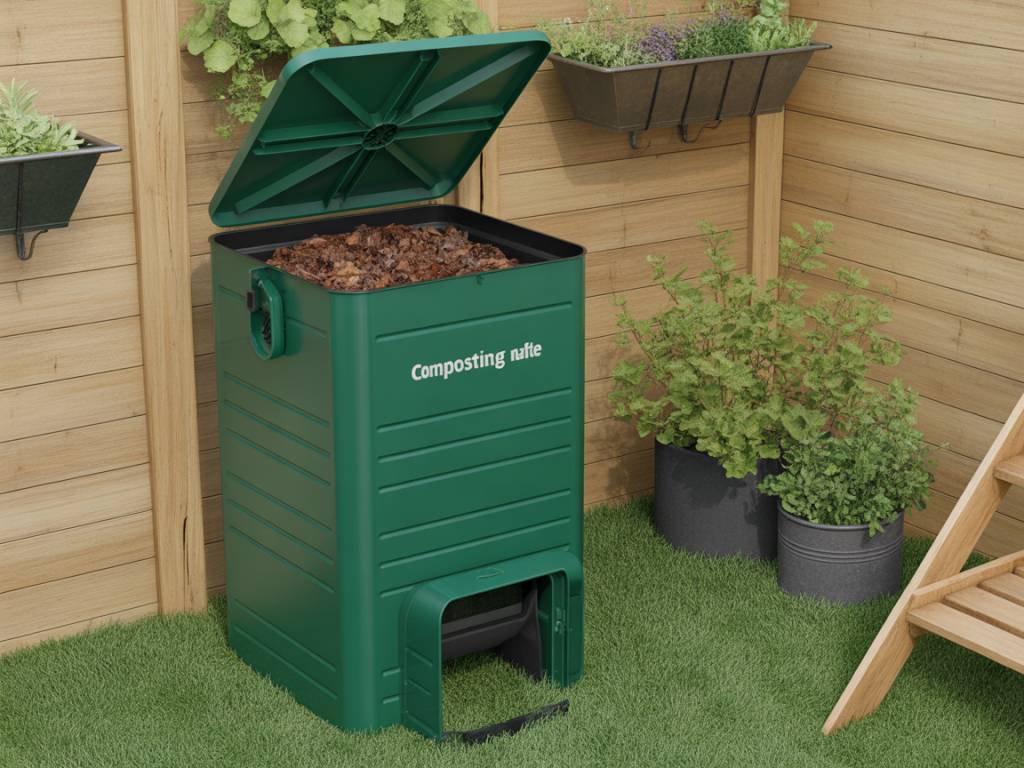
On a drizzly Tuesday in Bristol, I visited a friend who grows an improbable jungle of herbs and tomatoes on a balcony barely wide enough for two chairs. Between the rosemary and the recycling box sat a small, unassuming container. It didn’t look like much, yet it turned her kitchen scraps into the rich, dark crumble that fed the entire balcony. No garden shed. No lawn. Just a few square feet of sky and the quiet, alchemical work of compost.
If you live in a flat, a terraced house with a courtyard, or a home where “garden” is more idea than reality, composting can feel like a luxury reserved for those with sprawling lawns. It isn’t. With the right tools and a little rhythm, you can transform peelings and coffee grounds into soil food, even in the smallest UK spaces.
Let’s explore how to make composting easy and almost invisible in small gardens, balconies and courtyards, using space-saving systems that work with your home, not against it.
Why composting belongs in small UK spaces
In the UK, an average household throws away kilos of food each week. Most of it ends up in landfill, where it rots without oxygen and releases methane, a potent greenhouse gas. Yet the same scraps, given a little air, time and care, become a resource rather than a problem.
For small-space dwellers, composting offers some very particular advantages:
- Less rubbish to store indoors: Food waste bin overflowing before collection day? Composting diverts much of that bulk.
- Free soil and fertiliser: Bagged compost is heavy, expensive and often peat-based. Home compost is free, local and sustainable.
- Healthier plants in pots and planters: Even a single window box benefits from a regular dose of compost.
- A quieter connection to the seasons: Watching your waste transform over months is oddly grounding — especially in a city.
And there’s a subtle psychological shift too. When you start seeing “waste” as future soil, the kitchen changes character. The end of a meal is no longer the end of the story.
The simple science: What compost really needs
Whether you’re composting on a balcony in Manchester or a courtyard in Brighton, the recipe is reassuringly simple. Compost is just controlled rotting with a bit of intention.
There are three main ingredients:
- Browns (carbon-rich materials): Cardboard, paper, dry leaves, straw, torn egg boxes. They add structure and stop things getting slimy.
- Greens (nitrogen-rich materials): Fruit and veg scraps, coffee grounds, tea leaves, fresh plant trimmings. These fuel the decomposition.
- Air and moisture: Like us, the composting microbes need oxygen and water, but not too much of either.
In a small-space system, the “art” lies in balancing the wet kitchen scraps (greens) with enough dry material (browns) to keep smells away and the process moving. If you can remember this, even vaguely, you’re already most of the way there.
Now, how do we fit all that into a tiny footprint without turning your balcony into a science experiment gone wrong?
Wormeries: Silent workers for balconies and courtyards
Wormeries are often the first love of small-space composters. A wormery is essentially a compact, stacked system where composting worms (usually red wigglers) quietly transform your kitchen scraps into rich worm castings and a liquid fertiliser.
Imagine a vertical column of trays, each no larger than a side table, tucked into a sheltered corner. Inside lives an entire ecosystem, working day and night.
Why wormeries are ideal for small spaces
- Very compact: Most systems fit into a 40–60 cm square footprint.
- Fast processing: Worms can eat roughly half their body weight in food scraps per day under good conditions.
- Low odour: When managed properly, a wormery smells like damp woodland rather than rubbish.
- Perfect for pots and containers: The finished vermicompost is incredibly concentrated and effective in small planters.
Where to keep a wormery in the UK
Worms prefer a relatively stable environment, ideally between about 10–25°C. In the UK that means:
- On a sheltered balcony, away from direct midday sun.
- In a shaded corner of a courtyard.
- In an unheated but frost-free shed or utility space, if you have one.
In winter, you might wrap the wormery in an old blanket or bit of insulation if your space is particularly exposed. In summer, simple shade is usually enough.
What you can feed a wormery
- Fruit and vegetable peelings
- Coffee grounds and paper filters
- Tea leaves and most tea bags (check they’re plastic-free)
- Crushed eggshells (in moderation)
- Small amounts of shredded cardboard or brown paper
It’s best to avoid meat, fish, dairy, large amounts of citrus, and very oily foods. These can smell, attract pests or simply decompose too slowly in a small system.
Picture this: a quiet Sunday morning, rain pattering on the balcony rail, and you step out with a small caddy of kitchen scraps. You lift the wormery lid, add a handful, scatter a layer of torn cardboard on top, and close it again. No drama, no smell — just a small, satisfying ritual.
Bokashi: The indoor option for flats and tiny courtyards
If your outside space is limited or shared — perhaps a communal courtyard or a balcony prone to high winds — bokashi composting can be a game changer.
Bokashi is a Japanese method that ferments food waste in an airtight container using a special bran inoculated with beneficial microbes. It’s particularly good for households that cook a lot and don’t want to fuss with outdoor bins.
Why bokashi works well in the UK home
- It lives indoors: The bin can sit quietly under a sink or in a cupboard.
- Takes almost all food types: Including meat, fish, cheese and cooked leftovers — things most compost systems hate.
- Very compact: A standard bokashi bucket has a footprint similar to a small pedal bin.
- Odour-controlled: When the lid is on, there’s virtually no smell; when opened, it’s more like sharp pickles than rotting food.
How bokashi works, step by step
- Add a layer of food waste to the bucket.
- Sprinkle with bokashi bran (the microbial “starter”).
- Press down to remove air, then close the airtight lid.
- Repeat until the bucket is full, draining off the liquid every few days.
- Leave the full bucket to ferment for about two weeks.
At the end, the contents won’t look like compost yet. They’ll look like pickled food scraps. This is where your tiny garden, balcony or courtyard comes into play.
Finishing bokashi in small spaces
In a traditional garden, you’d bury the bokashi directly in the soil. In small spaces, you can:
- Add it to a regular compost bin or wormery (in thin layers, mixed with brown material).
- Mix it into a large planter or raised bed, covering it well with soil and leaving it to break down for a few weeks before planting.
- Use a sealed outdoor container (like a second bin) filled with some soil, where bokashi can complete its transformation.
Bokashi is particularly attractive if you’re in a flat with little outdoor access but dreams of eventually borrowing or sharing soil — with neighbours, a community garden, or even a friend’s allotment.
Compact bins and tumblers for tiny gardens
If you have even a modest courtyard, a narrow side return, or a patch of paving where a pot can stand, you can probably host a small compost bin or tumbler.
Compact compost bins are simply shrunken versions of the classic garden compost bin, while tumblers are drum-like containers on a frame that you spin to mix the contents.
Benefits for small UK gardens
- Simple to use: No special equipment or worms required.
- Weather-tolerant: Designed to live outdoors in our famously unpredictable climate.
- Neat footprint: Many small bins take up less space than a garden chair.
- Great for garden waste: Ideal if you have plant cuttings, deadheading, or autumn leaves.
Finding space for a bin in small plots
- Tuck it into a shady corner where it won’t bake in summer.
- Place it at the end of a narrow path or side return — an often-forgotten strip of potential.
- Use it as a kind of functional sculpture: a dark, cylindrical object behind a pot of lavender or a climbing rose on a trellis.
Keeping it odour-free and tidy
The secret to a sweet-smelling, compact bin is balance:
- Add browns (shredded cardboard, paper, dry leaves) for every layer of food scraps.
- Avoid large amounts of cooked food, meat or dairy.
- Chop materials into smaller pieces to help them break down faster.
- Give it a turn or shake now and then (with tumblers, this is the whole point; with static bins, use a hand fork).
On a warm evening in late summer, you might lift the lid and see the slow architecture of decomposition: browns and greens melding into something darker, threads of mycelium weaving through, the air smelling faintly of woodland floor rather than bin day.
Stacking, hiding and integrating compost systems
In small UK homes, the question isn’t just “How do I compost?” but “Where on earth do I put the thing?” Thoughtful placement can mean the difference between a system you love and one that annoys you every time you hang out the washing.
Think vertically
- Choose stackable wormeries or tall, narrow bins to use height instead of floor space.
- Place a small wormery on a sturdy plant stand, with herbs or trailing plants on the tiers below to disguise it.
- Use a slimline bin against a fence or wall rather than a wide, low one.
Blend it into your planting
- Surround a compact bin with pots of mint, thyme or geraniums to soften its lines.
- In a courtyard, let a climber drape over a trellis behind your compost to distract the eye.
- Paint a wooden enclosure or screen in the same colour as your fence so the bin simply disappears into the background.
Make it part of your routine
Place your compost system on a route you walk every day:
- Next to the path you take to the front gate.
- Close to the outdoor tap where you water plants.
- By the back door, where your indoor caddy naturally empties.
The less effort required to reach your compost, the more likely you are to use it consistently.
What to compost – and what to skip – in tight quarters
When space is limited, it pays to be a little choosy about what goes into your system. This isn’t a farm-scale heap; it’s a carefully managed micro-world.
Excellent candidates for small-space composting
- Fruit and vegetable peelings and cores
- Coffee grounds and paper filters
- Crushed eggshells
- Stale bread in small amounts
- Plant trimmings from houseplants or balcony pots
- Shredded brown cardboard and paper (no glossy coatings)
li>Loose tea and most plastic-free tea bags
Things to avoid (or treat with caution)
- Meat, fish and dairy in open outdoor systems — they attract pests and smell.
- Oily or very fatty foods — they break down slowly and can go rancid.
- Large amounts of citrus or onion in wormeries — they can irritate worms if overdone.
- Bioplastics and “compostable” packaging — many require industrial conditions you won’t have at home.
- Dog and cat waste — it can carry pathogens and is best kept out of home systems.
If in doubt, ask a simple question: “Would I be happy if this sat in a small container near my back door for the next few months?” If the answer is no, it probably belongs in your council food waste collection instead.
Using your compost in containers, beds and borrowed soil
One crisp March morning in Leeds, I watched a neighbour tip a bucket of home compost into a single raised bed in her tiny yard. She mixed it in with last year’s soil, smoothing it with the back of a rake. That patch of earth would soon host an unruly chorus of kale, nasturtiums and basil, all fuelled by last winter’s peelings and tea leaves.
In small spaces, a little compost goes a very long way.
How to use compost in pots and planters
- Mix 1 part compost to 3 parts peat-free potting mix for most containers.
- Add a small handful of compost to the planting hole when potting up herbs or flowers.
- Top-dress established pots with a 1–2 cm layer of compost in spring, then water it in gently.
Using compost in courtyards and small beds
- Spread a thin layer (about 2–3 cm) over the surface of your beds once or twice a year.
- Gently fork it into the top layer of soil, taking care not to disturb plant roots.
- Combine with a mulch (like bark or leaf mould) to keep moisture in during dry spells.
No soil of your own?
If you live in a flat with no garden but an active compost system, you still have options:
- Share with neighbours: Offer bags of compost to others in your building or street who garden.
- Donate to a community garden or allotment: Many are delighted to receive locally made compost.
- Use it for houseplants: A small pinch mixed into indoor potting soil can work wonders.
Your balcony or windowsill may be small, but the life it supports is part of a much wider urban ecosystem.
Fitting composting into everyday UK life
Composting in small spaces isn’t about perfection. It’s about quietly aligning our habits with the cycles that already exist in nature.
On a grey Thursday, when the rain hangs in the air over a row of terraced houses, you might carry a little caddy of peelings down a narrow path to a compact bin. On a bright Saturday morning, you might pour the week’s coffee grounds into the wormery before heading to the market. Over time, these small gestures accumulate into something quietly radical: less waste, richer soil, healthier plants.
In a world of big solutions and grand designs, there is something wonderfully modest about tucking a tiny compost system onto a balcony or into a courtyard. It’s a reminder that even in the tightest corners of our UK homes, there is room for transformation — from scraps to soil, from throwaway to return.