
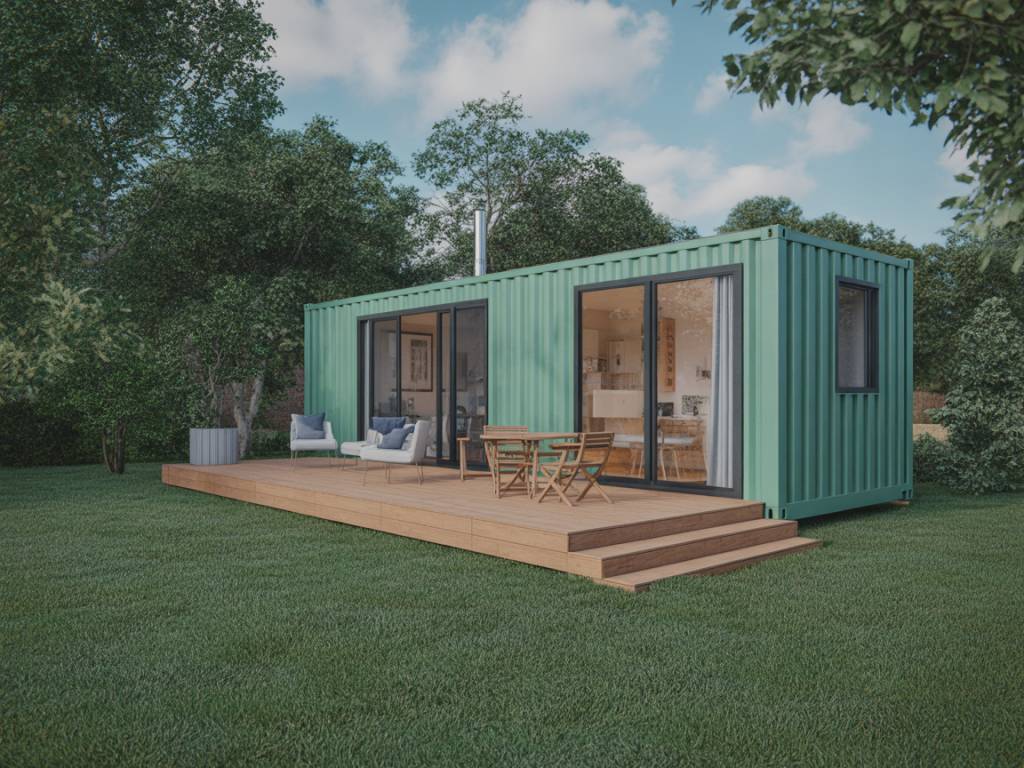
On a grey Tuesday somewhere between Bristol and the Severn, I once stood in an empty steel box that smelled faintly of rust and sea salt. It had crossed oceans stacked with others like it, and was now waiting in a muddy yard to become someone’s sunlit kitchen. The wind rattled the corrugated walls and, just for a second, it was hard to imagine this cold shell ever feeling like home.
That, in essence, is the container home paradox: it looks like an affordable shortcut to a bespoke house, but the journey from steel box to warm sanctuary is longer, and more expensive, than many self-builders expect.
If you’re in the UK and dreaming of building your own container home, this guide will walk you through a realistic cost breakdown and practical budgeting tips, so you can plan with clear eyes and still keep the magic of the idea intact.
Are container homes really cheaper in the UK?
Let’s start with the question everyone whispers over Pinterest boards and late-night spreadsheets: “Will this actually save me money?”
The honest answer: they can, but only if you approach them with the same rigour as any other self-build. A container home in the UK is not a £10,000 shortcut to a Grand Designs life. For a comfortable, well-insulated, building-regulation-compliant home, you’re more realistically looking at:
That’s often comparable to a small conventional new-build – but with potential savings in structure and speed, and more control if you’re willing to get hands-on.
To see where the money actually goes, we need to unpack the main cost categories.
Cost of the containers themselves
There’s a kind of romance in scrolling through listings of old shipping containers, each one a veteran of distant ports. But romance aside, what will you actually pay?
For a small one-bedroom home you might use two 40ft high-cube containers; for a modest three-bedroom layout, four to six containers is common.
Don’t forget:
At this stage, many people feel buoyant: “Six containers at £3,000 each? I’m halfway to my dream home for under twenty grand.” But the containers themselves are usually under 15–20% of the final build cost.
Groundworks and foundations
Before the first steel box touches your site, the earth under it needs to be ready. Groundworks are where your project quietly eats cash, especially in the UK’s diverse (and often soggy) soils.
Typical costs:
Even with a “lightweight” container structure, building control will want proof that the foundations are appropriate. For sloping or difficult plots, don’t be surprised if foundations rival or exceed the cost of the containers.
Structure, cutting, and welding
Ordering containers is one thing; turning them into a habitable shell is another.
Each large opening weakens the corrugated walls. That huge sliding door to the garden? Beautiful, yes – but it might require a steel frame costing hundreds or thousands. It’s one of the places where design ambition and budget should have an honest early conversation.
Insulation, thermal performance and cladding
A bare container is essentially a metal box that will sweat with condensation and freeze in winter without serious attention to insulation and ventilation. UK building regulations (Part L) are not something you can sidestep.
Typical routes and costs:
Many self-builders choose to “hide” the container externally with timber cladding, both for planning acceptability and thermal bridges. It adds cost but can drastically improve comfort and lifespan.
Windows, doors and openings
The poetry of a container home lies in its light – in the way large panes of glass carve views out of the steel. Financially, though, glazing is rarely poetic.
For a modest container home, window and door packages of £8,000 – £20,000 are common. Triple glazing, aluminium frames, or complex arrangements push that upwards. Plan window positions early so the steel cutting and reinforcement can be efficient rather than improvisational.
Interior fit-out: where it starts to feel like home
This is where the cold metal box finally softens: plasterboard, timber floors, the bathroom you’ve saved on a Pinterest board for three years.
Broad cost ranges per m² of internal floor area:
What’s included here?
As with any home, kitchens and bathrooms are cost multipliers. A frugal but functional kitchen can be under £3,000; a high-spec, stone-worktop version may easily hit £10,000–£20,000.
Services: heating, plumbing, electrics
This is the invisible nervous system of your container home – mundane until it fails, crucial when you want comfort on a February morning in Yorkshire.
In a sustainability-focused home, you might consider:
These add to the upfront budget but can reduce running costs dramatically, especially in a small, well-insulated container home. For off-grid dreams, factor in batteries, larger PV arrays, and potentially backup generators – that’s another budget universe entirely.
Professional fees, permissions and the silent paperwork
No one ever fell in love with a planning application form, but without it your containers are just very expensive garden ornaments.
In the UK, expect:
Container homes, being non-traditional, may attract more scrutiny. A good architect or designer familiar with alternative construction can save you headaches – and, often, money through smarter detailing.
Land costs: the elephant in the budget
All of the above presumes you already own land. In much of the UK, the land itself will dwarf the cost of the containers.
Because container homes are compact and modular, you can sometimes make “awkward” plots work well – long, narrow, or sloping sites. But always budget for surveys and potential surprises in the soil.
Hidden and often-forgotten costs
These are the line items that quietly sabotage optimistic spreadsheets:
A sensible rule of thumb is to add a 10–15% contingency to your total build cost, or 20% if the site is challenging or you’re new to self-building.
Example budgets for UK container homes
To ground all this in something more tangible, here are two simplified scenarios. These are ballpark figures, not quotes – but they give some sense of scale.
1. Compact one-bedroom home (around 40–50 m²)
Approximate total (excluding land): £96,500
2. Family-sized three-bedroom home (around 90–110 m²)
Approximate total (excluding land): £227,700
Notice how quickly the “cheap steel box” evolves into a full, complex house. The container provides a structural head start – but the rest of the journey is very familiar territory in the world of building.
Budgeting strategies for UK container self-builders
So how do you stop your project drifting away from your financial shoreline?
1. Start with space, not steel
Instead of asking “How many containers can I afford?”, ask “How much space do I genuinely need for a good life?” Smaller, better-designed homes are always easier on the budget and the planet.
2. Design around standard dimensions
Containers are modular. So are many building products. Aligning windows, doors, and interior layouts with standard sizes reduces cutting, waste and bespoke costs. An architect who understands this can pay for themselves in what they save you.
3. Decide early where you’ll DIY and where you won’t
DIY can save thousands – or cost thousands if you need to redo work. Sensible splits:
4. Fix prices where you can
Ask for fixed-price quotes on discrete packages: foundations, windows, roofing, key services. Labour and material costs fluctuate; locking in prices reduces nasty surprises. Just ensure specifications are crystal clear.
5. Sequence sustainability investments
In a perfect world, you’d fit solar, heat pumps, battery storage and rainwater harvesting all at once. In the real world, you can phase:
A well-insulated container home with modest systems often outperforms a leaky house with expensive tech bolted on.
6. Track every pound
Create a simple spreadsheet with categories matching those in this article. Log every invoice and receipt, however small. It’s surprising how quickly silicone, screws and site coffees accumulate.
Common financial pitfalls with container homes
Having watched a few projects wobble on their steel legs, these are the recurring patterns:
When the numbers and the dream meet
Standing in that cold container years ago, I remember tracing my hand along the inside wall, feeling the dents of its past journeys. It struck me that a container home is really a collaboration: between global industry and local craft, between hard numbers and soft aspirations.
If you go into the process understanding that the container is only one chapter in the story – perhaps 15% of the cost, but 100% of the initial daydream – you’re far more likely to emerge with a home that works on all levels: financial, emotional, and environmental.
Run the numbers. Be honest about what you can do yourself and where you need help. Ask the awkward budget questions early, when a line on a drawing is still cheap to change. And then, when the steel box finally lands on your piece of British soil and the rain drums its first rhythm on the roof, you’ll know you’ve built not just a curiosity, but a carefully considered, sustainable home.