
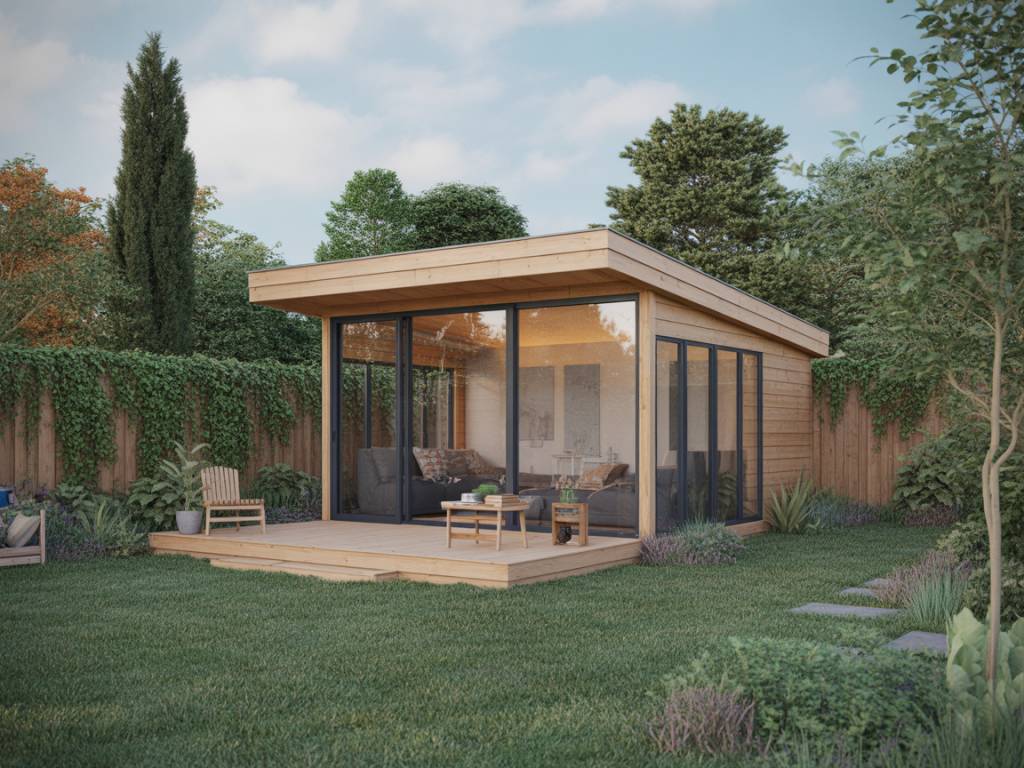
Designing a genuinely net-zero garden room in the UK is more complex than adding a few solar panels to a timber pod at the end of the garden. It involves careful attention to materials, construction details, heating systems and, crucially, realistic expectations of energy performance. This article explores how to approach a net-zero garden room as a small but serious piece of architecture rather than an oversized shed.
What “net-zero” really means for a garden room
In the context of a garden room, “net-zero” usually means that over the course of a year, the building generates at least as much renewable energy as it uses for heating, lighting and any plug-in equipment.
Two separate questions need to be addressed:
- Operational energy: how much energy the garden room will consume in day-to-day use.
- Embodied carbon: the emissions linked to manufacturing and transporting materials, and to construction itself.
A garden room can be net-zero in operational terms while still having a relatively high embodied carbon footprint, depending on the materials used. A genuinely low-impact project aims to reduce both.
Planning basics and use patterns
Before specifying materials or heating, it helps to be precise about two things: legal constraints and how the room will be used.
On the regulatory side in the UK, many garden rooms fall under permitted development, provided they meet height and placement limits and are not used as a self-contained dwelling. For year-round use, building regulations around insulation, electrical safety and ventilation should be treated as a baseline, even if your particular build might not be formally inspected.
On the usage side, energy performance will depend heavily on:
- Hours of occupation: a few evenings a week vs. a full-time garden office or studio.
- Internal gains: computers, lighting, musical equipment or exercise machines can significantly warm a small space.
- Comfort expectations: maintaining 21°C in January is very different from a room used only in the shoulder seasons.
Clarifying these points early allows you to decide what “net-zero” means for your specific project, and whether you are targeting near-passive performance or simply a reduced-impact outbuilding.
Fabric-first design: the building envelope
A net-zero garden room starts with a fabric-first approach. In other words, most of the performance gains come from the building envelope rather than from technology added later.
The key priorities are:
- High insulation levels in floor, walls and roof.
- Excellent airtightness to prevent uncontrolled heat loss.
- Low thermal bridging, especially around junctions and openings.
- Appropriate glazing for daylight without excessive heat loss or summer overheating.
For a small building, modest areas of poor detailing – a poorly sealed door, an uninsulated slab edge – can have a disproportionate impact on performance. Precision in the fabric is often more cost-effective than oversizing heating or renewable systems.
Structure and main materials
Several structural approaches are common for UK garden rooms, each with different thermal and environmental implications.
Timber frame is usually the most straightforward way to achieve a low-embodied carbon structure. When responsibly sourced, timber sequesters carbon and is easy to work with on smaller sites. A typical build-up might be:
- Timber studs with insulation between and outside the frame.
- Sheathing board (often OSB) for racking strength and airtightness.
- Breathable membranes and battens.
- External cladding such as larch, cedar, thermowood or fibre-cement.
Structural Insulated Panels (SIPs) offer:
- Very high insulation in a compact thickness.
- Good inherent airtightness when correctly taped and sealed.
- Rapid installation, useful for garden sites with tricky access.
The downsides relate to embodied carbon. Most SIPs use polyurethane or EPS insulation and OSB facings, which are fossil-fuel derived and relatively high in embodied emissions compared with natural alternatives. For some homeowners, the operational energy gains justify this; others prefer to minimise synthetics.
Masonry or blockwork garden rooms offer longevity and thermal mass, which can buffer temperature swings. However, standard concrete block and poured concrete foundations carry significant embodied carbon. If a masonry approach is chosen, consider:
- Using lower-carbon blocks where available.
- Minimising concrete volumes via strip or pad foundations instead of full slabs where structurally appropriate.
- Combining masonry with external insulation to meet high performance targets.
Insulation options and thicknesses
To move towards net-zero operational energy, insulation levels should exceed minimum building regulation requirements. As a rough guide for a high-performance garden room in the UK climate:
- Floor: 150–200 mm of high-performance insulation or equivalent U-value around 0.12–0.15 W/m²K.
- Walls: 150 mm or more, aiming for U-values below 0.18 W/m²K.
- Roof: 200–300 mm, targeting U-values below 0.12–0.15 W/m²K.
Common insulation options include:
- Mineral wool (glass or rock wool): widely available, non-combustible, good acoustic performance.
- Wood fibre or other bio-based boards: lower embodied carbon, “breathable”, add some thermal mass, useful for summer comfort.
- Rigid PIR/PUR boards: high thermal performance per thickness, but higher embodied carbon and more sensitive to precise installation to avoid gaps.
- Sheep’s wool, cellulose, hemp: renewable, hygroscopic and often locally sourced, but availability and cost vary by region.
Layering different materials – for example, mineral wool between studs and wood fibre board outside – can improve performance and reduce thermal bridging, especially when supported by good detailing.
Glazing, orientation and shading
Glazing design for a net-zero garden room is a balancing act:
- Too little glass reduces daylight and makes the room less pleasant to use.
- Too much glass can lead to winter heat loss and summer overheating.
For comfortable, low-energy use:
- Use high-performance double or triple glazing with warm-edge spacers and low-E coatings.
- Prioritise south-east to south-west orientation for main windows where feasible, to capture low winter sun while avoiding too much west-facing afternoon heat gain in summer.
- Add external shading such as overhangs, pergolas, deciduous planting or external blinds for large glazed areas.
- Pay close attention to frame performance: well-insulated timber, alu-clad timber or high-quality uPVC frames generally outperform basic aluminium systems.
Airtightness and ventilation
Airtightness is frequently the weak point of small buildings. Every penetration for cables, pipes and fixings is an opportunity for air leakage, which undermines insulation performance.
Key strategies include:
- Defining a continuous airtightness layer (e.g. internal OSB or dedicated membrane) early in the design.
- Using airtight tapes and grommets around services, windows and junctions.
- Minimising unnecessary penetrations.
An airtight garden room then needs reliable ventilation. Options include:
- Trickle vents and window opening for occasional use buildings.
- Wall-mounted decentralised MVHR units that provide heat recovery without duct runs, well-suited to compact rooms used daily.
Mechanical ventilation with heat recovery (MVHR) can recover a significant proportion of heat that would otherwise be lost, lowering overall heating demand, particularly in winter for intensively used rooms.
Heating options for a net-zero garden room
Because a well-insulated garden room has relatively low heating demand, the focus is less on power and more on controllability, responsiveness and compatibility with renewables.
Electric panel heaters and infrared panels
- Simple to install with no pipework or flues.
- Work well where grid electricity is matched by on-site solar PV.
- Infrared panels can be mounted on ceilings or walls and provide comfortable radiant heat, particularly in spaces with intermittent occupancy.
Electric underfloor heating
- Gives an uncluttered interior and even heat distribution.
- Best paired with good floor insulation to avoid downward losses.
- More suitable for rooms that will be heated for longer periods, as warm-up times are slower than panel heaters.
Air-to-air heat pumps (mini-split units)
- High efficiency, often delivering 3–4 units of heat for each unit of electricity.
- Provide both heating and cooling, which can be useful in well-insulated but highly glazed spaces.
- Higher upfront cost and visible indoor unit, but strong option when aiming for low running costs and low carbon intensity, especially if powered by solar.
Wood-burning stoves are sometimes installed for aesthetic reasons and occasional winter use. From a net-zero operational perspective, they are less attractive:
- Direct emissions of particulates and air pollutants.
- Oversized for small rooms, leading to overheating and inefficiency.
- Require a flue, complicating airtightness and detailing.
For most serious net-zero designs, all-electric heating with a focus on efficiency and smart controls is preferable.
Hot water and services
Many garden rooms do not include hot water; if they do, a small electric water heater or point-of-use instant heater is common. To reduce energy use:
- Minimise hot water demand by keeping sinks small and avoiding unnecessary basins and showers.
- Use efficient mixers and aerated taps.
- Insulate any hot water pipe runs adequately, especially where they pass outside the insulated envelope.
Electrical design should factor in PV generation (if used), EV charging on the property, and potential future loads such as additional workstations or equipment.
Integrating solar PV and storage
Solar PV is often central to a net-zero garden room strategy. An outbuilding roof can be ideal for panels, particularly if the main house roof is shaded or constrained by planning.
Key decisions include:
- Array size: a small garden room with very low heating demand might be well served by 1.5–3 kWp of PV, depending on orientation and shading.
- Connection: panels can feed into the main house electrical system, balancing generation across all household loads.
- Battery storage: optional, but can improve self-consumption of solar electricity, particularly if you work in the garden room during the day.
For some properties, solar on the main house may be more practical than on the garden room itself. What matters for a net-zero outcome over the year is the balance of total renewable generation against the additional load created by the garden room.
Realistic energy performance: what to expect
Claims of “zero heating required” in UK garden room marketing should be treated with caution. Even highly insulated, small volumes lose heat quickly when not occupied, especially if windows are left on trickle or if airtightness is mediocre.
For a well-built, highly insulated 15–20 m² garden room with good airtightness and double or triple glazing, used as a heated office five days a week, a rough range of annual space heating demand might be:
- In the region of 20–40 kWh/m² per year, depending on location, orientation, ventilation strategy and usage pattern.
For a 20 m² space, this equates to about 400–800 kWh per year of heat. With a high-efficiency air-to-air heat pump, electrical consumption for heating could fall into the 150–300 kWh per year range. In many UK locations, a modest PV array on the house or outbuilding roof could generate this amount several times over annually.
However, over-optimistic performance claims often ignore:
- Extended operating hours in winter.
- Higher than expected plug loads (multiple monitors, heaters, dehumidifiers).
- Lower than modelled airtightness.
- Behavioural factors such as leaving heaters on or windows open.
To move from theory to reality, consider:
- Installing a simple energy monitoring system on the garden room supply.
- Using smart thermostats and timers to avoid unnecessary heating hours.
- Documenting the actual construction details, so future improvements (for example, adding shading or extra airtightness work) can be targeted effectively.
Selecting products and suppliers
When evaluating garden room kits or turnkey suppliers, it is helpful to look beyond headline claims and ask for:
- Wall, floor and roof build-ups with stated U-values.
- Window specifications, including whole-window U-values, not just centre-pane figures.
- Details on airtightness measures and whether any testing is carried out.
- The type and thickness of insulation and its environmental credentials.
- Heating system details and estimated annual energy use.
For self-builders, it is often better to invest slightly more in envelope performance (insulation, windows, airtightness tapes) and choose simple, robust heating and ventilation solutions, rather than overspending on complex technologies that compensate for a mediocre fabric.
Approached in this way, a net-zero garden room in the UK becomes an opportunity: a small, carefully designed building that showcases good construction practice, reduces household emissions and provides comfortable, flexible space with modest running costs.