
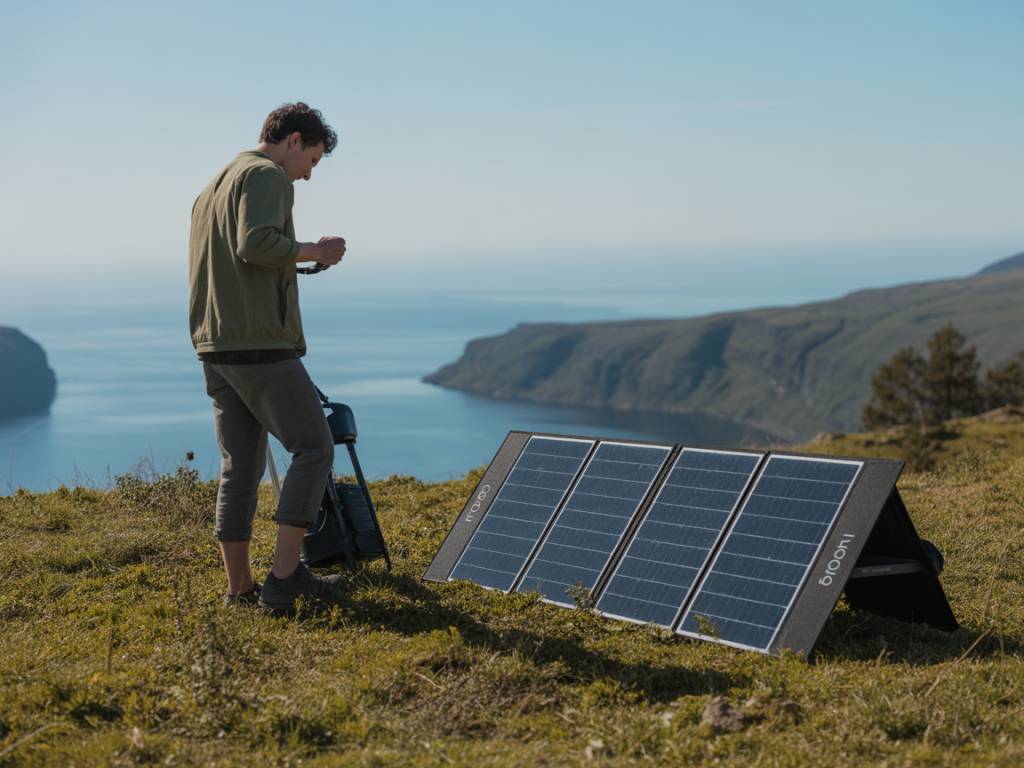
On a July morning in Devon, the sky was doing that particularly British thing of hesitating between blue and grey. A soft breeze moved through the hedgerows, the kettle was just beginning to whisper on the stove of the campervan, and on the grass beside me lay a neatly folded rectangle of black fabric: the EcoFlow 160W solar panel.
There is something quietly thrilling about that moment when you unfold a solar panel. It’s like opening a portable piece of infrastructure, a slice of autonomy that fits in the boot of a small car. But does this particular panel actually deliver, here in the UK, under clouds that seem professionally trained to dim enthusiasm?
Over several weeks, across the West Country and later back at a small urban terrace in Bristol, I lived with the EcoFlow 160W panel: carrying it, angling it, wiping off rain, and watching the wattage climb and fall with every passing cloud. This is what I found.
Why the EcoFlow 160W panel matters for UK living
The 160W sweet spot is interesting. It promises more punch than the ultra-portable 100–110W panels, yet remains far more manageable than the big, rigid rooftop beasts. For many people in the UK, that balance is exactly what’s needed:
- Enough power to meaningfully charge a portable power station.
- Portable enough to take in a car, campervan, or up to the allotment.
- Compact enough to stash in a hallway cupboard or under the bed in a small flat.
With energy prices rising and a growing desire to gently uncouple ourselves from the grid (if only for an afternoon in the garden), panels like this one are a gateway: not full-scale off-grid living perhaps, but “semi-detached from the socket.”
First impressions: design, weight and real portability
Folded, the EcoFlow 160W panel resembles a slightly oversized artist’s portfolio. It is not featherlight, but it is deliberate rather than cumbersome.
Key specs that matter in the hand, not just on paper:
- Weight: around 7 kg (including the carry case).
- Folded size: roughly 68 x 42 x 2.4 cm.
- Unfolded size: about 157 x 68 x 2.4 cm.
- Type: folding, semi-rigid panel with integrated MC4 connectors.
Carrying it from the car to a field 200 metres away, it feels like a moderate suitcase rather than camping clutter. You probably wouldn’t want to hike the Lake District with it on your back, but a train journey plus short walk to a campsite? Quite realistic.
The carry case deserves a note. It doubles as an adjustable stand — a design choice that looks slightly gimmicky until you angle the panel towards a low winter sun and watch the output jump by 20–30%. It’s not as rock-solid as a dedicated aluminium stand, but it packs flat and works well on reasonably flat ground (grass, gravel, patio slabs).
Edge stitching and zips feel robust, more technical-backpack than bargain-bin accessory. Over several damp mornings and one thoroughly sulky afternoon of drizzle in Cornwall, the panel shrugged off the weather, the surface beading water rather than soaking it.
Test setup: how I used it in real UK conditions
To get a sense of real-world performance, I tested the panel in several locations and conditions:
- Rural Devon (open field, minimal shading, summer).
- Cornish campsite (mixed sun and sea mist, early autumn).
- Urban Bristol terrace (partial shading, varying roofline obstacles).
For power storage, I primarily paired the panel with two EcoFlow power stations (a River 2 Max and a Delta 2), but I also tested with a generic MPPT charge controller to ensure the panel behaves sensibly with non-EcoFlow setups.
All measurements were taken in the UK, with latitudes between roughly 50° and 51°, which means low winter sun and a quite realistic dose of cloud drama.
Clear summer sun: the best-case scenario
Let’s start with something rare but not mythical: a genuinely sunny UK summer day. In Devon, on a cloudless July afternoon around 1 p.m., panel angled roughly 45° towards the south, I recorded the following peak figures using the EcoFlow app connected to the Delta 2:
- Peak output: 135–145 W.
- Sustained (over 30–40 min): 120–130 W.
- Panel surface temperature: warm-hot to the touch (heat always eats a bit of efficiency).
That’s about 75–85% of the rated 160 W, which is actually very respectable for a portable panel, particularly when you remember that test-lab ratings are usually taken at 25°C cell temperature and perfection-level sun angles.
In this best-case scenario, practical charging times looked like this:
- EcoFlow River 2 Max (512 Wh): about 4–4.5 hours from 20% to 100% if kept in good sun and left alone.
- EcoFlow Delta 2 (1024 Wh): 7–8 hours from 20% to 100%, essentially a full sunny day with occasional cloud shifts.
In other words: on a summer camping day, this panel is more than enough to make your power station feel “bottomless” for light to moderate use — phone, laptop, cameras, small LED lights, perhaps even a small 12V fridge, as long as you’re not trying to run everything as if you were still plugged into the grid.
Bright overcast: the UK’s most common mood
Of course, relying on clear skies in Britain is like planning your life around the punctuality of buses: optimistic, occasionally rewarded, often not. So the real test is overcast but bright — the type of sky that gives soft shadows but no direct sunlight.
In Bristol and Cornwall, on days like this, with the panel angled but not obsessively re-aligned every half hour, I saw:
- Typical output: 55–90 W.
- Average for a full “grey but bright” day: 60–70 W.
This is the important bit: even without strong sunshine, the panel was consistently providing enough power to at least partially offset daily use. On such a day, left out from late morning to late afternoon (say 6–7 hours of reasonably bright sky), I could put back around 350–450 Wh into the power station.
Translated into something tangible, that is roughly:
- 5–8 full phone charges.
- 2–3 laptop charges (depending on the beast you’re feeding).
- Several hours of a low-power 12V fridge or cooler.
- Evening lighting, router, and a bit of laptop time for a small home office setup.
Not heroic numbers, but for a portable panel — and in conditions many people write off as “too cloudy for solar” — it’s a quietly impressive reality.
Heavy cloud and drizzle: when Britain remembers who it is
The most humbling test came on a sodden afternoon near Bodmin Moor. Low, thick cloud. Occasional drizzle. The kind of day that makes you crave a pub fire and forget about the existence of shadows.
Here, the panel kept me honest:
- Output range: 10–35 W, with long stretches around 15–20 W.
- Total harvest over 5 hours out in it: around 80 Wh.
Is that depressing? Not necessarily. It’s simply physics. Under that kind of sky, most panels — even fixed rooftop ones — struggle. What matters is that the EcoFlow 160W panel still produced something, not nothing. Enough to slow the decline of a power station’s charge, though not enough to reverse it if you’re running anything heavier than phones and lights.
If you live in the UK and imagine a single 160W portable panel as your only winter energy source, you’ll want to adjust your expectations. It’s a superb supplement, not a total replacement.
Low winter sun: short days, long shadows
Autumn in Bristol provided a more nuanced test: lower sun but not total gloom. On a crisp late-October day, panel angled more steeply (close to 60°) to catch the low arc of the sun, I recorded:
- Peak output: 85–100 W around solar noon.
- Average over 4 useable hours: 60–70 W.
The lesson here is angling. In summer, you can get away with a lazy flat-on-the-grass layout and still do reasonably well. In winter and shoulder seasons, angle becomes non-negotiable. A few minutes spent adjusting the EcoFlow stand to face south-southwest pays back with a very visible jump in wattage.
On a clear winter day, you can still add 250–350 Wh to a power station — enough to run essential small devices and keep communication lines open even during grid wobbles.
Portability in practice: van life, garden offices and tiny flats
Who is this panel really for? After a few weeks of moving it around, three scenarios emerged where it shines.
1. Campervans and weekend road trips
For van dwellers and weekend adventurers, the EcoFlow 160W hits a sweet spot: it’s powerful enough that one sunny day can substantially charge a mid-sized power station, but small enough to live indoors when you park in the city.
Folded, it slid neatly between the van mattress and the side wall. Deployment took under a minute: unzip, unfold, plug in MC4 to the power station cable, adjust the kickstand angles, and watch the numbers tick up. Its ability to be moved around — chasing the sun while your van sits happily in the shade — is a quiet luxury that roof-mounted panels can’t offer.
2. Garden offices and sheds
On the Bristol terrace, the panel spent several days quietly working for a garden office. Propped on the small paved area at the back, angled towards a gap in the neighbouring roofs, it was enough to power:
- A laptop for most of the day.
- Wi-Fi router and a low-power desk lamp.
- Phone, headphones, and odds-and-ends charging.
A compact power station indoors, panel outdoors, cable between window and frame: not the engineering marvel you’d present to a planning committee, but a surprisingly reassuring arrangement in a world of rising bills.
3. Small homes and renters
Not everyone can (or wants to) cover their roof in silicon. For renters or people without suitable rooftops, a folding panel is a way to experiment with solar energy without drilling anything. You bring it out when you’re home, tuck it away when you’re not, and you can take it with you when you move.
In this context, 160W is enough to noticeably shave off the plug-in charging of your small electronics and perhaps keep a backup power station topped up for outages.
Build quality, durability and usability quirks
The tactile experience of any “outdoor” tech matters. You want confidence that it can live on damp grass, feel the occasional boot or dog paw, and survive British weather moods.
On that front, the EcoFlow 160W inspires trust:
- Panel surface: laminated, slightly textured, easy to wipe clean after mud or salt spray.
- Seams and folds: no alarming creaks when unfolding; hinges feel solid, not brittle.
- Connectors: standard MC4, firmly attached, with decent strain relief.
- Water resistance: rated IP67 for the panel itself — fine for rain, though the connectors and power station should be kept reasonably sheltered.
There are, however, a few quirks worth noting:
- The integrated kickstand (via the case) prefers flat surfaces; on sloping, uneven ground, you sometimes need a rock or two to stabilise things.
- The dark fabric and black cells can get hot in full summer sun. Performance drops slightly as panel temperature rises, as with all solar; angling to allow airflow behind the panels helps.
- In gusty wind, it behaves a bit like a sail. Pegs or weights are wise if you’re near a cliff edge or on an exposed campsite.
None of these are deal-breakers. They are simply the realities of a folding, portable panel: trade-offs between flexibility, weight, and rigidity.
How it compares in the EcoFlow line-up
EcoFlow offers several portable panels (110W, 160W, 220W and beyond). So why choose 160W in particular?
- Versus 110W: The 160W is noticeably bigger and heavier, but the 40–50% extra power is significant, especially in cloudy conditions where every watt counts. If you have the space and don’t need to hike with it, 160W is the more future-proof choice.
- Versus 220W: The 220W panel offers more potential output, but it edges into the “awkward to carry alone” territory for smaller-framed people and takes up more car boot space. For solo travellers or renters, 160W often hits a more comfortable balance.
I found 160W to be the panel I was most willing to actually take out on uncertain days. And the panel you use beats the one you leave at home.
Limitations and realistic expectations
It’s tempting to treat watts as a magic number, but solar living — even part-time — requires a little humility and planning.
Where the EcoFlow 160W panel doesn’t excel:
- Running high-power appliances continuously (kettles, hair dryers, full-sized fridges) — you’ll drain your power station faster than the panel can refill it, especially on cloudy days.
- Being a sole energy source in deep winter at UK latitudes — you’ll want either more panels, grid power as backup, or a very minimalist load.
- “Set and forget” rooftop-style use — portable panels shine when you interact with them: adjust angles, chase patches of sun, protect from theft.
Where it quietly excels:
- Keeping small devices and modest setups running indefinitely during decent weather.
- Reducing generator use on campsites or off-grid retreats.
- Letting you learn the rhythm of solar without major installation or financial commitment.
A small step towards quieter power
On my last evening with the panel in Devon, the sky finally settled on a clear, pale blue. The EcoFlow was angled towards a sinking sun, its surface catching the last warm light. The power station indoors hummed silently at 98% charge. The kettle boiled, powered from the grid this time — I’m not that romantic — but the laptop, phones, and the string of tiny lanterns in the van were all running on sunlight gathered throughout the day.
It struck me that one of the great pleasures of a portable solar panel is not simply the numbers — though I did enjoy watching 130W appear on the screen, like a quiet victory over economics — but the subtle shift in awareness it creates. You notice the passage of clouds in terms of watts. You find yourself angling your chair and your panel the same way, both turning their faces to the light.
The EcoFlow 160W solar panel is not a miracle machine. It won’t unshackle you entirely from the grid. But it’s an honest, capable, and surprisingly elegant tool for anyone in the UK who wants to start weaving solar into their daily life: in a campervan by the sea, a garden office under a maple tree, or a small flat whose only south-facing asset is a tiny patch of patio.
In that sense, it does exactly what good design should do: it makes a cleaner, quieter way of living feel not like a grand gesture, but like a simple habit — something you unfold on the grass, plug in, and let the day gently fill.