
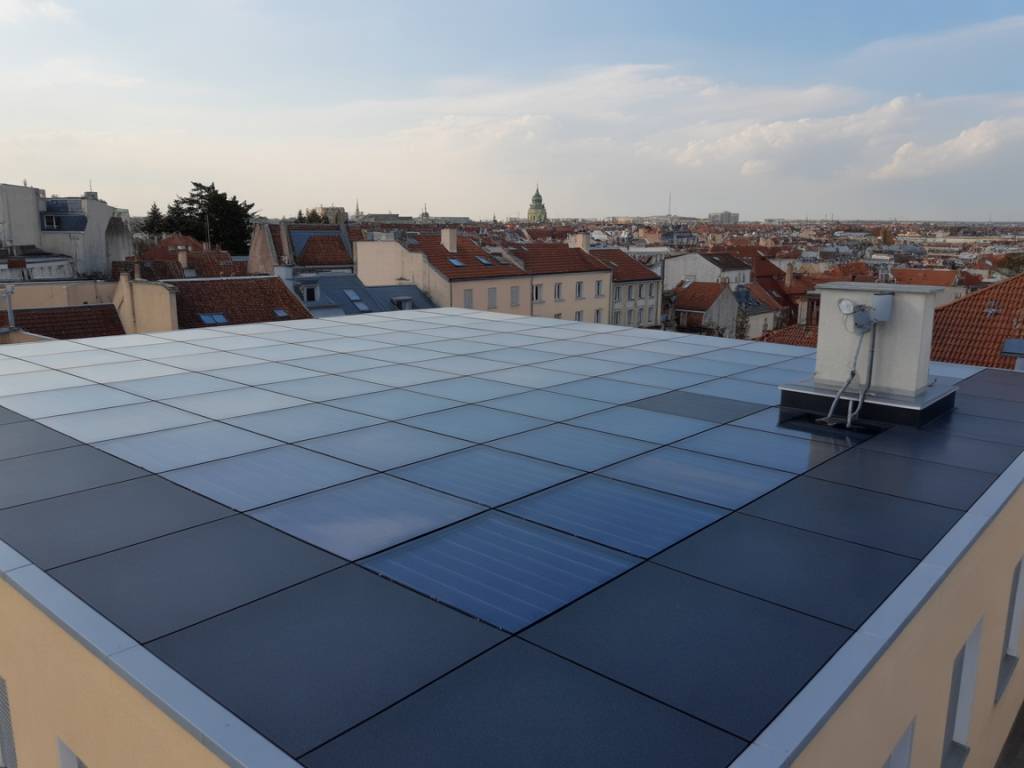
From the street, the building looks utterly ordinary. Brick façade, faint smell of coffee escaping from a ground-floor café, a bus sighing at the traffic lights. No one looking up would guess that, just a few metres above the pavement, the roof is quietly harvesting sunlight — without a single shiny panel breaking the skyline.
This is the quiet revolution: discreet solar on flat roofs, especially in dense towns and cities. No futuristic spaceship roof, no arguments with neighbours about “ugly panels”, no local heritage officer raising an eyebrow. Just renewable energy, hiding in plain sight.
Why hidden solar belongs in the city
Cities and towns are, paradoxically, both hungry for energy and short on visible space. We live stacked above each other, wrapped in brick and glass, sharing walls and views. In this context, the traditional image of solar — big, pitched-roof arrays glowing like mirrors — fits awkwardly.
Hidden solar on flat roofs answers three urban realities:
- Visual sensitivity: In conservation areas or historic streets, visible solar can clash with planning rules or local aesthetics.
- Shared boundaries: Overlooked roofs, nosy windows and rooftop terraces mean neighbours often have strong opinions.
- Underused flat roofs: Many urban buildings, from warehouses to extensions, have vast flat surfaces doing… absolutely nothing.
Discreet solar systems turn those forgotten planes into quiet power stations. The trick is to work with height, angle and colour so that, from street level, no one would ever know.
How solar hides on a flat roof
When we think of “hidden” we often think of underground. But on a roof, hidden usually means low, dark and cleverly angled. Here are the main ways it’s done.
Low-profile solar mounting systems
Traditional panels on pitched roofs are tilted at around 30–40 degrees — efficient, but highly visible. On a flat roof, you have more freedom. Low-profile systems use shallow angles (typically 5–15 degrees) so the panels are barely visible behind the parapet walls that many urban buildings already have.
Imagine standing on the pavement, craning your neck. If the parapet is, say, 50–80 cm high, and your panels only rise 20–30 cm above the roof membrane, the entire array can disappear from view.
These systems often use:
- Ballasted frames: Panels are held in place by weight (concrete blocks or similar), avoiding roof penetrations and protecting waterproofing.
- East–west layouts: Panels are arranged in back-to-back pairs facing east and west rather than facing south, allowing lower tilt and a flatter profile.
- Wind-optimised design: Deflectors and aerodynamic shapes reduce uplift, so less ballast is needed.
There is a trade-off: lower angles can reduce peak generation slightly. But in cities, where discretion and planning permission can be your biggest battles, accepting a few percent less yield is often a small price for getting the system approved and installed.
Solar that blends into the roof itself
Some systems don’t just hide behind parapets — they try to look like the roof.
For example:
- Solar membrane (thin-film) that can be bonded directly onto metal or single-ply roofs. From a distance, it can look like a uniform dark strip rather than individual panels.
- Dark-framed, all-black modules mounted low to the surface so they visually merge with dark roofing materials.
- Building-integrated PV (BIPV) solutions, where the energy-generating surface is the waterproofing or cladding, not something added on top.
These approaches shine (quietly) on apartment blocks, office buildings and modern extensions where a clean, minimalist roofline matters. The rooftop remains visually calm, even if you happen to see it from a penthouse or nearby balcony.
Designing for invisibility: the urban solar checklist
Hiding solar is not just a matter of adding low brackets and hoping for the best. It’s a small design exercise in itself, working with geometry, local viewpoints and the peculiarities of city life. A good installer or architect will walk through these questions.
Can you see it from the street – or from above?
In dense areas, the main viewpoints are:
- Street level, looking up past façades and parapets
- Upper-floor windows in neighbouring buildings
- Nearby roof terraces and balconies
Sometimes, you can hide a system perfectly from the street, only to discover that the top-floor neighbour across the road now has a front-row view of every panel.
To plan around this, designers will often:
- Use 3D modelling or simple sightline sketches (even a string and a spirit level can work on site).
- Cluster panels away from edges, keeping a clear setback around the roof perimeter.
- Place the highest elements (inverters, cabling runs, plant) where they are least likely to be visible.
It’s a little like setting up a rooftop garden that you want to keep “yours” — not for privacy in this case, but as a courtesy to the city’s shared skyline.
Finding the sweet spot between efficiency and stealth
Solar panels like a good tilt and a clear view of the sun. Urban roofs offer neither by default. Chimneys, lift overruns, air-conditioning units and neighbouring buildings all cast shadows that dance across the day.
For hidden systems, the design often aims to:
- Use shorter rows of panels to reduce self-shading between one row and the next.
- Adopt east–west arrays that run lower and yield a broad, flatter production curve across the day.
- Integrate optimisers or micro-inverters so that shading on one panel doesn’t drag down the whole string.
A low, dark row of panels that produces well from morning to early evening may be far more valuable, in practice, than a taller, more visible array that slightly outperforms it at noon.
Weight, waterproofing and the hidden engineering
Flat roofs in cities carry their own quiet stories: layers of felt, insulation, maybe an older structure beneath that never imagined supporting a modern solar system.
Before any panel appears, a structural and waterproofing check is essential, especially in older buildings:
- Load capacity: Ballasted systems add weight. Engineers check beams and decks to ensure they can handle it — especially when combined with snow or water loads.
- Roof membrane compatibility: Mounting systems must be gentle on the roof, often using protective pads or rails that spread the load.
- Drainage and access: Panels must not block drains or make it impossible to reach roof plant for maintenance.
Paradoxically, the more hidden you want your solar to be, the more carefully visible its impact on the roof’s structure and drainage needs to be, at least on the drawings.
Planning permissions and the politics of visibility
One of the underrated benefits of discreet solar is how it can glide through local rules.
In many regions, small rooftop solar systems are considered “permitted development” — no full planning application is needed, as long as you follow certain height and visual impact limits. Even in stricter conservation areas, planners are often much more open when panels are not visible from key public viewpoints.
Typically, hidden flat-roof solar systems are designed to:
- Stay below or just at parapet height so they are invisible from street level.
- Avoid altering the building’s silhouette in any obvious way.
- Use muted colours and non-reflective finishes to reduce glare.
That said, every city has its quirks. A brief conversation with your local planning department, armed with a sketch or two, can save weeks of back-and-forth. Many officers appreciate proposals that clearly respect the character of the area while still embracing renewable energy.
Neighbours, heritage and urban diplomacy
Energy might be technical, but cities are stubbornly human. Your hidden solar project lives in a web of relationships — the older couple who have watched the street change for forty years, the café owner who stores chairs on the flat roof, the upstairs neighbour who loves their rooftop view.
Discreet solar is often the most diplomatic option:
- Less visual shock: Instead of suddenly seeing a glittering array sprouting above the parapet, neighbours see… nothing at all, most of the time.
- Shared benefits: On shared buildings, solar can support communal lighting, lifts, or hot water, reducing service charges for everyone.
- Heritage-sensitive: In older districts, hidden systems preserve rooflines that carry architectural or emotional weight.
In some co-owned buildings, residents have even found that the act of planning a discreet solar installation becomes a way of gently renegotiating their relationship to the building — talking about energy, comfort, and the future, rather than just paint colours and hallway carpets.
Real-world urban scenarios
How does this look in practice? Picture these three everyday city settings.
1. The Victorian terrace with a secret
A row of late 19th-century houses, all high parapets and ornate brickwork. The local council is notoriously protective of the street’s appearance. A typical pitched-roof array facing the road would never get planning approval.
Instead, the owner installs a low-profile, ballasted system on the rear flat roof extension. Panels are angled at 10 degrees in an east–west configuration. From the street, nothing is visible. From the neighbour’s upper floors, only the edges of dark, matte rectangles peek out — neat, quiet, almost like rooflights.
The system quietly runs the kitchen, an air-source heat pump and the lights in the home office, dramatically reducing daytime grid use. Passers-by notice nothing, but the owner’s electricity bills and carbon footprint tell a different story.
2. The city-centre office block
A mid-rise office in a dense commercial area, hemmed in by glass towers and shops. The flat roof is already a mosaic of plant: air-conditioning units, vents, a small communications mast. Space is fragmented but underused.
An engineer designs a series of compact solar “islands” that fit between existing equipment, all kept under parapet height. The panels power communal lighting, data rooms and a portion of the building’s cooling system.
Nearby offices with higher vantage points can see the panels, but at a distance they resemble orderly, dark roof plant. From the street, the building’s profile hasn’t changed at all. Only the annual energy report hints that the roof has become an active participant in the city’s energy transition.
3. The apartment block with shared sunshine
A small apartment building with a flat roof in a mixed residential district. The residents’ association has long argued about how to use the roof — some want a terrace, others prefer leaving it untouched.
The compromise: a partial solar installation at the centre of the roof, low and tight, surrounded by a simple gravel or planted border. No panels are visible from the street, and there’s still a small accessible space for a bench and some pots of lavender.
The generated electricity feeds the building’s common areas: the lift, corridor lights, and communal laundry room. Each resident might only see a modest reduction in monthly charges, but the psychological impact is larger: the building starts to feel less like a passive consumer and more like a quiet producer, woven into the city yet generating its own slice of power.
Making the most of an invisible asset
Once solar is hidden away on the roof, it’s tempting to forget about it — like a boiler in a locked cupboard. But an invisible system deserves visible benefits.
- Monitoring: Use an app or web portal to track real-time generation. It connects the abstract idea of “solar” to the tangible reality of your daily use.
- Load shifting: In homes or small businesses, simple adjustments — running washing machines, dishwashers or charging devices in the sunniest hours — maximise self-consumption.
- Battery storage (where viable): A compact battery, also tucked away, can extend the usefulness of your hidden array into the evening.
There is a quiet satisfaction in cooking dinner or running a laptop on energy that never announced itself with a gleaming panel visible from half the street.
When hidden solar is worth pursuing
Discreet, flat-roof solar is particularly well-suited if:
- You’re in a conservation area or a neighbourhood with strict visual guidelines.
- Your building has a flat or gently pitched roof with parapet walls.
- You want to avoid neighbour disputes about views or aesthetics.
- You’re renovating or re-roofing anyway, and it’s a good time to integrate solar without extra disruption.
It might be less ideal if the roof is heavily shaded for most of the day, structurally compromised, or already full of equipment that leaves little room for safely accessible arrays. In those cases, facades, balconies, or even community solar schemes might offer better alternatives.
A quieter, more thoughtful urban energy future
Not every environmental gesture needs to shout. In the countryside, a field of panels can feel like a bold statement. In the city, there’s a certain grace in letting your solar work silently, invisible to the hurried passer-by buying a coffee or catching a bus.
Hidden solar on flat roofs doesn’t only produce electricity. It softens the relationship between heritage and modernity, between shared skylines and private choices. It allows towns and cities — places of stone, brick and memory — to step into a renewable future without losing their familiar silhouettes.
If your home or building is blessed with a flat stretch of roof, technically modest but full of potential, it might be worth climbing up there one day (safely, of course) and looking around. Notice the parapets, the nearby windows, the dance of light and shadow. Imagine a set of low, dark panels quietly at work where, until now, only rain and pigeons have lingered.
The city will look exactly the same from below. But somewhere above, your roof will be whispering a different story — one where the everyday surfaces of urban life quietly, discreetly, begin to create their own light.