
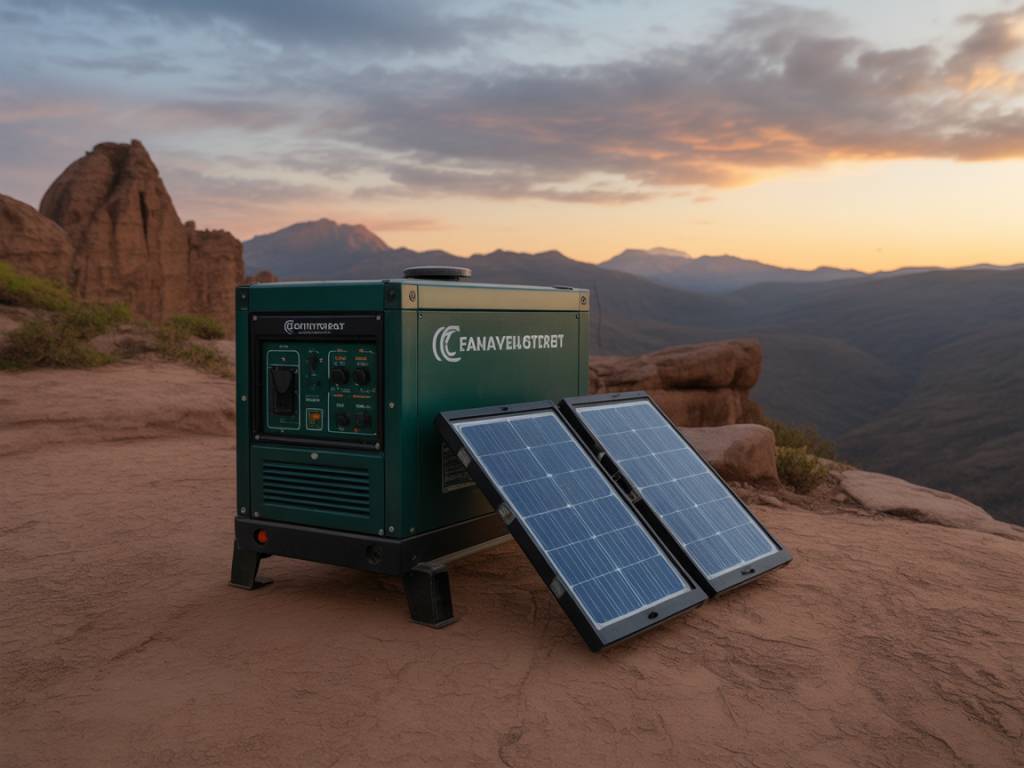
On a still August evening in the Welsh countryside, I watched a cabin light up without a single cough of an engine. No diesel fumes, no generator roar to drown out the crickets. Just the soft click of a relay and a faint hum as solar-charged batteries woke up to feed the lights, a laptop, and a small fridge. It felt almost like cheating the night.
That quiet transformation is exactly what a solar-powered generator offers: electricity without combustion, autonomy without constant refuelling. But how does it actually work, and when is it truly a match—or even an upgrade—for a diesel generator?
What a “solar generator” really is (and what it isn’t)
The name is a little misleading. A solar generator doesn’t really “generate” power the way a diesel engine does. It’s more like a smart, portable power station that happens to be fed by the sun.
Most modern solar generators are made up of four main components:
- Solar panels – They capture sunlight and turn it into DC electricity.
- Charge controller – It regulates the flow of energy from the panels to the batteries, preventing overcharging.
- Battery bank – Usually lithium-ion or LiFePO₄, it stores energy for later use.
- Inverter – It converts the low-voltage DC power from the batteries into 230V AC (in the UK and much of Europe), the kind your home appliances use.
All of this is wrapped in a single box, often with handles, wheels, and a neat digital display showing how much power you’re using and how much you have left. Plug your panels in on one side, your devices on the other, and you have a silent, solar-fed alternative to a small diesel generator.
How solar powered generators work, step by step
The magic lies not in any single piece of hardware, but in the dance between them. Here’s the flow, in plain language.
1. Sunlight hits the solar panels
Each solar panel is made of photovoltaic (PV) cells. When sunlight hits these cells, it knocks electrons loose in the material (typically silicon), creating an electrical current. It’s DC power—direct current—like from a battery.
2. The charge controller takes over
Left unchecked, those panels would happily try to cram as much energy as possible into your batteries, which is not as kind as it sounds. The charge controller acts as a gatekeeper, adjusting voltage and current to match what the batteries can safely accept. More sophisticated controllers (MPPT type) also optimise how much power you harvest under changing light conditions.
3. The batteries store the energy
This is your real “fuel tank”. Modern solar generators typically use lithium-based batteries because they’re lighter, more efficient, and cope better with daily charge-discharge cycles than traditional lead-acid batteries. The capacity is usually measured in watt-hours (Wh) or kilowatt-hours (kWh) – a direct indicator of how long you can keep things running.
4. The inverter creates usable mains power
Most household devices and tools expect alternating current (AC) at around 230V. The inverter takes the low-voltage DC from the battery and converts it into AC, delivering power through standard sockets. Good inverters also produce a “pure sine wave” output, which is gentler on sensitive electronics like laptops or fridges.
5. The monitoring system makes it useable
Finally, there’s the part you actually see: a screen showing input (from solar), output (to your appliances), and remaining battery charge. Some systems add Wi-Fi or app control, letting you check on your energy from a hammock a few metres away—or half a world away if it’s part of a permanent off-grid home.
What solar generators are actually good at powering
A solar generator’s capabilities depend on two key numbers:
- Battery capacity (Wh or kWh) – how long it can run things.
- Inverter power (W) – how much it can power at once.
So, what does that look like in real life?
- Perfectly suited for: LED lights, phones, laptops, routers, cameras, small fans, low-wattage kitchen gear (blenders, induction hobs used thoughtfully), small fridges, routers and modems, tools like drills or jigsaws in short bursts.
- Possible but demanding: Electric kettles, toasters, microwaves, hairdryers, washing machines—these work, but they’re hungry. You need a large system and some discipline.
- Generally unrealistic (for portable units): Whole-house heating, electric showers, large air conditioning units, big pumps or compressors. For those, you’re in the territory of whole-home solar systems or still in diesel country.
Think of a solar generator not as a replacement for the entire grid, but as a silent, clean, and highly efficient power bubble. The smaller your bubble (a van, an off-grid cabin, a tiny house), the more it makes sense.
Solar vs diesel: how they really compare
If you’ve ever stood downwind of a running diesel generator on a still morning, you already know one of the main arguments for solar: air and noise.
But let’s go deeper.
Running costs
- Diesel: You pay every hour you run it—fuel, oil changes, filters, occasional repairs. In remote locations, getting fuel there might be more costly than the fuel itself.
- Solar: Most of the cost is upfront. Once you’ve bought your generator and panels, the sun doesn’t invoice you at the end of the month. Panels typically come with 20–25 year warranties.
Noise and comfort
- Diesel: Even the quiet ones still rumble. They vibrate. They smell. They dominate a soundscape that might otherwise be birdsong and wind through grass.
- Solar: No moving parts, no combustion. At most, a faint fan whir from the unit under heavy load. You forget it’s there until the battery gauge reminds you.
Reliability and maintenance
- Diesel: Mechanical engines like to be maintained—and used. Leave a diesel generator idle in a damp shed and it may sulk when you really need it.
- Solar: Panels are inert glass and silicon. The batteries and electronics do age, but with far fewer points of failure and no oil or filters to change.
Environmental impact
- Diesel: Direct CO₂ and particulate emissions, noise pollution, risk of spills, and a line of extraction and transport behind every litre.
- Solar: No emissions in use, but it does involve mining and manufacturing at the start, and recycling at the end of life. Over its lifetime, however, the carbon footprint per kWh is vastly lower than diesel.
Power profile
- Diesel: Good for high, steady loads, and situations where you need guaranteed power regardless of weather. As long as you have fuel, you have electricity.
- Solar: Best for variable or modest loads, especially where silence and low running cost matter. It’s weather-dependent, but that can be balanced with enough battery capacity and, if needed, a backup source.
The bottom line? Where diesel shouts strength and brute-force reliability, solar whispers enduring patience: “I’ll give you power every day, as long as you let me sip the light.”
When a solar powered generator is a genuinely good alternative
There are certain scenarios where choosing solar over diesel isn’t just about being greener—it’s also more comfortable, more affordable over time, and sometimes simply more practical.
Off-grid cabins and tiny houses
Imagine a woodland cabin where your evenings are shaped by the rhythm of lamps and kettles, not the anxiety of, “Can I bear to turn on the generator again?” For small homes with efficient appliances, a well-sized solar generator and panel array can comfortably power daily life—lights, laptop, Wi-Fi, a small fridge, occasional power tools, maybe even an induction hob if you’re thoughtful about timing.
You gain:
- Quiet, always-on “background” power without needing to start anything.
- No fuel deliveries down muddy tracks.
- A system that simply gets on with its job while you get on with yours.
Vanlife and camper conversions
This is where portable solar generators shine. Instead of wiring a full 12V electrical system from scratch, many van dwellers simply bolt solar panels to the roof and plug them into a solar generator box inside.
It’s compelling because:
- Installation is beginner-friendly—no complex electrical design.
- You can run a fridge, lights, laptops, fans, and occasional cooking appliances in silence.
- The entire system is portable. Sell the van, take the power system with you.
A diesel generator in a van, by contrast, is noisy, smelly, and often banned on many quiet campsites.
Back-up power for grid-tied homes
More homeowners are picking solar generators as an alternative to diesel or petrol “emergency” generators. In a power cut, you can keep essentials running: internet, phones, a router, some lights, medical devices, maybe even the boiler controls and a fridge.
Why it works well here:
- No fumes, so the unit can stay indoors (as long as it’s a proper, certified solar generator).
- No fuel storage issues in a garage or shed.
- Solar panels can keep topping the battery up during prolonged outages.
Events, pop-up shops, and outdoor work
Think of market stalls, food trucks, outdoor exhibitions, or even mobile studios. A solar generator offers “clean” power where a roaring diesel would be intrusive or simply not allowed.
This is especially attractive when:
- You’re using mainly low-to-moderate power devices: card readers, lights, laptops, small tools.
- You care about your environmental image—showing up with solar fits the story better than a smoking exhaust.
- Noise restrictions make diesel awkward or impossible.
Remote research, fieldwork, and humanitarian use
In fragile environments—coastal dunes, forests, conservation areas—bringing in diesel feels increasingly out of step with the mission. Solar generators allow researchers, medics, or aid workers to operate laptops, communications gear, lab equipment and refrigeration with minimal disturbance to the landscape they’re there to protect.
When diesel still makes more sense
The sun is generous, but it has limits, and honesty matters. There are scenarios where diesel is still the more practical option.
- High continuous power demand: If you’re running large pumps, welders, heavy machinery, large air conditioning or entire buildings with high baseload, a portable solar generator will not keep up unless you build an entire, substantial solar-plus-battery system.
- Long, sunless stretches: High latitudes in winter, heavily forested areas with limited panel exposure, or operations that must run around the clock regardless of weather still lean toward diesel, or at least a hybrid setup.
- Short-term, high-power construction sites: If you’re on-site for a few weeks and need big tools all day, a temporary diesel generator may be simpler than setting up a substantial solar-battery array.
In many of these cases, an interesting compromise emerges: use solar as your “base load” provider, and keep a smaller diesel or petrol generator as a backup for peak loads or emergencies. That way, the loud machine is the exception, not the rule.
Designing a solar generator setup that actually works for you
It’s easy to fall in love with sleek marketing photos of solar generators beside tents and lakes. But the difference between a romantic prop and a genuinely liberating system lies in the sizing.
Start with two simple questions:
- What do I need to power? List your devices, their wattage, and how many hours per day you use them.
- How independent do I need to be? Is this for occasional weekend escapes, daily off-grid living, or emergency backup?
From there, you can estimate daily energy use (in Wh or kWh), and match it with:
- Battery capacity: Aim for at least one full day of usage, more if you expect cloudy weather.
- Solar panel size: Enough to comfortably recharge your daily use under your typical sun conditions. As a rough guide, 400–800W of panels is common for serious off-grid van or tiny home use.
- Inverter output: It must exceed the peak load you ever intend to draw at once (kettle + fridge + laptop, for instance).
It’s not about perfection—few systems run at laboratory efficiency—but about temperament. Do you like the ritual of watching the weather, adjusting usage, and learning the moods of your system? Many people find that this gentle discipline deepens their relationship with energy itself. Instead of a hidden, infinite tap in the wall, electricity becomes something visible, precious, and worthy of respect.
Living differently with solar-powered energy
In the end, a solar-powered generator is more than a gadget. It’s a quiet tutor in sufficiency.
You learn that running a kettle on a bright morning feels different than on a foggy afternoon, that charging a laptop at midday sun is somehow more satisfying than letting it sip from the mains at midnight. You become more aware of devices left on standby, of the way a fridge cycles, of how much light a single efficient bulb can cast.
And somewhere in that awareness, your idea of comfort shifts. You stop asking, “How do I replace diesel entirely?” and start asking, “How much can I do without burning anything at all?”
For off-grid cabins, campervans, tiny homes and thoughtful households, solar-powered generators now offer something diesel never could: dependable power wrapped in silence, with the sky itself as your fuel station. When chosen and sized with care, they turn energy from a noisy, smoky intrusion into a quiet partnership with the daylight hours themselves.