
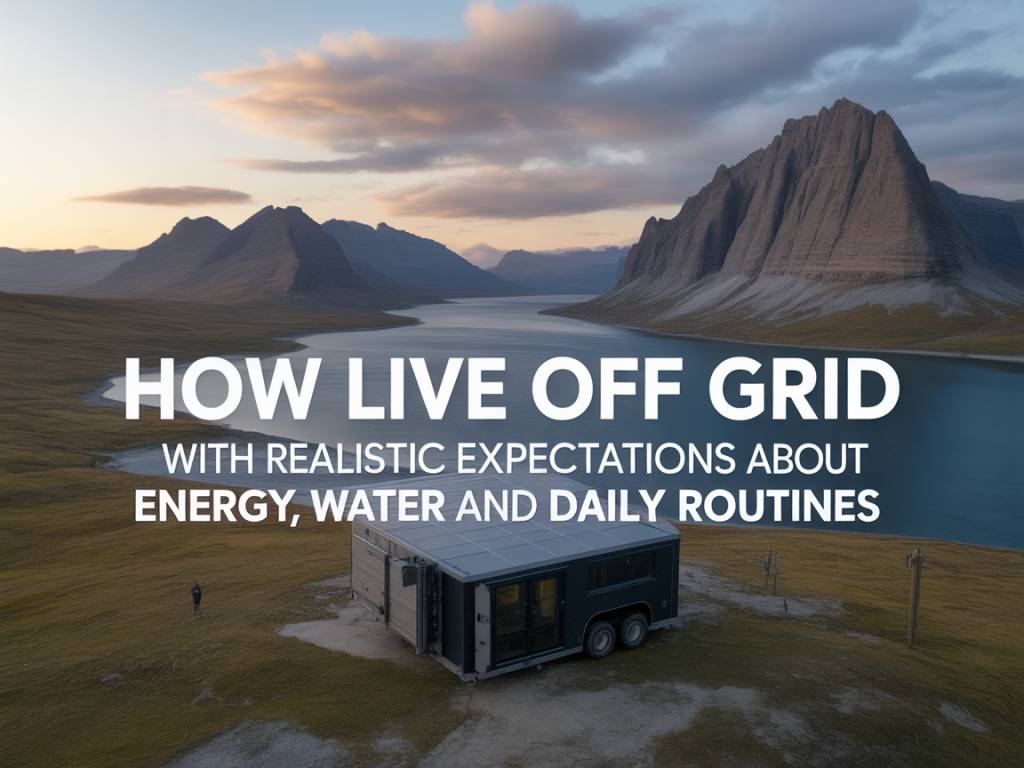
Stepping Off the Grid: What It Really Feels Like
There is a particular silence that exists only off grid. It’s not the absence of sound, but the absence of hum: no fridge motor cycling every few minutes, no distant traffic, no chorus of appliances on standby. Just the wind pressing gently against the cabin walls and the soft tick of cooling metal as the solar inverter winds down for the night.
For many, this silence is the dream. Yet what happens after the dream? After the Instagram sunsets and wide-angle shots of solar panels on the roof, there is a daily choreography made of kilowatts, litres, and habits that quietly reshape your life.
This is an invitation to step behind the postcard and into the routine: to explore what it means to live off grid with realistic expectations about energy, water, and the small rituals that will anchor your days.
Rethinking Comfort: Off Grid Is Not “On Grid, But Cheaper”
Before we talk numbers and systems, it helps to reset expectations. Off-grid living is not simply a countryside version of your current life, magically powered by the sun. It is a different rhythm altogether.
On the grid, energy is invisible and seemingly infinite. You can plug in a tumble dryer, kettle, dishwasher and electric heater, all at once, and the worst that happens is a slightly higher bill at the end of the month.
Off grid, every electrical decision is a small negotiation with your system:
- Can my batteries handle this load now?
- Is there enough sun in the forecast to justify running the washing machine today?
- Do I really need that appliance, or can I do it by hand?
Comfort doesn’t disappear. It simply changes shape. A hot shower might feel even more luxurious when you know exactly how much rainwater and solar energy went into heating it.
Energy: From Unlimited Illusion to Daily Budget
The most striking shift off grid is this: energy is no longer a background condition, but a daily budget you learn to respect. Think of it less as a fixed infrastructure and more like a seasonal, living relationship.
Understanding Your Solar Reality
Let’s begin with solar, because for most off-grid homes in Europe and the UK, it’s the backbone of the system.
Imagine a modest off-grid cabin with:
- 2–4 kW of solar panels on the roof
- A battery bank of 5–15 kWh
- A backup generator for winter or long grey spells
On a bright day in late spring, the panels hum with generosity. You can charge laptops, run a washing machine, perhaps even use a small power tool without worry. By mid-afternoon, the batteries are full, and the surplus energy begs you to use it: bake bread, run the vacuum, heat water.
But in November, under a sky the colour of pewter, the story changes. The panels produce a fraction of their summer output. A kettle here, a long shower there, and the batteries sag quicker than you’d like. You find yourself making different choices:
- Using the generator for heavy loads
- Boiling water on a gas hob instead of an electric kettle
- Letting the washing wait for a brighter day
It’s not deprivation; it’s choreography. You move your activities into alignment with light.
Appliances: What Stays, What Goes, What Changes
Living off grid doesn’t mean becoming a 19th-century homesteader (unless you want to). It does, however, invite a sharp look at every appliance you own and how much energy it uses.
Most off-grid homes end up with a simple rule: anything that heats using electricity is suspicious. Kettles, electric radiators, tumble dryers, hairdryers, electric ovens — these are the big beasts in the energy jungle.
They’re not forbidden, but they demand respect. If you want to keep them, you’ll need:
- More solar panels and a larger battery bank
- A bigger inverter to handle the peak load
- Or the discipline to use them only at certain times
Meanwhile, you’ll learn to love low-energy alternatives:
- A+ or A++ appliances (especially fridges and freezers)
- LED lighting everywhere
- Induction hobs used thoughtfully, or gas hobs powered by bottle or biogas
- Mechanical tools and manual kitchen gadgets where it makes sense
I remember standing in a small, off-grid kitchen one winter morning, watching the owner grind coffee by hand. When I asked whether they missed their electric grinder, they smiled and said, “Here, the ritual is part of the energy system.” The few extra turns of the wrist were a quiet reminder that power is precious.
Water: Every Drop Has a Story
On-grid water is anonymous. It arrives from a tap and disappears down a drain, its origins and destination hidden from view. Off grid, water has a narrative you can trace point by point: rain on the roof, filters in the shed, tank in the field, pipe to the kitchen sink.
Sources: Rain, Boreholes and Springs
Your water may come from one or a combination of:
- Rainwater harvesting systems that feed storage tanks
- A borehole or well with a pump
- A nearby spring or stream (with careful treatment)
Each has its own quirks. Rainwater is abundant in wetter regions, but requires well-designed gutters, filters and tanks. A borehole offers independence but relies on a pump — which means electricity. Springs may run merrily in winter and sulk in mid-summer.
The underlying lesson: water becomes seasonal. Long showers in August might be less about “self-care” and more about “is the tank still half full?”
Using Water Differently
Once your water has a visible origin, your habits begin to shift almost automatically. You may find yourself:
- Turning off the tap while soaping dishes or brushing teeth
- Reusing greywater (from sinks and showers) for garden irrigation, with eco-friendly soaps
- Watching the weather forecast as closely for rain as for sunshine
Simple design choices help enormously:
- Install low-flow shower heads and taps
- Place water storage where you can see levels or easily check them
- Separate blackwater (toilets) and greywater (sinks, shower, laundry) for easier re-use
A composting toilet is often the biggest mental hurdle, but also one of the most liberating changes. No septic tank to pump, no vast quantities of clean water used to flush waste away. Just a carefully managed cycle that, in time, can return nutrients to the land. Less glamorous than a designer bathroom, perhaps, but infinitely more elegant from an ecological point of view.
Daily Routines: Life Runs on Weather, Not on Clocks
If energy and water set the boundaries, your daily routines are the art you create within them. Off-grid life subtly reorders time. Days are no longer carved into rigid, industrial hours; they lean instead toward the sun and the seasons.
Designing Your Day Around Power
Imagine a typical day in an off-grid home:
- Morning: You wake with the light, not an alarm. A quick check of the battery monitor tells you how generous you can be today. Overnight usage has drawn the batteries down a little; now you wait for the solar panels to catch the first rays.
- Late morning: As the sun strengthens, chargers come out. Laptops, phones, power tools — all the light loads that fit easily within your growing solar surplus.
- Midday to mid-afternoon: This is when the energy party happens. Washing machine on, perhaps a bit of baking in an efficient electric oven, vacuuming the house. You concentrate heavy usage in this window when the panels can do most of the work directly.
- Evening: Lights dim, screens go off earlier. You might read, talk, or sit outside and listen. You become quietly aware that every unnecessary watt after sunset is borrowed from tomorrow’s sunrise.
It may sound restrictive, but many people find it oddly liberating. Instead of a constant, invisible draw of power, there is intention: a sense that each action has a place in the day.
Chores Become Systems, Not Inconveniences
Living off grid is often described as “more work”, which is true — but the nature of that work matters. Many chores that once felt like annoyances start to feel like vital components of a larger, meaningful system.
- Cleaning the solar panels becomes a small ritual of gratitude toward the sun.
- Checking the water filter is not drudgery, but an act of stewardship over the invisible river flowing into your kitchen.
- Bringing in wood for the stove turns into an embodied reminder that warmth has weight and texture.
These are not tasks to be “automated away” at all costs. They are touchpoints that keep you in conversation with your home and its environment.
Emotional Expectations: From Romanticism to Resilience
Every off-grid story begins with an emotion: hunger for freedom, a wish to tread lightly, a longing for silence. These are beautiful starting points, but they must be married to an equally strong tolerance for inconvenience, adaptation, and learning curves.
The first winter will test you. Batteries that behaved perfectly in July will suddenly feel insufficient. Damp may creep into clothes, into walls, into moods. There will be days when you wonder whether the grid, with all its compromises, wasn’t such a bad idea after all.
But then there are the other days. The evening when the generator fails, and you manage, candle-lit, with just enough power to keep the fridge running. The storm that knocks out power to nearby villages while your lights stay calmly on. The quiet recognition that you are not immune to the world’s turbulence, but you are a little less dependent on its fragile networks.
Living off grid nudges you from romanticism toward resilience. The idyll becomes something sturdier, less decorative and more deeply satisfying.
Planning Your Own Off-Grid Path (Without Self-Sabotage)
If you feel the pull toward this way of living, how can you begin without being swallowed by unrealistic expectations?
A few grounding principles can make the difference between a poetic vision and a sustainable reality.
- Start with your habits, not the hardware. For a week, track how and when you use electricity and water. Which appliances do you lean on most? Which could you let go of? This will inform your system more than any glossy brochure.
- Design for the worst month, not the best. Size your system with November (or your local greyest month) in mind, not June. It’s easier to enjoy a surplus in summer than to endure a chronic deficit in winter.
- Accept backup systems. A generator, a bottled gas hob, a wood stove: these are not failures of purity. They are safety nets that give you breathing room to learn and adapt.
- Leave room to grow. Your first system does not need to be perfect. Design it so you can add panels or battery capacity later, as your budget and experience grow.
- Invest in monitoring. A simple, clear energy monitor and water level gauges are worth their weight in gold. You cannot manage what you cannot see.
Perhaps most importantly, be honest about what you truly enjoy. If ironing clothes brings you joy, maybe the off-grid life you design keeps an efficient iron and dedicates a sunny afternoon to it. If, on the other hand, you’re happiest in muddy boots and a wool jumper, you may discover just how few modern conveniences you actually need.
Reweaving the Fabric of Home
In the end, off-grid living is less about cutting a cable and more about reweaving the fabric of home. It asks questions that grid-connected life rarely bothers to pose:
- How much is “enough” when it comes to power and water?
- Which forms of comfort deepen my life, and which merely numb me?
- What rhythms emerge when I let the natural world set the tempo?
You may find your answers in a stone cottage at the end of a track in Wales, in a small cabin tucked into Scottish woodland, or simply in a suburban house that gradually adds rainwater harvesting and solar panels until the boundary between “on grid” and “off grid” begins to blur.
Realistic expectations don’t dampen the magic; they make space for a quieter, more enduring enchantment. When you know that the light above your kitchen table is powered by today’s sun, stored in batteries you carefully sized, guarded by panels you brushed clean after last week’s storm, something in the ordinary act of switching it on becomes extraordinary.
Living off grid won’t make life perfect. It won’t free you from hard days, muddy boots, or the occasional cold nose on a winter morning. But it might bring you closer to the sources that sustain you — the sun, the rain, the land under your floorboards — and to a daily routine where energy, water and time are no longer invisible utilities, but companions on the journey.