
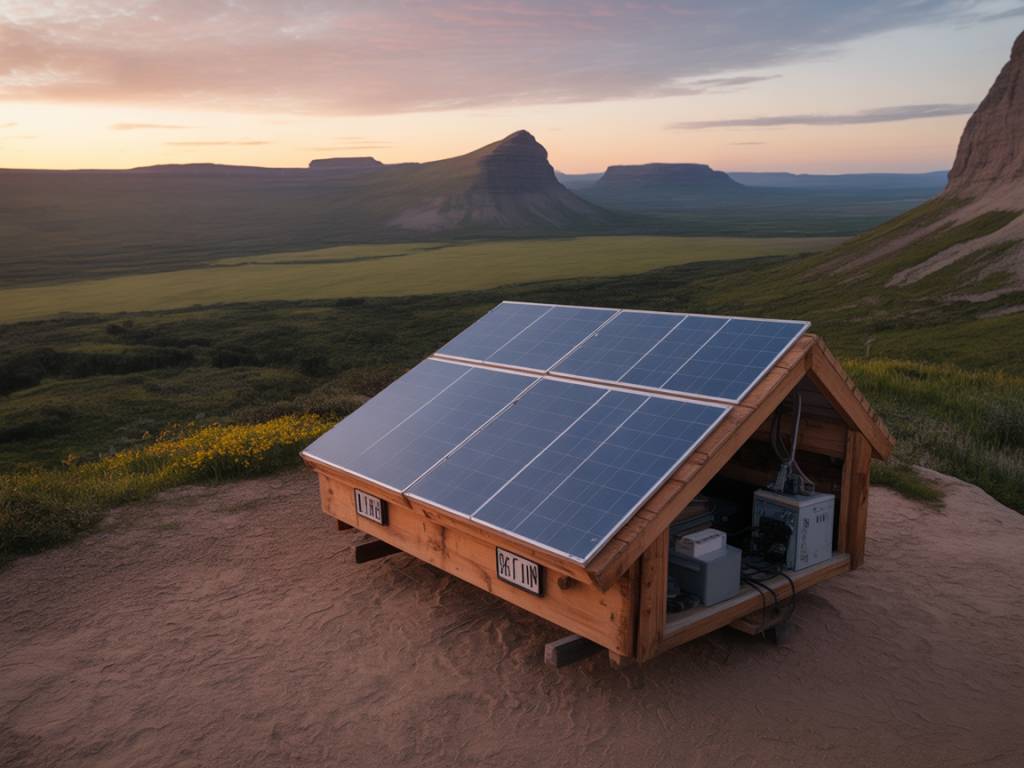
Somewhere at the end of a gravel road, far from the reassuring hum of the grid, a single lightbulb hangs in a wooden cabin. You flick the switch and, for a brief second, you wonder: Will the batteries manage tonight? That small doubt is often born from a bigger question that appears deceptively simple:
How do you go from 1 ampere to watts… and from there to a correctly sized off‑grid system?
Behind that question lies the difference between a peaceful, self-sufficient evening and the quiet panic of a fridge shutting down in the middle of summer. Let’s unpack it slowly, clearly, like laying tools neatly on a workbench.
Amps, volts, watts: the three characters in your off‑grid story
Before we convert anything, it helps to understand what we’re actually measuring. Picture a narrow path in the hills after the rain.
Amperes (A) are like the flow of water in a stream – how much charge is moving through the wire each second.
Volts (V) are the pressure pushing that flow – the “push” that makes electrons move. A higher voltage is like a steeper slope.
Watts (W) are the useful work being done by that flow under that pressure – in other words, power. How much energy per second your system is actually delivering.
Mathematically, the relationship is beautifully simple:
Power (W) = Volts (V) × Amps (A)
So whenever you see amps on a label and you know the voltage, you can get watts with a single multiplication.
How to convert 1 ampere to watts (with real, off‑grid examples)
Because of that formula, 1 ampere doesn’t mean much on its own. It only becomes meaningful when you pair it with a voltage.
Let’s look at a few common off‑grid system voltages:
- At 12 V DC: 1 A × 12 V = 12 W
- At 24 V DC: 1 A × 24 V = 24 W
- At 48 V DC: 1 A × 48 V = 48 W
- At 230 V AC (typical UK mains): 1 A × 230 V ≈ 230 W
So when you say “this device draws 1 amp”, it could mean anything from a modest 12 W on a 12 V battery system to a rather hungry 230 W on a household socket.
Imagine you’re running a small 12 V LED strip in your cabin that draws 1 A. That’s 12 W – hardly anything. Now picture a 1 A kettle at 230 V (if such a thing existed). At around 230 W, it would be the world’s most patient kettle.
Same current, completely different reality.
The twist with AC: power factor in one breath
For most off‑grid setups, your solar and batteries are DC, and your household appliances are AC, supplied through an inverter. The simple formula still applies, but AC has a small complication called power factor (PF).
In short:
For AC: Watts (W) = Volts (V) × Amps (A) × Power Factor (PF)
For many resistive appliances (heaters, kettles, toasters), PF ≈ 1, so V × A gives you a good approximation of watts. For motors, fridges, some electronics, PF might drop to 0.8 or lower.
If your label says: 230 V, 2 A, 300 W, but 230 × 2 = 460, you’re seeing power factor at work. The device only uses about 300 W of “real” power.
To keep things practical in off‑grid planning:
- Use the watts printed on the device whenever possible.
- If you only have volts and amps, assume PF ≈ 0.8 for motors and fridges, and PF ≈ 1 for simple resistive loads.
Watts vs watt‑hours: why time matters
Converting amps to watts tells you the instant power. But an off‑grid system doesn’t just need to know how hard it works; it needs to know for how long.
That’s when watt‑hours (Wh) enter the scene:
Energy (Wh) = Power (W) × Time (hours)
For example:
- 1 A at 12 V = 12 W
- If it runs for 5 hours: 12 W × 5 h = 60 Wh
You’ll use watt‑hours (and kilowatt‑hours, kWh) to size batteries and solar panels. Amps are just a stop on the way.
Step 1 – List your loads: the quiet inventory
Before talking about system size, forget equations for a moment. Imagine a typical day in your off‑grid space. From the moment you wake up to the last lamp you switch off at night, what do you actually use?
Make a simple table on paper or a spreadsheet. For each device, write:
- Device name (e.g., “12 V fridge”, “LED ceiling light”, “phone charger”)
- Voltage (V)
- Current (A) or Power (W)
- Hours of use per day
If the label shows amps but not watts, you now know what to do:
W = V × A
A small example for a minimalist cabin:
- 12 V LED light, 1 A, used 4 hours/day
- USB phone charger, 5 V, 2 A, used 2 hours/day (through a 12 V to USB converter or inverter)
- 12 V fridge, 3 A, running 8 hours/day on average (compressor cycling)
Step 2 – Convert everything to watts and watt‑hours
Let’s walk that same cabin through the maths.
1) 12 V LED light
- Power: 12 V × 1 A = 12 W
- Daily energy: 12 W × 4 h = 48 Wh/day
2) Phone charger
Phone chargers are often labelled in watts already (e.g., 10 W, 18 W). If not:
- Power: 5 V × 2 A = 10 W
- Daily energy: 10 W × 2 h = 20 Wh/day
You might add 20–30% extra to allow for inverter or converter losses. For simplicity, let’s keep 20 Wh, knowing reality is slightly higher.
3) 12 V fridge
- Power: 12 V × 3 A = 36 W
- If the compressor effectively runs 8 hours/day: 36 W × 8 h = 288 Wh/day
Now sum everything:
- LED light: 48 Wh
- Phone charger: 20 Wh
- Fridge: 288 Wh
- Total daily energy: 356 Wh/day
In this quiet cabin, your life runs on less than half a kilowatt‑hour per day. Knowing this number is the first real step toward a correctly sized system.
Step 3 – Translate energy into battery capacity
Now, how big must your battery bank be to support those 356 Wh a day?
Batteries are usually rated in ampere‑hours (Ah) at a certain voltage. To connect that with your energy needs:
Energy (Wh) = Battery Voltage (V) × Battery Capacity (Ah)
Rearranged:
Battery Capacity (Ah) = Energy (Wh) ÷ Voltage (V)
Let’s assume a simple 12 V battery system.
1) Daily use in Ah
We already have: 356 Wh/day.
- Daily Ah at 12 V = 356 Wh ÷ 12 V ≈ 29.7 Ah/day
So your cabin consumes around 30 Ah per day at 12 V.
2) Autonomy days and depth of discharge
You probably don’t want your system to collapse after one cloudy afternoon. Two important ideas enter the conversation here:
- Days of autonomy: how many days can you go with little or no sun?
- Depth of discharge (DoD): how much of the battery’s theoretical capacity you’re willing to use regularly.
For example, with lithium batteries, a common usable DoD is around 80–90%. For lead‑acid, keeping daily DoD under 50% greatly improves lifespan.
Let’s say you want:
- 2 days of autonomy
- Lead‑acid battery bank (use only 50% of capacity)
Needed usable energy for 2 days:
- 356 Wh/day × 2 = 712 Wh usable
But that 712 Wh should be 50% of your total battery capacity (because you don’t want to go below 50% on a regular basis).
Total required battery energy:
- 712 Wh ÷ 0.5 = 1424 Wh total capacity
Convert that to Ah at 12 V:
- 1424 Wh ÷ 12 V ≈ 119 Ah
So a battery bank around 12 V, 120 Ah (or slightly larger, say 150 Ah to be comfortable) would support your cabin for two cloudy days without abusing the batteries.
Step 4 – Sizing your solar (or other generation) to refill the tank
Batteries are only half the picture. They’re your reservoir, quietly waiting under the bench; your solar panels (or wind turbine, or micro‑hydro) are the rain on the hills that keeps the stream alive.
To size solar, ask:
- How much energy do I use per day? (We know: 356 Wh)
- How many peak sun hours do I realistically get per day where I live?
Peak sun hours (PSH) don’t mean hours of daylight, but the equivalent hours of full 1000 W/m² sun your panels receive. In much of the UK, for instance, you might assume:
- Winter: 1–2 PSH/day
- Summer: 4–5 PSH/day
For a conservative, year‑round system, you size it to survive winter – the season when hot tea and working lights matter most.
Let’s assume 2 PSH/day in winter.
Now choose a target daily energy from the solar array. You want to cover your 356 Wh/day plus a bit more for system losses (inverter, charge controller, wiring). A safe rule of thumb is to add 20–30%.
- 356 Wh × 1.3 ≈ 463 Wh/day from solar
To find the required solar array size in watts:
Array size (W) = Daily energy (Wh) ÷ Peak sun hours (h)
Using our 2 PSH:
- 463 Wh ÷ 2 h ≈ 232 W of solar
So a solar array in the 250–300 W range, well‑oriented and kept reasonably clean, could support this small cabin even through darker months, with a bit of margin.
Where amps sneak back in: wiring and safety
Once you’ve converted everything to watts for sizing, amps reappear in two practical places: wire sizing and fuse/breaker selection.
You know by now:
Amps (A) = Watts (W) ÷ Volts (V)
If your solar array is 300 W on a 12 V system (before the charge controller steps it down/up as needed), the potential current on the DC side can be significant.
- 300 W ÷ 12 V = 25 A
Even if your real‑world current is lower, you size wires and fuses for worst‑case scenarios plus a safety margin.
Higher system voltages (24 V, 48 V) reduce the current for the same power, which allows thinner cables and fewer losses. That’s one reason many larger off‑grid systems abandon 12 V once they grow beyond the “tiny cabin” stage.
For example, the same 300 W at 24 V:
- 300 W ÷ 24 V = 12.5 A
Half the current for the same power. The arithmetic is simple, but the impact on copper cost and efficiency is huge.
A more complete example: from lamp to fully sized system
Let’s imagine a slightly more ambitious off‑grid home – perhaps a converted barn on the edge of a field, with mornings steeped in mist and evenings lit by warm LEDs.
Daily loads might look like this:
- LED lighting: 60 W total, used 5 h/day → 60 × 5 = 300 Wh
- Fridge (A+++, 230 V, 80 W average): 80 W × 10 h/day cycling → 800 Wh
- Laptop: 60 W × 4 h/day → 240 Wh
- Internet router: 10 W × 24 h/day → 240 Wh
- Phone charging & small devices: 30 Wh/day
Daily total ≈ 1610 Wh/day (1.61 kWh).
You might run most of these on AC via an inverter and have your battery bank on 24 V to keep currents reasonable.
Daily Ah at 24 V:
- 1610 Wh ÷ 24 V ≈ 67 Ah/day
If you want 3 days of autonomy on lithium batteries (usable DoD ≈ 80%):
- Usable energy: 1610 Wh/day × 3 = 4830 Wh
- Total battery capacity: 4830 Wh ÷ 0.8 ≈ 6037 Wh
- In Ah at 24 V: 6037 Wh ÷ 24 V ≈ 252 Ah
A 24 V, 250–300 Ah lithium bank (about 6–7.2 kWh) would serve this home comfortably.
Solar array sizing (for winter, 2 PSH/day, 30% losses):
- Target generation: 1610 Wh × 1.3 ≈ 2093 Wh/day
- Array size: 2093 Wh ÷ 2 h ≈ 1046 W
So you might design around a 1.2 kW solar array, a 24 V / 250 Ah battery bank, and an inverter sized comfortably above your maximum simultaneous load (perhaps 2 kW to allow some margin).
All of that flows from the ability to move calmly between amps, volts, watts, and watt‑hours.
Common pitfalls when thinking in amps and watts
Even experienced DIYers sometimes stumble over a few recurring traps. Watching out for them can save both money and frustration.
- Looking only at amps, ignoring voltage. “It’s only 1 A, it must be fine” – until it’s 1 A at 230 V and suddenly 230 W is chewing through your battery bank via the inverter.
- Confusing watts with watt‑hours. A 100 W bulb does not “use 100 watts per hour” – it uses 100 watts continuously. Over 5 hours, that’s 500 Wh.
- Underestimating inverter losses. Cheap or overloaded inverters waste more power than you think. A 90–94% efficient unit is ideal; assume 85–90% in your planning.
- Ignoring starting surges. Fridges, pumps and some tools can draw 2–3× (or more) their running watts for a second or two at startup. Your inverter and battery cables must tolerate that.
Bringing it all together in everyday language
Once you internalise the relationships, your off‑grid system stops feeling like a mysterious box of electrons and starts feeling like a well‑understood ecosystem.
- To go from amps to watts: multiply by volts.
- To go from watts to energy: multiply by hours → watt‑hours.
- To go from watt‑hours to battery size: divide by battery voltage, then adjust for days of autonomy and usable depth of discharge.
- To size solar: divide your required daily watt‑hours (plus a safety margin) by peak sun hours.
The magic of “1 ampere” becomes entirely ordinary once it’s walked through volts, watts and time. Ordinary, but empowering – because from that simple multiplication grows the entire architecture of an off‑grid life done right.
And next time you’re in that cabin, when the wind presses against the windows and the only sound is the soft hum of your fridge and the whisper of LED light on wood, you won’t be wondering if the batteries can handle it. You’ll know exactly why they can.