
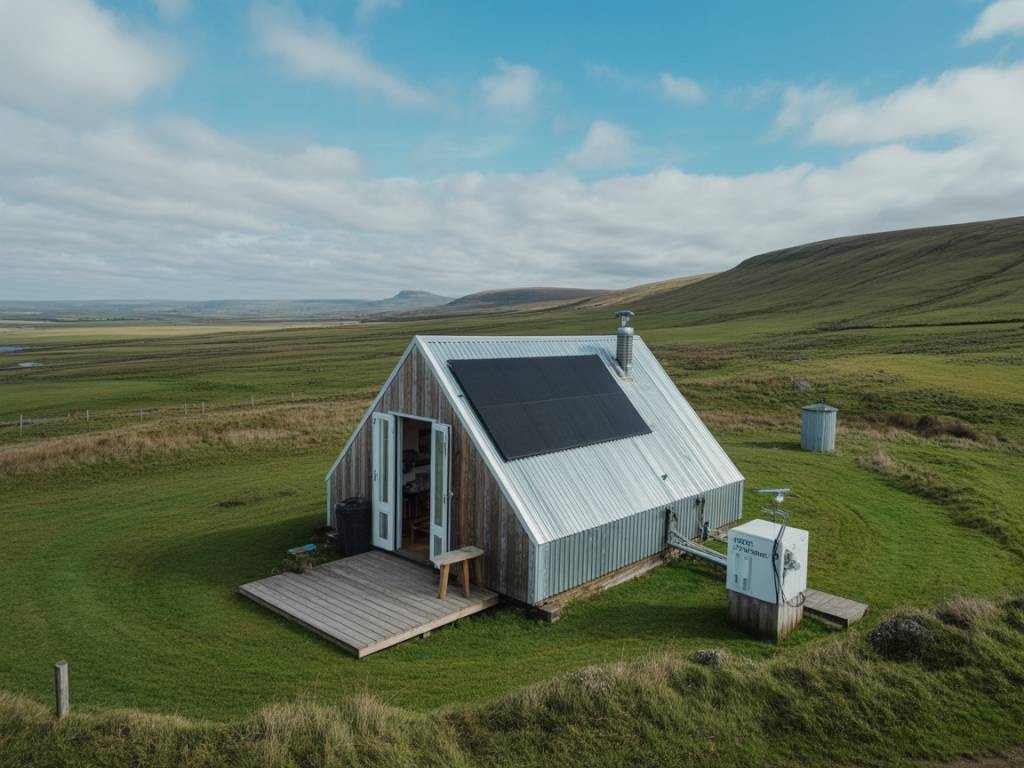
Why “off‑grid” in the UK doesn’t have to mean “off‑life”
Somewhere between the fantasy of a cabin in the Highlands and the reality of a wet Tuesday in February lies the true shape of off‑grid living in the UK. It is less about running away, more about redesigning your relationship with energy, water, and waste in a country of hedgerows, planning rules, and endlessly changeable skies.
In the UK, going off‑grid is absolutely possible, but it has to be done with the landscape and the law, not against them. The aim of this guide is simple: show you how to live off‑grid within current regulations, climate, and infrastructure, without sacrificing comfort, safety, or sanity.
What “off‑grid” really means in the UK
Off‑grid does not have a single legal definition in the UK. It is more a spectrum than a switch. In practice, people use it to describe one or more of the following:
- Living without a mains electricity connection
- Living without mains water or mains sewerage
- Minimal reliance on fossil fuels, supermarkets, and conventional infrastructure
- Being physically remote from towns, or simply energetically independent in a village or suburb
You can be legally and fully “off‑grid” in the middle of a small town if you have your own power, water, and waste systems and never flip on a mains switch. Conversely, you can be in a remote croft in the Highlands and still rely entirely on the national grid.
For regulators, what matters is not whether you call yourself off‑grid, but whether your home:
- Has planning permission (or falls within permitted development rights)
- Meets Building Regulations if it is a permanent dwelling
- Deals with water and waste safely and legally
- Is paying the correct council tax or business rates
Choosing a location that works with UK rules (not against them)
The romance of “somewhere remote” in the UK runs straight into a practical wall: almost every acre is spoken for by planning rules, designations, and sometimes centuries of habit. Before you fall in love with a field on Rightmove, you need to know what you are actually allowed to build and do.
Key questions to ask about any potential site:
- What is the current planning status? Is it agricultural land, woodland, brownfield, or already residential?
- Is it in a protected area? National Park, AONB, Green Belt, SSSI or conservation area all tighten what you can build.
- Does it already have a dwelling or a lawful use? Converting an existing building (barn, outbuilding, cottage) is often easier than starting from scratch.
- Access and rights of way: You may need permission or an easement to use farm tracks or private roads.
The UK planning system is local. Always read your specific council’s Local Plan and supplementary guidance. Many councils now include sections on:
- Low‑impact development
- Eco‑homes and sustainable design
- Rural workers’ dwellings and agricultural occupancy
You will sometimes see people quietly living in woodland cabins, narrowboats on towpaths, or static caravans in fields. Some are beautifully legal, others are ticking clocks. Long‑term peace of mind comes from building something that planning officers, neighbours, and your insurance company can live with.
Planning permission, tiny homes, cabins and “temporary” living
Off‑grid living often starts small: a cabin, a yurt, a tiny house on wheels. UK regulations, however, care less about the romance of it and more about its use and permanence.
For most off‑grid scenarios, you will meet at least one of these categories:
- Permanent dwelling: Requires full planning permission and, usually, Building Regulations compliance.
- Caravan or tiny house on wheels: Legally a “caravan” if it meets size and mobility tests. Use is controlled by planning, even if the structure is technically movable.
- Annexe or outbuilding: Sometimes allowed under permitted development if within the curtilage of an existing home and used in an “incidental” way.
Some relevant frameworks to research:
- Caravan Sites and Control of Development Act 1960: Defines caravans and regulates sites.
- Town and Country Planning Act 1990: The base legislation for most planning decisions.
- Permitted development rights: Limited rights to erect certain structures without full planning (heavily constrained in protected areas).
A recurring tactic is the idea of a “temporary” structure to avoid planning issues. In reality, if you are living in it as your main residence, most councils will treat it as a residential use needing permission, regardless of wheels or tent pegs.
This does not mean off‑grid is impossible; it means you will likely need:
- A coherent design and access statement explaining your low‑impact approach
- Evidence that your systems (water, waste, energy) are safe and self‑sufficient
- To show how you minimise visual and environmental impact
Building Regulations and staying safe off‑grid
If your home is classed as a permanent dwelling, Building Regulations will almost certainly apply, even if you never touch the national grid. These regulations are not the enemy; they are the framework that keeps your off‑grid dream from becoming a damp, fire‑prone nightmare.
Relevant parts include:
- Part A: Structure – your cabin or house must be stable and safe.
- Part B: Fire safety – escape routes, alarms, and safe installation of stoves and flues.
- Part F: Ventilation – crucial in a damp climate with woodburners and tight insulation.
- Part G: Sanitation, hot water, water efficiency.
- Part L: Conservation of fuel and power – insulation, airtightness, efficient heating.
- Part P: Electrical safety – applies even to stand‑alone solar systems.
An off‑grid home can absolutely be signed off if it meets these standards with alternative systems. Building control officers are often more open to unusual solutions than many people expect, provided you present:
- Clear designs and specifications
- Competent installation (e.g. MCS or NICEIC registered installers where relevant)
- Manufacturer documentation and calculations (for stoves, tanks, structural elements)
Designing energy systems for a cold, grey island
Off‑grid in Spain and off‑grid in Scotland are two different planets. The UK offers short winter days, frequent cloud cover, and long periods of damp cold rather than crisp dry cold. Your energy design has to be honest about this.
Think of your system as a triangle:
- Reduce demand – insulation, airtightness, efficient appliances.
- Generate power – solar, wind, hydro, or a combination.
- Store and back up – batteries and possibly a generator.
Insulation first
A well‑insulated, compact building is the most powerful “technology” you will ever buy. In the UK climate:
- Aim for very low U‑values in walls, roof, and floors.
- Use high‑performance windows and doors with good seals.
- Consider natural insulation like wood fibre, sheep’s wool, hemp, or cellulose for breathability.
Many UK off‑griders find that once the building envelope is done properly, heating needs fall so low that a modest woodburner and occasional electric top‑up suffice, even in January.
Solar in a UK winter
Solar PV works in the UK, but winter output can be as little as 10–20% of summer. Planning for real conditions means:
- Oversizing your array relative to average use, especially in northern latitudes.
- Looking at roof and ground‑mount options for better orientation and tilt.
- Accepting that winter will demand rationing, backup, or both.
If you choose to remain physically connected to the grid but “net‑zero” in your usage, you will need to deal with your Distribution Network Operator (DNO) and possibly certify your system (often with MCS) for Smart Export Guarantee (SEG) payments.
Wind and water: the UK’s secret weapons
Where the UK lacks in winter sun, it compensates with wind and rain.
- Small‑scale wind: Viable on exposed sites, especially coastal or upland. Check planning rules; even small turbines may need permission.
- Micro‑hydro: Gold dust if you have a reliable stream and sufficient head. You may need abstraction licences and environmental permissions from the relevant agency (EA, SEPA, NRW or NIEA).
Hybrid systems (solar plus wind, or solar plus hydro) often provide the most resilient UK off‑grid setups, smoothing out seasonal and daily fluctuations.
Backup power
For most UK off‑griders, a generator is the insurance policy they hope never to use and are very glad of during a week of sleet and flat batteries. To keep it sustainable:
- Choose a high‑efficiency model sized correctly for your loads.
- Run it in short, well‑planned bursts to top up batteries rather than powering everything directly.
- Consider HVO (hydrotreated vegetable oil) or bio‑diesel where locally available and compatible.
Heating: staying warm without roasting the planet
In the UK, energy is mostly about heat. An off‑grid home can quickly become a wood‑hungry beast or a model of elegant frugality, depending on design and habits.
Common solutions:
- Woodburning stoves: Simple, robust, and cosy. Look for clean‑burn (Ecodesign‑ready) models and install to HETAS standards. In Smoke Control Areas, ensure your stove and fuel are approved.
- Thermal mass: Designing floors or internal walls to store heat from stoves or sun for slow release.
- Heat pumps: Can be used off‑grid with a strong solar and battery system, but demand careful load calculation.
- Passive solar: South‑facing glazing, overhangs, and good shading to capture winter sun without overheating in summer.
Whatever you choose, the UK’s damp climate makes ventilation non‑negotiable. Mechanical ventilation with heat recovery (MVHR) can pair beautifully with a tight, well‑insulated off‑grid home, keeping indoor air fresh without haemorrhaging heat.
Water: from sky, spring, or standpipe
Living off‑grid in the UK does not mean living dry. If anything, the challenge is quality and storage, not quantity.
Potential water sources
- Rainwater harvesting: Particularly suited to the UK. Roof collection into above‑ or below‑ground tanks, with filtration for household use.
- Private wells and boreholes: More common in rural areas. You may need tests and, for higher volumes, abstraction licensing.
- Springs and streams: Romantic but vulnerable to contamination. Always treat and test.
- Shared or communal supplies: Some off‑grid sites develop cooperative systems for distribution and maintenance.
Regulations and safety
- The Drinking Water Inspectorate sets quality benchmarks; you are responsible for private supplies.
- Filtration and disinfection (e.g. UV units) are often needed for drinking water.
- Large abstractions may require permission from the Environment Agency or equivalent in devolved nations.
Rainwater can comfortably supply toilets, washing machines, and gardening with basic filtration. Many UK off‑griders split systems: pristine treated water for kitchen taps and showers; lightly filtered rainwater for everything else.
Dealing with waste: septic, compost, and the quiet rules beneath your feet
If energy is the most discussed part of off‑grid life, waste is the least glamorous. It is also where regulators take a very close interest.
Blackwater (toilets)
- Septic tanks and small treatment plants: In England, the General Binding Rules govern discharges. Poorly sited or old systems may need upgrading.
- Composting toilets: Often ideal for off‑grid, but require disciplined management and safe, long‑term composting. Some councils are supportive; others more cautious.
- Cesspits: Storage‑only tanks requiring periodic pump‑out. Simple but high‑maintenance and costly over time.
Greywater (sinks, showers, washing machines)
- Can often be reused for irrigation through reed beds or soil infiltration systems, if designed correctly.
- Must avoid contaminating watercourses. Natural soaps and detergents help keep things simple.
Because waste systems are highly site‑specific, it is worth consulting both your local planning authority and environmental regulator early in your design. Show them you take pollution risks seriously and have done your homework.
Staying connected: roads, broadband and community
Off‑grid does not have to mean off‑people. Many UK off‑grid homes are a bus ride from town, their owners moving fluidly between self‑reliance and the shared richness of local life.
When choosing or designing a site, consider:
- Access: Can emergency vehicles reach you? Will your track become a mudslide each winter?
- Internet: 4G and 5G routers, satellite internet, or fixed wireless can all serve rural properties. Check coverage maps before committing.
- Supplies and services: How far will you drive for food, medical care, tools, and social contact?
- Local attitudes: Are you arriving as an eccentric curiosity, a welcome neighbour, or an unwelcome planning battle?
Off‑grid living tends to work best when it feels like a gift to the local area rather than a withdrawal from it. Sharing surplus produce, tools, or expertise, or opening your site for education days, can transform how your project is perceived.
Money, legality, and long‑term security
A final, less romantic but essential layer to UK off‑grid life involves ownership, finance, and ongoing legality.
- Land ownership or secure tenure: Long‑term leases, shared ownership, community land trusts and co‑operatives can all provide stability beyond informal arrangements.
- Council tax: Even an off‑grid home will usually be banded for council tax once recognised as a dwelling.
- Insurance: An unusual build or unconventional power system can make insurers nervous; specialist providers may be needed.
- Mortgages and resale: More traditional lenders often prefer standard homes with full permission and Building Regulations compliance. Plan for this, even if you are paying cash today.
Living invisibly may seem tempting, but it is rarely restful. There is a quiet pleasure in receiving an official letter that acknowledges your unconventional home as completely, boringly legitimate.
Living with the weather, not against it
In the end, to live off‑grid in the UK is to accept that the weather is not background; it is a character in the story. You plan your washing by the forecast. You learn the different voices of the rain on tin, slate, and canvas. You know the angle of winter light on your panels like the face of an old friend.
Regulations, climate, and infrastructure do not exist to stop you; they shape the kind of off‑grid life that can last decades rather than a single enthusiastic season. Within their lines, there is huge scope for creativity: earth‑sheltered homes in Welsh hillsides, straw‑bale cottages in East Anglia, woodland cabins on Scottish lochsides, suburban semis quietly unhooked from almost everything.
The practical path is simple, if not always easy: understand the rules deeply, over‑insulate, design for winter not summer, treat water and waste with reverence, and stay on good terms with both your neighbours and your building inspector. Do this, and you will find that “off‑grid” in the UK is less a drastic break and more a carefully tended conversation between you, your home, and the land it rests on.