
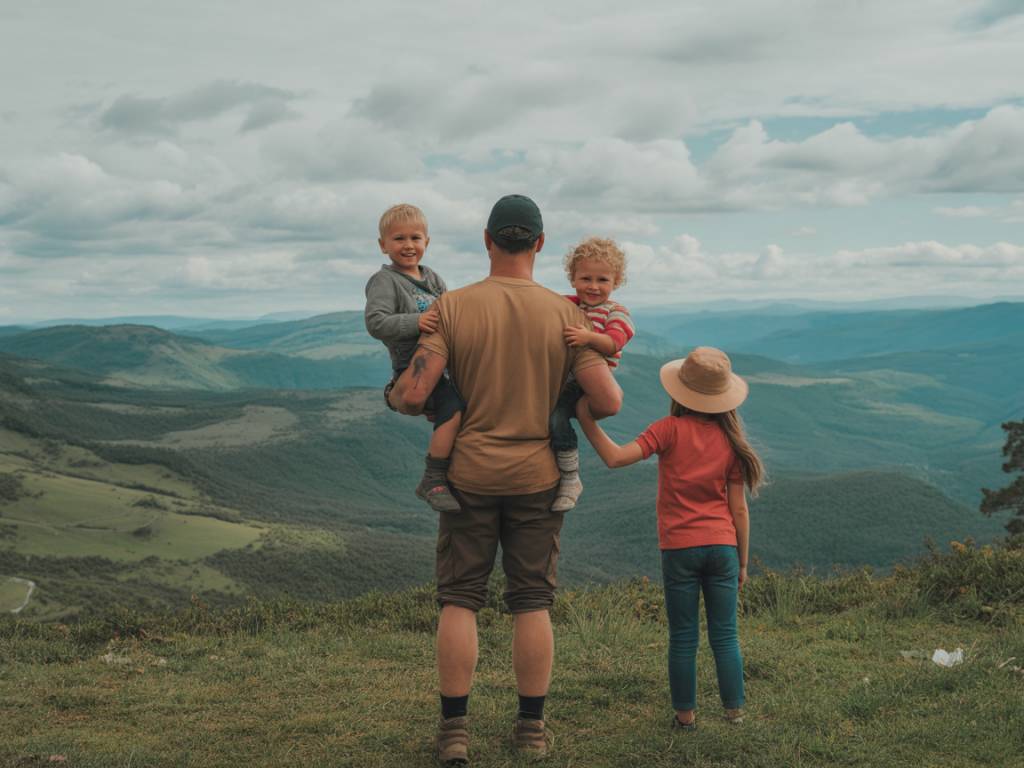
On the first autumn morning we spent fully off-grid with our children, the house was still half-finished. The walls smelled of freshly cut timber, the solar system was temperamental, and the compost loo was a source of deep suspicion to our youngest. But as the mist lifted from the valley, they ran outside to count birds, trace animal tracks in the mud, and argue over who got to check the water gauge. School, in that moment, felt very far away – and strangely close.
Living off-grid with children sits at the crossroads of idealism and logistics. It’s a life built on big words – autonomy, resilience, sustainability – but it is lived in very small details: an extra torch by the bunk bed, a second pair of wellies, a backup lesson plan when the internet drops. Done well, off-grid family life can offer an education richer than any curriculum, a safety net woven from competence instead of convenience, and a community that may not share a postcode, but shares a purpose.
This guide isn’t about a fantasy of cabin life where children are permanently wholesome and no one ever misses hot showers or takeaway pizza. It’s about solutions that actually work – in the mud, in the dark, in the messy middle between wild freedom and real responsibility.
What children really gain from off-grid living
Before talking about schooling methods or wiring diagrams, it helps to ask: what do we want children to carry away from an off-grid childhood?
Patterns from families who have lived this way for years tend to repeat:
- A tangible sense of cause and effect. Flick a switch, watch the battery monitor. Use too much water, the tank runs low. Children see that their choices shape their environment, daily.
- Comfort with the natural world. Night isn’t an abstract; it’s the sky above the roof. Weather isn’t background noise; it decides how you spend the day.
- Practical competence. From a young age, children learn to use tools, recognise hazards, read a sky full of weather, and solve small problems before they become big ones.
- A slower, deeper rhythm. Without the constant hum of mains power and dense schedules, there is more room for boredom – and what they do after boredom often turns into the best learning of all.
None of this happens by magic. It happens because the adults around them design their days, their spaces, and their safety nets with intention. That starts with education.
Education: turning your off-grid life into a living classroom
Off-grid families rarely fit into just one educational box. Instead, they tend to mix approaches: a little formal structure, a little wild exploration, and a dose of digital tools when they’re genuinely useful.
Four pillars show up again and again in setups that work.
1. Anchored home education
While “unschooling in the wilderness” sounds romantic, most families find that a simple framework keeps everyone sane. Successful off-grid home education often includes:
- A short daily core. Maths and literacy, most days, at roughly the same time. It might be 60–90 minutes, but that regularity gives children a sense of progression.
- Clear, modest goals. Rather than “cover the entire national curriculum”, think in terms of milestones: “comfortably multiply and divide by the end of the year”, “read fluently enough to enjoy chapter books”.
- Paper-first resources. Workbooks, printed guides, maps on the wall. They are immune to cloud cover and failed batteries.
In Scotland, I once visited a small croft where the dining table became “school” from nine to ten-thirty. After that, the timetable dissolved into lambing, solar maintenance, bread making and tree planting. The trick wasn’t perfection; it was gentle, relentless consistency with the basics.
2. Embedded, place-based learning
Living off-grid gives you a gift most schools dream of: context. Energy, ecology, design, even economics are not theoretical; they are literally built into the walls.
Families who lean into that will do things like:
- Use the solar system to teach graphs, estimation and basic physics: “How many kWh did we produce today? Why?”
- Turn garden planning into geometry and biology: bed spacing, soil composition, plant lifecycles.
- Make maintenance days into mini engineering workshops: labelling components, sketching systems, measuring distances and angles.
One off-grid parent put it simply: “We stopped asking ‘How do we fit school into our life?’ and started asking ‘How do we name the learning that is already happening?’”
3. Smart use of online tools (without becoming screen-dependent)
Even in a low-tech home, the internet can be a powerful ally, especially for older children. With a modest solar and battery setup plus a careful data plan, you can blend:
- Asynchronous platforms like Khan Academy, Oak National Academy or Coursera for structured courses.
- Downloadable resources – podcasts, documentary series, audiobooks – for offline use during low-power times.
- Occasional live sessions with tutors or homeschool groups for subjects where your own expertise is thin.
The off-grid twist is to ritualise screen time. You might declare cloudy mornings “book and workshop days” and reserve digital lessons for bright afternoons when the batteries are full. Children quickly understand that electricity is not infinite, and they start to treat it as the precious resource it is.
4. Cooperative learning with other families
Education is easier – and more joyful – when you’re not carrying it alone. Even in remote areas, families are finding creative ways to co-educate:
- Rotating “learning days” where one parent hosts a small group for science projects or art.
- Shared field trips to museums, farms, historic sites, timed with town supply runs.
- Online “study circles” where teens from different off-grid homes meet weekly to discuss books or work through tricky maths together.
This doesn’t just lighten the load; it signals to your children that their world includes more than your immediate household, even if your nearest neighbour is a long walk away.
Safety: designing a home where freedom and security coexist
When people worry about off-grid life with children, they rarely start with exam results. They ask about accidents, medical care, or what happens when something goes badly wrong on a stormy night.
Safety in an off-grid setting is less about bubble-wrapping and more about layering competence, design and preparation. Three areas matter most.
1. The physical environment
Off-grid homes often come with extra risks: tools, steeper stairs, open fires, bodies of water, wildlife. The aim is not to remove every hazard, but to make each one visible, teachable and appropriately contained.
- Zones with clear rules. A “workshop zone” where children only enter with an adult; a “play field” where they are free to roam; a “no-go area” near water or drops.
- Design that guides behaviour. Latching gates at key points, non-slip surfaces by outdoor taps, hooks for headtorches at children’s height.
- Age-graded responsibilities. A six-year-old might be trusted to fetch kindling, a twelve-year-old to light the stove, a teenager to check the generator or read the weather forecast.
Think of it as an apprenticeship in risk. Children are not kept from danger; they are gradually taught to read it.
2. Health and emergency readiness
Distance from services doesn’t have to mean vulnerability, but it does demand foresight.
- A robust first-aid setup. Beyond plasters and paracetamol, many off-grid homes keep steri-strips, dressings, a thermometer, oral rehydration salts and a clear, laminated emergency protocol.
- Skills for adults and older children. A weekend first-aid course for parents, plus teaching older kids basics: how to clean a cut, recognise signs of dehydration or hypothermia, call emergency services and state your location.
- Redundancy in communication. If mobile signal is weak, a satellite messenger, radio link with neighbours, or a landline at a known point along the track can be literally life-saving.
Some families rehearse “what if” scenarios the way city families rehearse fire drills: “What if Dad falls from the ladder?” “What if a forest fire starts on the ridge?” These rehearsals are frightening only the first time; after that, they are a quiet source of confidence.
3. Emotional safety and mental health
A child can be physically safe yet lonely, restless, or quietly furious at the life their parents have chosen. Space, silence and tight-knit family routines are not automatically peaceful. They can feel claustrophobic if children have nowhere to take their questions or frustrations.
- Predictable rhythms. Regular mealtimes, weekly rituals (a film night, a shared Sunday walk, a call with grandparents) create islands of reliability.
- Private corners. Even in a tiny cabin, a curtain, a top bunk or a treehouse can become a child’s own space to retreat and decompress.
- Deliberate social contact. Visits to town, cousins staying over, online gaming sessions with friends from a former school – for some children, these are not luxuries but lifelines.
Listen for the moment when a child stops merely observing your off-grid experiment and starts to articulate their own relationship with it. That is when genuine resilience begins.
Community: building a village when you don’t live in one
Modern off-grid living rarely looks like hermit life. Solar panels, shared tools, cooperative land trusts and online forums have made it less about isolation and more about choosing how, and with whom, you connect.
For children, those connections shape their sense of what “normal” looks like.
1. Finding your people
Parents who thrive in off-grid setups tend to cast a wide net when they seek community:
- Local, but not necessarily off-grid. The farmer who ploughs your track, the librarian who saves books for your kids, the café owner who doesn’t flinch at muddy boots – these are part of your support network, even if they love fluorescent lighting and central heating.
- Regional eco and homeschool groups. Forest school circles, permaculture meetups, renewable energy workshops, home education networks: children meet peers whose families also live a little sideways.
- Online communities with real-world anchors. Forums and message boards are helpful, but the gold lies in gatherings: a yearly camp, a shared work weekend, a seasonal festival.
In Wales, I met a loose cluster of off-grid families whose children thought nothing of a three-hour drive to spend a weekend together. “It’s like visiting cousins,” one teenager shrugged. “Just… cousins with better solar arrays.”
2. Sharing resources
Community is not only about friendship; it is also about pooling tools, skills and emotional load. Off-grid families often experiment with:
- Skill swaps. One parent is a former maths teacher, another is a carpenter, a third is quietly brilliant at storytelling. Children rotate through their strengths.
- Shared infrastructure. A communal workshop, a co-owned minibus, a joint order of bulk staples that all the kids help to unpack and store.
- Rituals that mark the year. Seasonal work parties, solstice feasts, harvest celebrations where children see adults cooperate, negotiate and celebrate around something bigger than any one home.
These webs of shared effort form a kind of extended family, even when no one is related by blood.
Real-world examples: what actually works day to day
Abstract principles become clearer when you watch them at work in real kitchens, gardens and muddy boots. Three composite portraits, drawn from several families, illustrate different ways this life can look.
The woodland cabin with young children
Two adults, three children under ten, a small timber cabin on a south-facing slope. They harvest rainwater, cook on gas and wood, and bring in a modest income through remote work and craft sales.
- Mornings follow a simple pattern: breakfast, 90 minutes of table work, then outside projects. The youngest plays with loose parts near the cabin; the older two help with the garden or animal care.
- Safety is handled through strict zones: the stream is fenced, the axe and saw are in a locked shed, and the children are taught from three onwards to carry a whistle and stay within earshot.
- Once a week, they drive into town for swimming lessons, the library, and a long park session with other home-educated children.
On stormy nights, everyone sleeps in the same room. There is a candlelit story, a whispered check of the battery levels, and shared excitement as the wind roars over the roof.
The off-grid smallholding with teens
On a wind-swept ridge, two teenagers share a modest strawbale house with their parents. The family sells surplus vegetables and eggs, their solar setup is generous, and there is a small workshop where the father repairs tools for neighbours.
- Formal education is split between online courses (maths, languages, exam prep) and projects: designing an irrigation system, building a bike shed, keeping a shared budget for the household’s food costs.
- Each teen has a clear emergency role. One knows the off-grid power system well enough to diagnose most faults; the other handles radio checks with neighbours during storms.
- Every few weeks, friends from their old town visit for the weekend. In turn, the teens go back for concerts, sports events and the occasional fast-food binge.
When asked whether they feel they’re “missing out”, one of them shrugs. “I know how to fix things,” she says. “And I know where Orion is in the winter sky. My friends know bus routes. We’re all learning something.”
The semi-off-grid terrace in town
Not all off-grid life happens in a forest or valley. A family in a normal terraced house has installed solar panels, rainwater capture, high-efficiency insulation and a tiny courtyard garden. They remain grid-connected, but live as if they were not for most of the year.
- The children attend a local school. At home, they help track energy production, manage the “no-mains” days, and learn to plan meals around the garden’s output.
- Community is dense: neighbours share tools and recipes, the kids walk to friends’ houses, and the parents run occasional workshops on home energy for the street.
- Safety issues are urban rather than rural, but the skills are similar: situational awareness, clear communication, a practiced family plan for power cuts.
This hybrid setup reminds us that “off-grid” is not an all-or-nothing identity. It can be a direction of travel, a set of values woven into very ordinary streets.
Preparing to take the leap – or the next small step
If you are already off-grid and parenting in the middle of it, you may recognise fragments of your own life in these stories. If you are still at the threshold, wondering whether to step through, it can help to zoom out and ask three grounding questions:
- What kind of learning do we want our children to remember? List experiences, not grades: building a shelter, cooking from scratch, reading by firelight, negotiating with neighbours, fixing a leak.
- Where are our current weak spots? Maybe it’s maths confidence, maybe it’s first aid, maybe it’s social contact for a solitary child. Name the gaps, then design around them.
- How can we build community before we “need” it? Join the group, attend the meetup, send the email now, not after the first hard winter.
Living off-grid with children is not a shortcut to a simpler life; it is an invitation to inhabit complexity more consciously. The wires are visible, the water’s source is obvious, the weather has consequences, the neighbours – however scattered – are essential.
For children raised in such homes, the world is not something that happens on a screen or behind a switch. It is something they touch, shape, repair and occasionally curse under their breath on a cold morning. They learn that comfort is made, not bought; that safety is shared, not assumed; and that education is less a place you go, and more a way you move through the days you’ve been given.