
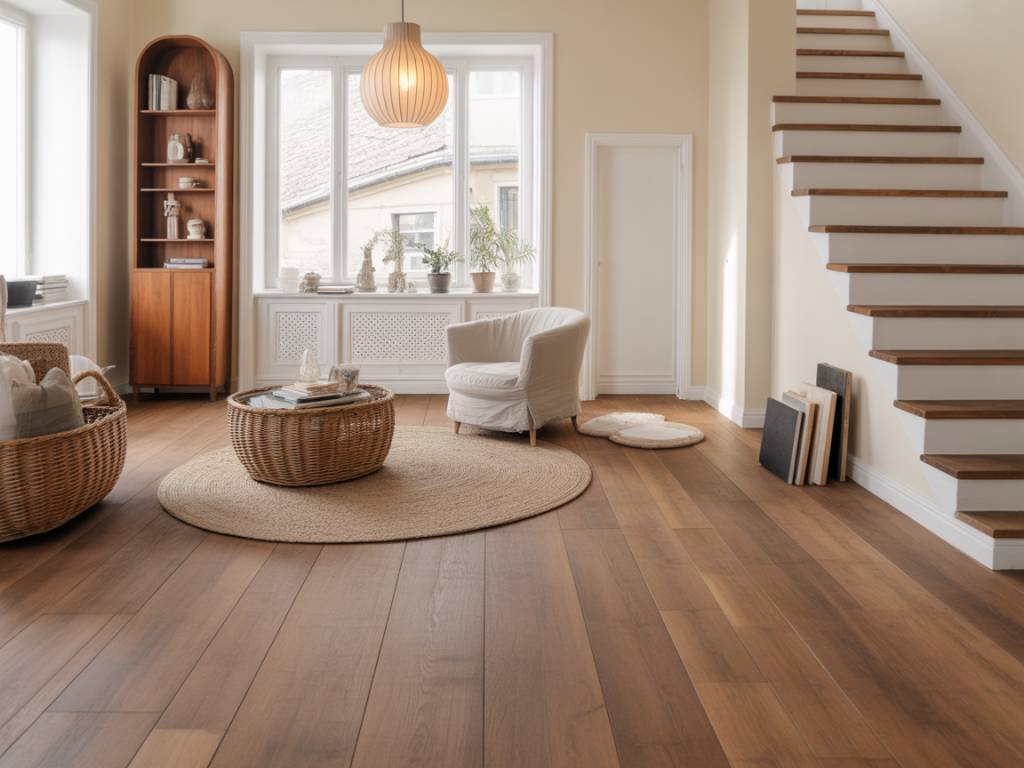
On a quiet January morning in the Cotswolds, I remember stepping barefoot onto a flagstone floor just as the first light slipped through the window. The stone held the night’s coolness, but beneath it, a low, steady warmth pulsed from the underfloor heating. It felt like standing on a sun‑warmed riverbed in slow motion. That floor wasn’t just beautiful – it was working quietly in the background: storing heat, moderating the indoor climate, and treading lightly on the planet.
Flooring is one of those decisions we tend to rush. Pick a colour, a style, something that “goes with the sofa” – job done. Yet under our feet lies one of the biggest opportunities to reduce the carbon footprint of our homes, improve indoor air quality, and create spaces that genuinely feel good to live in.
From stone to timber and a handful of often-overlooked alternatives, let’s explore low‑carbon flooring options that serve both the house and its inhabitants – including some that might surprise you.
Why flooring matters more than you think
Every square metre of floor carries a story of extraction, manufacturing, transport and, one day, disposal. That story can either be carbon-heavy and toxic, or quietly regenerative.
When we talk about “low‑carbon flooring”, we’re really looking at three intertwined questions:
- Embodied carbon: How much CO₂ was emitted to produce, transport and install the floor?
- Longevity and repair: How long will it last, and can it be maintained rather than replaced?
- Health and comfort: Does it off‑gas chemicals? How does it feel underfoot, acoustically and thermally?
High‑impact materials – particularly vinyl (PVC) and many laminates – are packed with petrochemicals, plasticisers and glues. They’re often cheap to buy, but expensive in planetary terms. Low‑carbon options tend to share a few traits: natural or recycled content, minimal processing, long life, and the ability to age gracefully rather than peel, swell or warp.
Let’s start where houses have started for centuries: with stone and earth beneath our feet.
Stone flooring: old-world charm, low‑carbon backbone
Walk into a farmhouse in rural France or a hilltop home in Greece and you’ll often find the same thing: cool stone underfoot, worn soft by a hundred years of footsteps. Stone has been a flooring staple for millennia for good reasons – most of them aligning surprisingly well with modern low‑carbon thinking.
Why stone can be a low‑carbon option:
- Durability: Properly installed, stone can last longer than the building itself. This dramatically reduces lifecycle emissions because you’re not replacing it every 15–20 years.
- Minimal processing: Natural stone requires cutting and finishing, but the process is often less energy‑intensive than manufacturing complex synthetic materials.
- Thermal mass: Stone absorbs and releases heat slowly, pairing beautifully with underfloor heating or passive solar design. On a winter evening, that matters more than a design moodboard.
How to keep stone truly low‑carbon:
- Go local or regional: The biggest carbon hit with stone is often transport. A limestone quarried 40 miles away usually beats an exotic marble shipped halfway around the world, no matter how tempting that veined pattern may be.
- Choose finishes wisely: A honed or lightly brushed surface often requires less processing than high‑gloss polish. It’s also kinder underfoot and less slippery.
- Ask about quarry practices: Some quarries have strong environmental and labour standards; others… less so. A quick ask about sourcing can tell you a lot.
Stone won’t be right for every room (or every set of joints), and that’s where timber, the other great classic, steps in.
Timber flooring: carbon stored in every plank
There’s a particular sound only timber floors make – that soft, rounded resonance of footsteps in an old townhouse or cabin. It’s not just the acoustics we respond to; it’s something more primal. Wood has that curious ability to feel warm to the touch even when the air is cold.
From a climate perspective, timber is one of our strongest allies – if sourced and specified carefully.
Why timber can be an excellent low‑carbon choice:
- Carbon storage: Trees absorb CO₂ as they grow, locking it into their fibres. When you install a timber floor, you’re effectively storing carbon in your home rather than the atmosphere.
- Renewable (with caveats): Sustainably managed forests are a renewable resource, unlike fossil‑fuel‑derived materials.
- Repairable: Scratches can be sanded, damaged boards replaced. A well‑maintained wooden floor can see out multiple generations.
Solid vs. engineered wood:
- Solid wood boards are exactly what they sound like: one species, one piece. They can be sanded many times and often last a century or more. The trade‑off is that they use more timber and can be less dimensionally stable in humid environments.
- Engineered wood uses a thinner hardwood layer on top of a stable, often cross‑laminated base. This can be more resource‑efficient and more stable over underfloor heating – but it’s crucial to check what that base layer is made of (ideally FSC‑certified plywood with low‑VOC glues).
Key questions to ask your supplier:
- Is the timber FSC or PEFC certified? (This helps ensure responsible forest management.)
- Where was the wood grown and where was it processed?
- What finishes and adhesives are recommended – and are they low‑VOC (low volatile organic compounds)?
Finishes that respect indoor air quality:
You can have the most sustainable timber in the world and still spoil the party with a finish that off‑gasses harsh solvents for months. Look for:
- Natural oils and waxes (linseed, tung, hardwax oils) with verified low‑VOC formulations.
- Water‑based varnishes from reputable manufacturers with clear emissions data.
The reward? A floor that ages gracefully, develops a patina rather than “wear,” and quietly stores carbon as long as it remains in your home.
Reclaimed timber: floors with a past life
One of the most powerful ways to lower embodied carbon is to skip new production altogether. Reclaimed timber – boards salvaged from old barns, factories or houses – does exactly this.
In a converted warehouse flat in East London, I once stood on a floor made from old school gym hall boards. You could still see faint lines of paint, the ghosts of badminton courts past. The owners chose to keep them, sanding lightly and finishing with oil rather than erasing their story. The result was a floor that felt deeply alive – and had almost zero new material impact.
Why reclaimed wood is such a strong choice:
- Ultra‑low embodied carbon: The emissions of harvesting and milling were paid long ago.
- Character: Nail holes, colour variations, and old notches give a depth that new boards rarely match.
- Waste reduction: Material that might otherwise be landfilled or burned gets a second life.
Do check for reputable suppliers who:
- De‑nail and prepare boards properly.
- Can tell you where the wood came from.
- Offer guidance on installation (reclaimed often needs a fitter who’s patient and experienced).
Cork: soft, silent, radically renewable
If stone is the stoic elder and timber the versatile middle child, cork is the gentle, slightly quirky cousin who wins everyone over once you get to know them.
Harvested from the bark of cork oak trees (which are not felled in the process), cork is one of the most quietly impressive materials in the sustainable building world.
Why cork is worth serious consideration:
- Highly renewable: The bark regenerates every 9–12 years. Cork forests support biodiversity and store significant carbon.
- Soft and warm underfoot: Ideal for kitchens where you’re standing for long stretches, or bedrooms where you want that gentle give.
- Acoustic comfort: Cork’s cellular structure absorbs sound, making it perfect for flats or echo‑prone spaces.
Modern cork floors come in tiles or planks, often finished with protective coats. To keep things genuinely low‑impact:
- Choose cork products with natural binders or low‑VOC glues.
- Check for FSC certification or robust sustainability claims from European producers.
- Opt for click‑lock planks where possible to reduce adhesive use.
Visually, cork has come a long way from the 1970s orange tiles you might be imagining. Contemporary finishes range from pale, almost stone‑like tones to rich, variegated patterns that pair beautifully with minimalist interiors.
Linoleum (the real one): an unsung climate hero
“Lino” has an image problem. Many people hear the word and picture curling, plasticky sheets in an ageing rental kitchen. In reality, true linoleum is a natural material made from:
- Linseed oil
- Wood or cork flour
- Natural resins
- Jute backing
- Mineral pigments
It’s biodegradable, quietly robust, and miles away from vinyl in both composition and environmental impact.
Why linoleum earns its place on this list:
- Low embodied carbon: Ingredients are largely plant‑based and minimally processed.
- Durability: Traditionally used in schools and hospitals, proper linoleum can last decades when cared for.
- Healthier indoor air: No phthalates, no chlorine, and low emissions from reputable brands.
It’s available in sheets and tiles, in colours that range from calm neutrals to bold, Bauhaus‑inspired tones. For a low‑carbon installation:
- Work with an installer familiar with linoleum (it behaves differently from vinyl).
- Look for natural adhesives or low‑VOC options recommended by the manufacturer.
- Consider simple patterns that can survive changing tastes without needing replacement.
Bamboo: fast‑growing, but choose with care
Bamboo often appears in lists of eco‑friendly materials, and with some justification. As a grass that can grow up to a metre a day in optimal conditions, it’s unquestionably fast‑renewing.
Advantages of bamboo flooring:
- Rapid renewability: Bamboo can be harvested in 4–6 years, far quicker than most timbers.
- Hardness: Strand‑woven bamboo can be harder than oak, making it suitable for high‑traffic areas.
- Distinct aesthetic: Its linear grain and clean look suit contemporary interiors.
But – and it’s an important but – not all bamboo is created equal. Many products involve:
- Intensive processing.
- Long‑distance shipping (usually from Asia).
- Potentially high‑VOC glues and finishes.
If you’re drawn to bamboo, look for:
- Clear certifications (e.g., FSC for bamboo, credible third‑party eco labels).
- Manufacturers who publish VOC emissions data and have transparent supply chains.
- Products that use formaldehyde‑free binders where possible.
Bamboo can absolutely be part of a low‑carbon home, but it’s not a free pass. Ask questions. The honest suppliers are usually delighted to answer them.
Polished concrete and limecrete: floors as thermal batteries
In off‑grid and ultra‑low‑energy homes, you’ll often encounter a different kind of floor altogether: polished concrete or its gentler cousin, limecrete.
These are as much structural elements as they are finishes, and when the design is right, they can act like giant thermal batteries – soaking up daytime warmth, then releasing it slowly after sunset.
The upsides:
- Durability: Properly designed, these floors can easily outlast the rest of the building.
- Integration with heating: Underfloor heating systems pair beautifully with high thermal mass.
- Minimal extra layers: In some designs you avoid separate screeds and coverings, reducing materials overall.
The carbon question:
Standard concrete is carbon‑intensive due to its cement content. That doesn’t automatically disqualify it, but it does mean you should:
- Ask about low‑clinker cements or replacements like GGBS/fly ash where appropriate.
- Use only as much as is structurally necessary.
- Consider limecrete for smaller projects: lime has lower embodied carbon than Portland cement and even reabsorbs some CO₂ as it cures.
From a comfort perspective, polished concrete or limecrete can be softened visually and tactilely with natural rugs (wool, jute, sisal), maintaining the thermal benefits where you need them while giving toes gentler landings.
Underlays, adhesives and finishes: the hidden half of the story
A low‑carbon floor is not just about the visible surface. What lies beneath – underlays, glues, sealants – can make or break both the climate impact and the indoor air quality.
Underlays:
- Prefer natural materials such as wool felt, cork or recycled jute where compatible with your flooring type.
- If using foam or rubber, look for recycled content and explicit low‑VOC certifications.
Adhesives and sealants:
- Choose low‑VOC, water‑based products wherever possible.
- Follow manufacturer recommendations; sometimes a “green” adhesive used incorrectly can fail faster, leading to premature replacement.
Finishes and maintenance:
- Natural soap, oil and wax systems often age more gracefully and allow spot repairs.
- Gentle cleaners free of harsh solvents or synthetic fragrances keep emissions low long after installation.
Making the choice: a simple framework for your own home
Every house is a negotiation between dreams, budget, and the stubborn realities of existing structure. To choose a low‑carbon floor that genuinely fits your home, it helps to work through a simple set of questions:
- How long do I want this floor to last? If the answer is “as long as possible”, prioritise stone, solid or reclaimed timber, cork or high‑quality linoleum.
- What’s the climate and how is the house heated? In cold climates with underfloor heating, high thermal mass (stone, concrete/limecrete) can be powerful. In milder or damp climates, breathable, resilient materials matter.
- Who uses the space? For small children or people with joint issues, softer floors (cork, timber, linoleum) can be kinder.
- What’s available locally? A modest local limestone may beat a “perfect” but heavily imported option on carbon grounds.
- Can I live with patina? The more you embrace marks of use as character rather than damage, the more options open up – and the less replacement you’ll need.
If you’re still uncertain, it can help to test your instincts in a very simple way: visit a showroom or reclaimed yard, take your shoes off (yes, really), and just stand on each option. Close your eyes. Notice sound, temperature, and how your body responds. Our feet are surprisingly honest environmental critics.
Stepping into a quieter footprint
In the end, low‑carbon flooring is less about chasing the perfect material and more about making a thoughtful, well‑informed choice – one that respects both the house and the landscapes it’s made from.
Whether you fall for the cool solidity of local stone, the quiet warmth of reclaimed timber, the forgiving softness of cork, or the understated practicality of linoleum, the floor you choose will be your companion through countless small moments: early‑morning coffees, muddy boots shrugged off after a long walk, the echo of a child’s first steps.
If those surfaces can also store carbon, avoid poisoning the air, and sit lightly on the earth, so much the better. Every step then becomes, quite literally, a little lighter.