
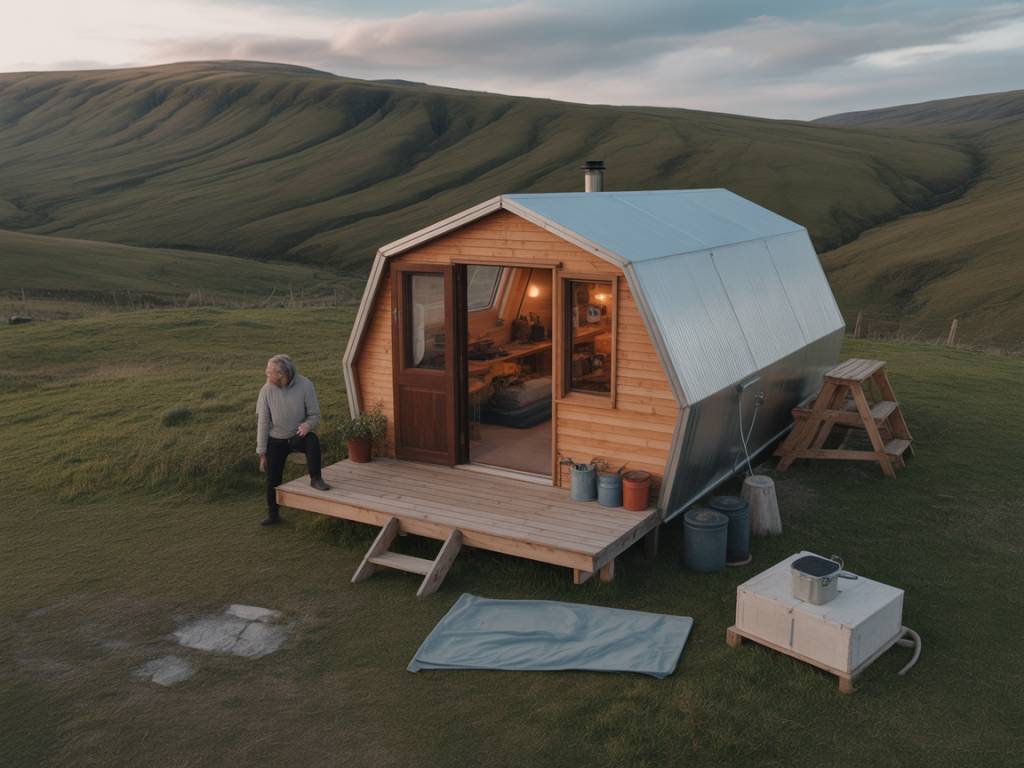
A quiet winter morning in the Scottish Borders. Heavy snow overnight. No traffic hum, no orange streetlight bleeding through the curtains — just the slow crackle of a woodburner and the soft pulse of a battery monitor counting down what the sun hadn’t yet replaced. That moment captures everything about off-grid living in the UK: genuinely beautiful, genuinely demanding, and nothing like the Instagram version.
The dream is everywhere right now. A Welsh hillside cabin. A Devon woodland yurt. A remote croft on the Hebrides. But for every thriving off-grid homestead, there are abandoned projects, drained savings, and cold caravans where enthusiasm collided with reality. This guide cuts through the romance and tells you what you actually need — and what to watch out for — before you spend a single penny.
Off-grid living in the UK: what you really need to get started and avoid common beginner mistakes
Let’s be clear about what « off-grid » actually means in a UK context. It does not mean living outside the law or vanishing from society. For most beginners, it means disconnecting from three mains systems:
- Electricity: replaced by solar panels, wind turbines, micro-hydro, batteries, or a generator.
- Water: replaced by a borehole, spring, rainwater harvesting, or tanker delivery.
- Sewage: replaced by a composting toilet, septic tank, reed bed, or packaged treatment plant.
Here is the first hard truth: off-grid living is rarely cheaper at the start. The infrastructure required to replace mains services costs real money. The lifestyle can be more resilient, more sustainable, and deeply rewarding — but it is not a shortcut to lower bills in year one.
Mindset before hardware
The single biggest predictor of off-grid success is not the size of your solar array. It is whether you genuinely enjoy problem-solving, physical work, and planning ahead. Before researching panels or composting loos, ask yourself these honestly:
- Can you tolerate inconvenience — waiting for batteries to charge, planning fuel deliveries, hauling water?
- How will you cope with a UK winter? Grey weeks in November when solar generation barely registers are not a theory; they are the baseline.
- Do you enjoy learning practical skills? Off-grid life makes you a part-time electrician, plumber, groundskeeper, and mechanic.
- How remote do you actually want to be? Some setups are deeply isolated; others sit within eco-communities that have their own social intensity.
If you lean towards comfort and predictability, that is not a dealbreaker — it just means you need more robust systems, better insulation, and a larger starting budget. Knowing that early saves you enormous pain later.
Land and planning law: the part most beginners skip
More off-grid dreams end in a planning officer’s inbox than in a broken inverter. UK planning law is the framework you must understand before buying land or placing any structure on it.
Key planning realities to know
- Full-time habitation almost always requires planning permission — whether your home is a cabin, tiny house, yurt, or static caravan. « It’s only temporary » is not a legal defence.
- Agricultural land is not residential land. Using it primarily as a home is not automatically permitted, even if you plant a vegetable garden.
- Designations matter: National Parks, Areas of Outstanding Natural Beauty (AONBs), Green Belts, and conservation zones all carry stricter controls than ordinary rural land.
- Access rights are critical: land without legal vehicular access becomes a logistical nightmare the moment you try to bring in a septic tank or building materials.
Routes that have worked for UK off-gridders
- « Low-impact development » policies, which exist in parts of Wales and some English councils, allow sympathetic residential use tied to land-based enterprises.
- Planning applications linked to small-scale farming, forestry, or eco-tourism — giving a functional justification for on-site habitation.
- Carefully designed, landscape-sensitive structures that planners view as enhancing rather than dominating the site.
The most common beginner mistake? Assuming that because a project is green or ecological, planning rules do not apply. They do, everywhere, without exception. Talk to your local planning authority before you spend big. Many councils will offer a pre-application advice service for a modest fee — worth every pound.
Water: the priority most people underestimate
Ask anyone who has lived off-grid through two or three UK winters and they will tell you the same thing: electricity gets all the attention, but water is what makes or breaks your comfort and health.
Your realistic options in the UK
- Spring or stream water: powerful if genuinely reliable year-round, but requires laboratory testing for bacteria, agricultural run-off, and heavy metals — plus filtration and UV sterilisation. Protect the source from livestock contamination.
- Borehole: expensive upfront (typically £5,000–£15,000+ depending on depth and geology), but often the most secure long-term solution. A proper hydrogeological survey is essential before drilling.
- Rainwater harvesting: excellent as a supplementary source, especially with large roof catchment areas and substantial storage tanks. Bear in mind that late-summer dry spells catch many beginners off guard.
- Tanker delivery: viable as a back-up, but unreliable and expensive as your primary water source — particularly in remote locations during winter.
The beginner errors that cause real suffering
- Underestimating daily usage — showers, cooking, laundry, growing food, and guests add up fast.
- Ignoring winter pipe and tank insulation. Frozen pipes can leave you melting snow in pans for days.
- Skipping water testing because « it looks clear ». Clarity is not cleanliness. Agricultural run-off, livestock faecal coliforms, and dissolved minerals are invisible.
Design your water system with the same rigour as your power system, and build in genuine redundancy — at least two independent sources or storage reserves to cover you when one fails.
Power: sizing your system for a British sky
The UK is not California or southern Spain. Those long July days when your batteries are full by mid-morning are real — but so are the grey November weeks when your solar charge controller barely flickers and you start eyeing the kettle with suspicion. A system designed for summer will fail you in winter. Always design for your worst-case months.
Building a realistic off-grid power system
- Audit your consumption first: list every appliance, its wattage, and realistic daily hours of use. Switching to LED lighting, A+++ rated appliances, and efficient cooking methods can cut your required system size dramatically.
- Design for December, not June: solar irradiance in the UK drops by roughly 70–80% in winter compared to peak summer. If your budget only covers a summer-adequate system, plan to run a generator through the dark months.
- Mix your generation sources: solar works well from March to October; wind can be highly productive in exposed upland or coastal sites especially in winter; micro-hydro is exceptionally reliable if you have a consistent water drop and flow year-round.
- Choose storage carefully: lithium (LiFePO4) batteries are lighter, more efficient, and longer-lasting but carry a higher upfront cost. Lead-acid alternatives are cheaper initially but require more space, ventilation, and careful depth-of-discharge management.
The generator: the honest secret of off-grid living
Many off-grid purists are reluctant to admit it, but a small, fuel-efficient generator is one of the most practical tools you can own — particularly during your first year while you learn your actual consumption patterns. Use it strategically during prolonged low-generation periods rather than as a daily crutch, and it costs very little to run while protecting your battery bank from deep discharge damage.
The practical starting checklist for UK off-grid beginners
Before committing significant funds, work through these steps in order:
- Research planning constraints on any land you are considering — check the local plan, any designations, and speak to the LPA.
- Investigate water sources on and near the site, and get at least one independent assessment of viability and quality.
- Audit your realistic energy needs honestly — not your aspiration, your actual daily behaviour.
- Visit at least two or three established off-grid properties and speak to the people living in them. Communities like those facilitated by Terra House can connect you with people who have already made the mistakes so you don’t have to.
- Build a financial buffer of at least 30% above your estimated project cost. Off-grid systems nearly always surface unexpected expenses in year one.
Off-grid living in the UK is genuinely achievable, increasingly popular, and for many people profoundly life-changing. The difference between those who thrive and those who quietly give up almost always comes down to preparation — particularly around land law, water, and honest self-knowledge about the lifestyle they are actually choosing. Go in with clear eyes, solid research, and a willingness to learn, and the rewards are very real.