
Why rainwater belongs in the British home
One October afternoon in Devon, j’ai vu la pluie (as my old French teacher would say) turn a slate roof into a mirror. The gutters overflowed, a small river formed along the edge of the lane, and I remember thinking: this is not “bad weather”, it’s wasted potential.
In a country where talking about the weather is practically a national sport, it’s surprising how rarely we talk about using it. Yet the UK’s mild, wet climate is almost purpose-built for domestic rainwater harvesting. With a well-designed system, an average British roof can quietly fill water butts, tanks and flushing cisterns while you sleep.
This guide walks you from first principles to practical installation: how a system works, what’s realistic for a typical British home, where to start, what it costs, and the small design details that make daily life smoother.
What rainwater harvesting actually is (and isn’t)
Rainwater harvesting is simply the practice of collecting and storing rain from your roof for later use. In most British homes, that means capturing water from:
- Roof surfaces (slate, tile, metal, sometimes flat roofs)
- Gutters and downpipes
- A storage tank (above or below ground)
- A simple distribution system (gravity or pump-fed)
At its most basic, it’s a water butt under a downpipe for watering the garden. At its most sophisticated, it’s an underground tank feeding toilets, washing machines and outdoor taps, with automatic mains backup.
One key clarification: in the UK, harvested rainwater is almost never used as drinking water without substantial filtration and treatment. For most households, it’s far more practical (and economical) to use it for:
- Toilet flushing
- Washing machines
- Garden irrigation and greenhouse use
- Car washing and outdoor cleaning
These are “non-potable” uses – they account for roughly 30–50% of a typical home’s water consumption. That’s where rainwater harvesting quietly shines.
Does rainwater harvesting make sense for your home?
Before sketching tanks and pipes, it’s worth asking three practical questions:
1. Do you have enough roof area?
A good rule of thumb: in much of the UK, every square metre of roof can capture 500–800 litres of rain per year. A modest 80 m² roof in Manchester, Bristol or Glasgow can deliver 40,000–60,000 litres annually.
In drier parts of the South East, the figure is lower but still meaningful. If you have a small roof and low water use (a couple in a flat, for example), a simple water butt may be all you need. For a family home with a decent roof area, a larger system becomes genuinely worthwhile.
2. How do you use water now?
Think in terms of habits, not just bills. Do you:
- Water a garden or allotment regularly?
- Run multiple loads of laundry per week?
- Wash a car or bicycles outdoors?
- Have (or plan) a greenhouse or polytunnel?
The more “outdoor” or non-drinking water uses you have, the more benefit you’ll see. A compact townhouse with no garden might suit a pared-back system feeding toilets only. A rural or edge-of-town home with beds, borders and a veg patch will make excellent use of a tank.
3. Are you renovating, building, or retrofitting?
Rainwater systems are easiest and cheapest to integrate during:
- New builds
- Extensions
- Bathroom or utility room refurbishments
- Driveway or garden landscaping
Running a new pipe to a downstairs WC is much more manageable when walls are already open. Similarly, installing an underground tank is more realistic when you’re already planning to tear up part of the garden or driveway.
Key components: from raindrop to tap
Whether you’re in a Victorian terrace in Leeds or a timber-framed home on the Cornish coast, rainwater harvesting systems all follow the same basic journey.
1. Roof surface and gutters
Your roof is the catchment area. Slates, tiles and metal roofs are ideal. Green roofs are compatible too, but yield slightly less water and often need more filtration.
Good guttering is non-negotiable. You’ll want:
- Clean, well-sized gutters with adequate fall (slope)
- Leaf guards or simple mesh to keep out large debris
- Secure, correctly angled downpipes
Many British homes still have a mix of aging cast iron and newer plastic components. Renovating gutters is often the quiet first step in your rainwater project.
2. First-flush diverter and filters
The first few litres of rain from a dry roof are the dirtiest: dust, bird droppings, moss fragments. A first-flush device diverts that initial runoff away from your tank, usually into a soakaway or drain.
After that, filters remove leaves, insects and finer particles. These can be as simple as an in-line basket filter or as refined as self-cleaning vortex filters for larger systems. For garden-only use, filtration can be minimal. For toilet and laundry use, better filtration reduces maintenance and odours.
3. The storage tank
This is the heart of the system, and where design choices matter. In British homes you’ll usually see:
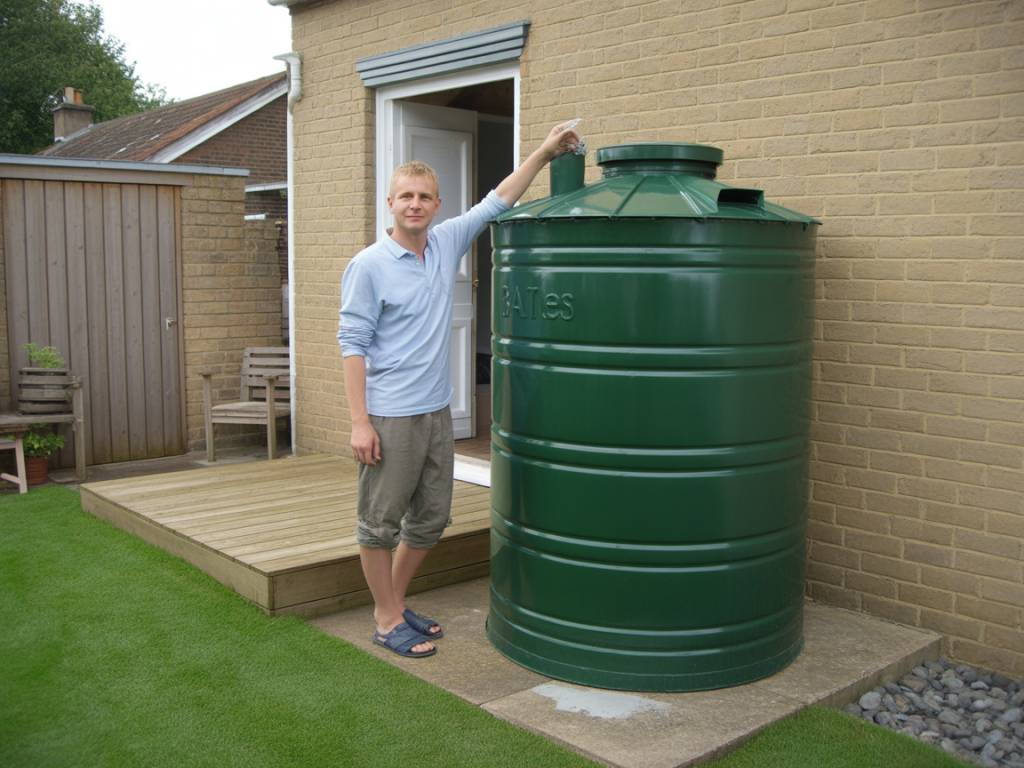
- Above-ground plastic tanks or barrels – cheaper, visible, easy to maintain. Good for gardens and sheds.
- Underground tanks – more expensive, invisible, thermally stable (important in hard frosts and summer heat).
- Basement or garage tanks – a neat compromise where below-ground isn’t feasible.
Tank sizing is a balance between:
- Roof area and local rainfall
- Intended uses (garden vs toilets + laundry)
- Budget and space
For many UK households, capacities between 2,000 and 6,000 litres work well. Oversizing sounds tempting, but unused water sitting for long periods can stagnate; regular turnover keeps the system healthier.
4. Pump and controls
If your tank is underground or at ground level, you’ll generally need a pump to deliver water to toilets or washing machines. Modern rainwater pumps are compact, quiet and often integrated with:
- Automatic mains water top-up when the tank runs low
- Level sensors and simple controller panels
- Backflow prevention, to protect the mains supply
If you’re only supplying garden taps that are lower than the tank, a gravity-fed system may be enough – a delightfully simple arrangement, especially in slightly hilly plots.
5. Distribution: pipes and points of use
In UK practice, dedicated pipework (often in blue or green, to distinguish from mains) will feed:
- Toilet cisterns (often starting with ground floor WCs)
- Washing machines in utility rooms or kitchens
- External garden taps (clearly labelled as non-potable)
By regulation, these must be kept completely separate from your potable (drinking) water system, with clear labelling and backflow prevention. An experienced plumber familiar with WRAS guidelines is invaluable here.
Designing a system for a British climate
Living under Atlantic skies gives us a gift: relatively steady rain across the year, punctuated by heavy downpours. Designing for this means thinking in seasons.
Winter and early spring
Roofs are generous; tanks fill quickly. This is when your system quietly earns its keep, topping up storage to carry into the drier weeks. Frost protection for exposed pipework and taps is important; underground tanks naturally stay above freezing.
Summer and early autumn
Demand rises in gardens and allotments just as rainfall can become erratic. A well-sized tank helps buffer dry spells, but expect that in a hot, dry July you may still need occasional mains backup – which is exactly why automatic top-up exists.
Urban vs rural realities
In dense terraces of London or Birmingham, space is the main constraint. Slimline wall tanks, linked water butts and compact underground units beneath parking spaces can work wonders.
In rural or edge-of-town settings, you may have more freedom: larger gardens, accessible driveways, and fewer immediate neighbours. Here, combining rainwater harvesting with other off-grid elements – solar, small-scale reed beds, greywater systems – can significantly reduce both bills and environmental footprint.
Installation pathways: from DIY barrels to full systems
Not every home needs (or wants) a full-blown, plumbed-in system from day one. Think of rainwater harvesting as a ladder with three main rungs.
1. Entry level: water butts and simple linking
For many British households, the first step is classic:
- Attach a rainwater diverter kit to an existing downpipe
- Install one or more water butts (100–300 litres each)
- Link butts with simple hoses to increase storage
Cost: often under £200 including fittings. Result: a reliable supply for pots, borders and modest veg beds. No electricity, no pumps, no permits – just gravity and a watering can.
2. Intermediate: pumped garden and outbuilding supply
The next stage adds:
- Larger above-ground tank (e.g., 1,000–2,000 litres)
- Small pump to feed hosepipes or drip irrigation
- Optional supply to a greenhouse or shed basin (non-potable)
This level particularly suits keen gardeners or those with polytunnels and greenhouses. In dry spells, it can make the difference between a thriving oasis and wilted frustration.
3. Advanced: integrated household system
Here we’re talking:
- Underground or large basement tank (2,000–6,000+ litres)
- Filtered supply to toilets, washing machine, garden taps
- Automatic mains backup and full compliance with UK standards
Typical installed costs in the UK for such systems can range from roughly £3,000–£7,000 depending on tank size, excavation complexity and plumbing distances. Integrated at build stage, costs can be lower; retrofitted into a tightly packed urban plot, they creep higher.
Regulations, safety and British practicality
Water in the UK is tightly regulated for good reason. A few key points keep things safe and legal:
- No direct connection between rainwater and mains drinking supply. Only via appropriate break tanks or air gaps.
- Clear labelling on pipes and outlets (“Non-potable water – Do not drink”).
- Backflow prevention to ensure harvested water can never siphon into mains pipes.
- Building Regulations approval if you are significantly altering plumbing or installing underground tanks.
A good installer will be familiar with WRAS guidance and BS 8515 (the British standard for rainwater harvesting systems). If you’re going the DIY route beyond simple butts, it’s worth at least a consultation with a qualified plumber or rainwater specialist.
Everyday life with a rainwater system
What does it actually feel like to live with one of these systems day to day? In truth: mostly invisible – and that’s precisely the point.
The first thing people often notice is the sound, or rather the absence of it. On a wet night in Yorkshire, rather than hearing water hammer through old downpipes and vanishing into a gulley, there’s a softer sense of purpose: the knowledge that the roof is quietly refilling the tank that will flush tomorrow’s toilets or water next weekend’s tomatoes.
There are, of course, a few rituals:
- A quick seasonal check of filters (more often in autumn, when leaves are falling).
- Occasional observation of tank levels during extended dry spells.
- An annual once-over for pumps and controls, much like servicing a boiler.
Many modern systems combine with smart home tech: a simple level sensor connected to a home hub, or an app that lets you see how much rainwater last night’s storm gifted you. It’s quietly satisfying to watch the numbers tick upward on a blustery evening.
Costs, savings and the less tangible dividends
From a purely financial viewpoint, payback can be modest, especially where water tariffs are low. A typical UK metered household might save:
- Up to 30–50% of mains water use
- Some sewerage charges, if these are linked to metered usage
For small systems, the payback can be quite reasonable. A few linked water butts might pay for themselves in just a couple of summers of lower water bills and reduced hosepipe reliance.
For larger, fully integrated systems, the story is subtler. The financial payback might be 10–20 years, depending on water pricing, but the other “returns” are harder to invoice:
- The resilience of having your own buffer during restrictions or supply issues.
- The delight of watering a garden with the very weather that feeds it.
- The quiet satisfaction of seeing stormwater slowed and softened, rather than hammering straight into an already stressed drainage system.
There’s also the wider ecological picture: in cities prone to surface water flooding, every litre captured and slowly used onsite is a tiny act of kindness to rivers, drains and downstream neighbours.
Practical tips for getting started
If the idea is tugging at you, a few grounded steps can turn it from notion to reality.
- Start small, learn, then scale. Begin with a water butt and diverter on your busiest downpipe. Notice how quickly it fills, how you use it, what you’d change.
- Map your roof and gutters. A quiet half-hour with a notebook, tracing downpipes and thinking about where water could be stored, reveals surprising possibilities.
- Time upgrades with other works. If you’re changing a driveway, redoing a patio, or renovating a bathroom, that’s the perfect moment to integrate tanks and pipework.
- Talk to neighbours. In Victorian terraces and semi-detached streets, shared knowledge (and even shared tanks) can go a long way.
- Choose components you can maintain. Elegant, self-cleaning filters and robust tanks that you can actually access will serve you better than overly complex setups that intimidate you.
Reframing rain as a resource
Once you start collecting rain, the British sky shifts character. Grey clouds become less of an inconvenience and more of a quiet ally. A forecast of “heavy showers” no longer spells just traffic jams and damp socks, but a free refill of the invisible cistern under your lawn or the neat barrel beside your shed.
In the end, rainwater harvesting is not about gadgets or tanks, but about reweaving the home back into its landscape: roof speaking to soil, gutter to garden, storm to stored abundance. It’s about standing at the kitchen window on a wet Tuesday, hearing the soft percussion on glass and slate, and knowing that your house is not simply enduring the weather, but gently working with it.
For a country stitched together by drizzle and downpour, that feels like a quietly radical way to live.