
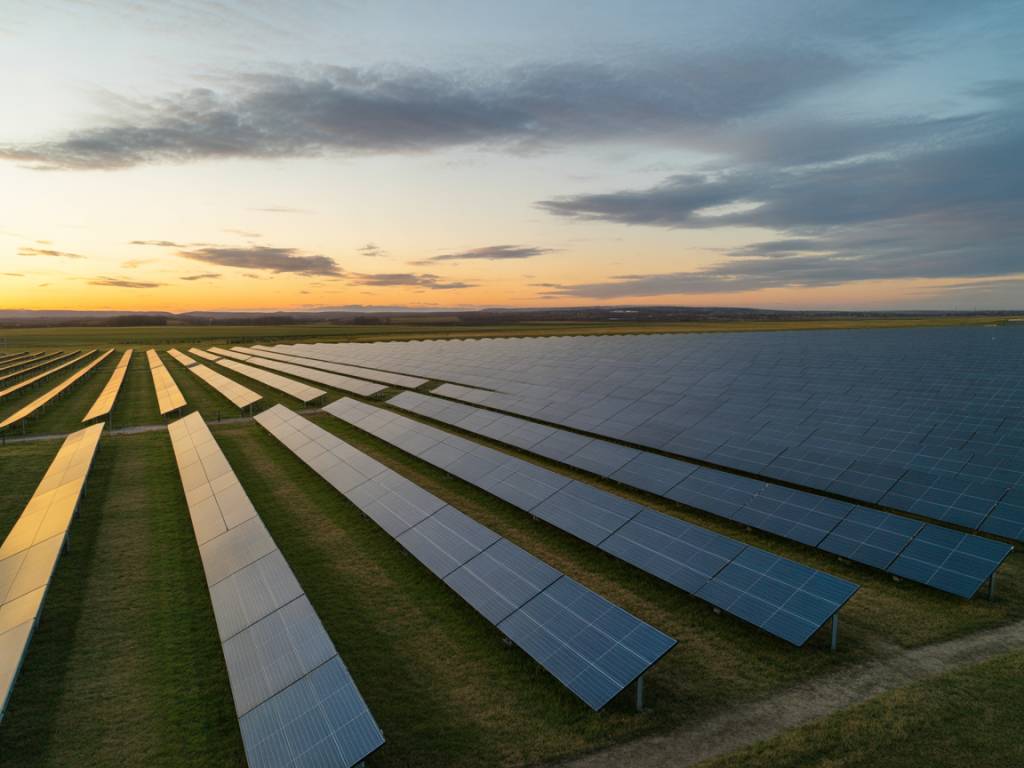
There is a particular kind of light in the UK that never quite makes it into the glossy brochures about solar energy. Not the blazing noon of Spanish rooftops, but something softer: a washed-out sky over terraced houses in Manchester, the hesitant brightness that breaks through after a Cornish downpour, that thin, pearly light you get on a January afternoon at 3:30pm.
It’s under this sky that many people quietly ask the same question:
“Is solar really worth it here?”
Not in theory, not in some Californian suburb, but on an ordinary British roof, under clouds, drizzle and “light showers, becoming heavier later”. For long-term savings and resilience, does switching to solar in the UK genuinely make sense?
Let’s unpack that — not in the abstract, but in the practical, day-to-day reality of bills, blackouts and a future where energy feels both precious and uncertain.
Clouds, myths, and what solar panels actually need
One of the most persistent myths about solar energy is that panels need strong, direct sunshine to work. In reality, solar panels feed on light, not heat, and they are surprisingly content under a grey sky. The UK may not be sun-drenched, but it does offer something else: consistency.
Modern solar panels can generate electricity from diffuse light — the kind that filters through clouds and mist. That’s why countries like Germany (hardly a tropical paradise) became early world leaders in solar adoption.
To put it into perspective:
- Southern England typically receives around 900–1,100 kWh of solar energy per square metre per year.
- Scotland is lower, but still often between 800–1,000 kWh per square metre per year.
- A decent 4 kWp solar system in much of the UK can generate roughly 3,400–4,200 kWh of electricity per year — broadly similar to the yearly electricity use of a typical efficient household.
So while we can’t compete with Lisbon or Seville, we’re working from a baseline that is far from hopeless. We’re just harnessing a quieter, steadier kind of light.
What a typical UK solar setup really looks like
Imagine an ordinary semi-detached house somewhere between Bristol and Birmingham. A slate roof, a modest south or south-west facing pitch, perhaps lightly dusted with moss that’s seen too many winters. On that roof, you could reasonably fit a system in the 3–6 kWp range, roughly:
- 8–16 panels (depending on panel wattage)
- System size: 3–6 kWp
- Space needed: around 15–30 m² of unshaded roof
As for energy production, ballpark annual figures for much of England and Wales might look like:
- 3 kWp system: ~2,600–3,000 kWh per year
- 4 kWp system: ~3,400–4,000 kWh per year
- 6 kWp system: ~5,000–6,000 kWh per year
There will always be rainy months where the panels seem to be dozing and bright spells when they suddenly feel like a secret superpower. But over a year, the numbers begin to even out, like the slow balancing of a set of scales.
Costs, payback and the quiet arithmetic of long-term savings
When the installer’s quote arrives in your inbox, the poetry of low-carbon living briefly collides with hard numbers. Let’s talk money.
As of recent UK market conditions, very rough typical costs (supply and install) might be in the following ranges:
- 3–4 kWp solar PV only: ~£4,500–£6,500
- 5–6 kWp solar PV only: ~£6,500–£9,000
- Battery storage (5–10 kWh): ~£3,000–£7,000 (depending on brand and capacity)
Prices vary with roof complexity, equipment brands, scaffolding needs, regional labour costs and whether you add extras like EV chargers. But once installed, the system quietly gets on with its work. The more of that energy you actually use at home, the better your returns.
Typical annual savings (again, rough and highly dependent on tariffs and usage patterns):
- A 4 kWp system might save £400–£700 per year on electricity bills if you use a good proportion of the power on-site.
- With a battery, self-consumption can climb from ~30–50% to as high as 70–90%, deepening those savings.
- Export tariffs (like Smart Export Guarantee schemes) let you earn a modest income from surplus electricity, often a few pence per kWh.
Under current energy prices, typical payback times in cloudy UK conditions often fall in the range of 8–15 years, sometimes less with high usage or good export deals. Panels themselves commonly carry performance warranties of 20–25 years.
In other words: the UK won’t hand you a “get rich quick” scheme. But it can offer a slow, dependable unwinding of your electricity costs over decades — a sort of long-term truce with your energy bills.
Solar in the UK: not just savings, but resilience
Money is only one part of the story. The other has to do with something more subtle: a sense of control.
In recent years, we’ve seen just how fragile energy systems can feel. Price spikes, supply worries, talk of grid stress. In stormy winter evenings, when the wind lashes at the windows and the lights flicker, we’re reminded that the cables feeding our homes are not invincible.
This is where solar in a cloudy climate begins to show another side: resilience.
Solar panels alone, without a battery or specific backup configuration, won’t typically keep your lights on during a power cut (for safety, most standard inverters shut down with the grid). But when paired with the right system design, you can enjoy:
- Battery backup: A storage battery can keep essential circuits running for several hours — lighting, broadband, a fridge, a couple of sockets for charging devices.
- Load shifting: You can use stored solar energy during peak-price periods, softening the impact of volatile tariffs.
- Partial autonomy: You may not go fully off-grid, but you become less exposed to every twitch in the market.
Is this resilience worth the extra cost of a battery in the cloudy UK? For many, the answer is increasingly yes — not just in financial terms, but psychological ones. Knowing that part of your home’s energy is generated and stored right above your head is quietly reassuring.
And on those pale, bright winter days when the panels surprise you by filling the battery earlier than expected, it’s hard not to feel a certain satisfaction: the house humming gently on its own captured light.
Real-world rhythms: a year of solar under grey skies
Solar in the UK doesn’t follow a neat, even pattern. It lives by the seasons. To understand whether it’s “worth it”, you have to see the whole year:
- Winter: Generation is at its lowest. Short days, low sun angle, frequent clouds. This is when solar feels least impressive, but even then it can cover a share of baseload usage — routers, background appliances, a few lights.
- Spring and autumn: These shoulder seasons often surprise people. Cooler temperatures actually help panel efficiency, and you can get beautifully productive days in March and April.
li>Summer: The system comes into its own. Long days, higher sun, more opportunity to run energy-hungry tasks (washing machines, dishwashers, EV charging) directly from the roof.
Instead of thinking in terms of daily consistency, it’s better to think in annual balance. Over 12 months, even under our famously sulky skies, the generation curve tends to do its work.
Is your UK home a good candidate for solar?
Not every roof is a solar dream, and honesty here matters. Before falling in love with the idea, it’s worth asking a few grounded questions:
- Orientation: South-facing is ideal, but east–west can also work well. North-facing rooftops are usually less promising.
- Shade: Nearby trees, chimneys or taller buildings can dramatically reduce output, especially if they cast shadows at midday.
- Roof condition: If your roof needs replacing in the next 5–10 years, it’s often wiser to tackle that first.
- Electricity usage: The more electricity you use in daylight hours, the faster your payback tends to be.
- Future plans: Planning an EV, home office, air-source heat pump? Solar becomes more compelling when your electric demand grows.
An experienced installer should provide a detailed yield estimate, take shading into account and model your expected annual generation. In a cloudy climate, accuracy matters even more than enthusiasm.
Policy, incentives and the slow shift in the UK landscape
The days of the generous UK Feed-in Tariff are gone, and with them the era of very short payback periods. But that doesn’t mean policy is irrelevant. Instead, we’ve quietly entered a more mature phase of solar adoption.
Today, the landscape typically looks like this:
- Smart Export Guarantee (SEG): You can get paid for surplus electricity exported to the grid, usually under a rate set by your chosen supplier. The tariffs are modest but helpful.
- Zero VAT (subject to policy updates): At times, solar installations on residential properties have benefited from reduced or zero VAT under certain government schemes, improving upfront affordability.
- Local grants and schemes: In some areas, councils or devolved governments offer incentives, loans or support for low-carbon home upgrades, including solar.
- Green mortgages and property value: Some lenders offer better terms or recognise increased property value for homes with strong energy performance.
The financial landscape isn’t as headline-grabbing as it once was, but if you’re planning to live in your home for 10+ years, the combination of lower bills, export income and potential property value uplift often stacks up convincingly — even under a cool grey sky.
Solar plus lifestyle: designing your habits around the light
One of the quiet pleasures of having solar in the UK is how it gently reshapes your habits. Not in a restrictive way, but with a new awareness of rhythm.
You may find yourself:
- Running the washing machine after the sun climbs above the neighbour’s roofline.
- Charging laptops and devices during bright midday windows.
- Timing a slow-cooked meal for a sunny afternoon, letting your panels pay for dinner.
With a battery in the mix, this dance becomes more flexible, but the underlying principle is the same: use the brightest hours to do the heaviest lifting. It’s a small, daily reminder that your home is part of the natural cycle, not separate from it.
Viewed this way, solar is not just a financial instrument; it’s a subtle re-alignment of how you inhabit your house and your day.
When solar might not be worth it — for now
For all the enthusiasm, it’s important to admit that solar is not a universally perfect choice, even in a country where it often makes sense. It may not be the right time if:
- Your roof is heavily shaded and alternative mounting options are limited.
- You plan to move within a few years and aren’t confident you’ll see a resale premium.
- Your electricity use is extremely low, so the payback stretches well beyond your comfort zone.
- You simply don’t have the capital and financing options available are unattractive.
In those cases, other steps — insulation, draught-proofing, efficient appliances, heating upgrades — may yield better returns for now. Solar can wait until circumstances shift. The clouds, after all, will still be here.
So, is switching to solar in the UK worth it — really?
The honest answer is that under a British sky, solar is rarely a drama of instant transformation. It is not glamorous, and it will not rescue you from every bill. But it is often quietly, stubbornly worthwhile.
For many UK homes with a decent roof and average consumption, solar offers:
- Steady, long-term electrical savings over 20–25 years.
- Protection against some of the volatility of future energy prices.
- The option of resilience in power cuts when paired with the right battery system.
- A direct, tangible reduction in your household carbon footprint.
- A different attitude to energy — one that feels more participatory than passive.
In a cloudy climate, we learn to appreciate subtleties: the way light shifts across a room, the sudden brightness after a shower, the long, pale evenings of June. Solar in the UK is much the same. It’s not about dazzling sunshine. It’s about a quiet, persistent partnership with the sky we actually have.
If you can look up at your own, modest stretch of roof and imagine it working gently away on a drizzly Tuesday afternoon — earning its keep, softening the edge of future bills, offering a little more independence than you had yesterday — then yes, even under the clouds, it may very well be worth it.