
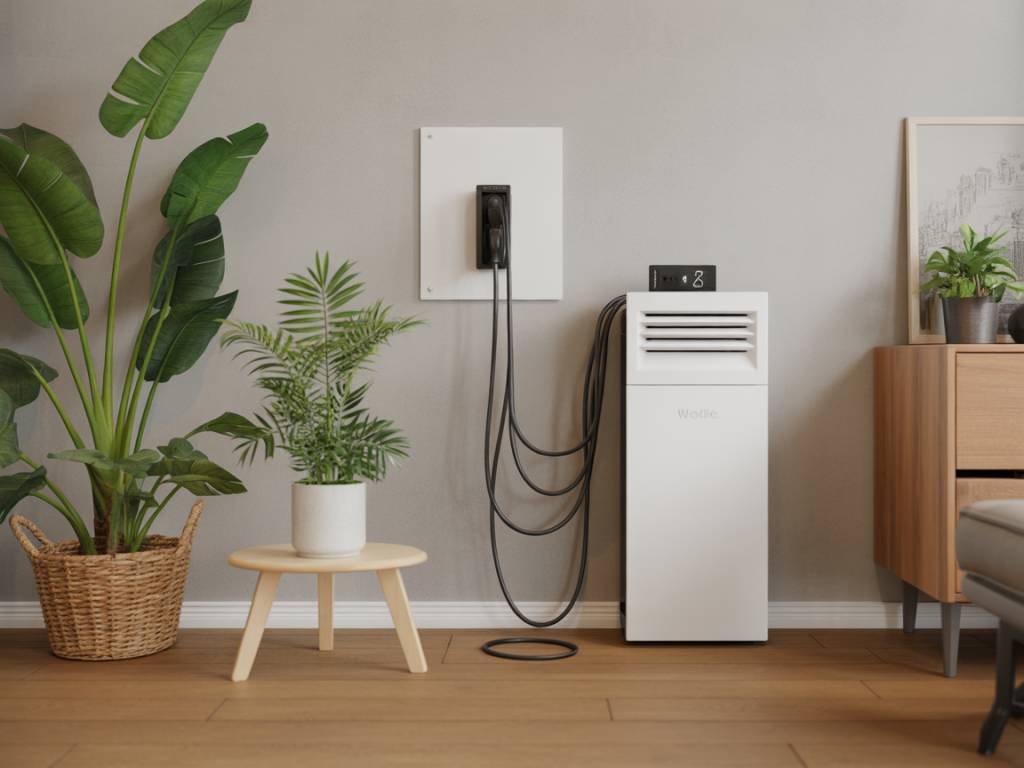
On a still winter morning, I stood in a quiet Cornish workshop watching a planer-thicknesser glide through a slab of oak. No strain, no flicker of light, no angry hum from an overworked motor. Outside, an EV charged silently, while the heat pump whispered warmth into a stone cottage that had known centuries of open fires. The quiet hero tying this modern choreography together wasn’t a shiny gadget or an app. It was something far more prosaic – and far more powerful: three-phase electricity.
If you’re renovating, building, or gently future-proofing an older home, three-phase power can feel like an obscure technical detail best left to electricians and utility companies. Yet for workshops, EV charging and heat pumps, it’s often the missing piece that makes everything run smoothly, efficiently, and sustainably.
What three-phase power actually is (in plain English)
Most homes in the UK and much of Europe are wired with single-phase power: one “live” conductor and one neutral. It’s perfectly adequate for lights, sockets, and the usual domestic appliances.
Three-phase power, by contrast, gives you three live conductors, each carrying power at a slightly different point in the AC cycle. Think of it like rowing in perfect timing with three oars instead of one:
- Power delivery is smoother and more constant.
- Motors start more gently and run more efficiently.
- The total available power to your property can be significantly higher.
In practical terms, a typical UK single-phase supply might be 60–100A. A three-phase supply can offer something like 3 × 63A, dramatically increasing what you can run at once – and how happily your electrical system copes with it.
For a home that wants to host a serious workshop, fast EV charging and a heat pump, this extra capacity is less a luxury and more a structural foundation.
Why three-phase matters for a sustainable, resilient home
As homes shift away from gas and oil, electricity becomes the backbone of daily life: heating, hot water, transport, perhaps even cooking. That means:
- Higher peak loads (e.g. everyone arrives home, plugs in the EV, throws on the oven, and cranks up the heating).
- A desire to keep bills reasonable through efficiency.
- A need for stability and safety as renewable technologies are layered in.
Three-phase power supports that shift in a few subtle but important ways:
- More capacity without constant compromise: You can run high-demand loads together without tripping breakers or playing domestic “load Tetris”.
- Better match for modern tech: Many heat pumps, EV chargers, and workshop machines are available in three‑phase versions that are more efficient and better behaved electrically.
- Easier integration of solar and batteries: Larger inverters and energy storage systems often prefer or require three-phase to share loads evenly and export cleanly to the grid.
In short, if you imagine your home becoming an all-electric ecosystem over the coming decades, three-phase is the stronger skeleton on which to hang it.
Three-phase and home workshops: where tools finally breathe
Workshops are often the first place where a single-phase supply starts to feel cramped. The frustrations are familiar:
- Lights dimming when the table saw spins up.
- Breakers tripping when a dust extractor and compressor happen to run together.
- Tools struggling on startup or running hot under load.
Three-phase power addresses this on several fronts.
1. Access to industrial-grade tools
Many of the best-quality machines are built primarily for three-phase use:
- Cabinet saws and bandsaws in the 3–5 kW range.
- Planer-thicknessers with wide capacity.
- Serious air compressors capable of continuous duty.
- Metalworking lathes and mills.
On single-phase, these machines either aren’t available, are derated, or require compromises such as soft-start add‑ons and oversized circuits. On three-phase, they simply do what they were designed to do.
2. Smoother, more efficient motors
Three-phase motors:
- Start with less current surge.
- Run cooler and generally last longer.
- Are often simpler, smaller and more robust than equivalent single-phase motors.
That means less stress on your electrical system and fewer inconvenient interruptions mid-cut when a breaker disagrees with your ambition.
3. A calmer, quieter workshop environment
There is a subtle but very real difference in feel. With three-phase:
- Voltage drops are reduced, so lights stay steady when large tools start.
- Multiple machines (e.g. saw + extraction + small compressor) can run together without a sense of being at the limit.
- You’re less tempted to use long extension leads and questionable “workarounds” because properly sized circuits are easier to plan.
The result is a workshop that feels more like a studio: focused, safe, and pleasant to work in for hours on end.
Three-phase and EV charging: faster, smarter, more future‑proof
EVs are quietly transforming driveways the way central heating once transformed sitting rooms. And, like heating, they place real demands on your electrical supply.
Faster home charging without overstressing the system
On single-phase, home EV chargers in the UK are typically limited to around 7.4 kW (32 A at 230 V). On three-phase, you can step up to 11 kW or even 22 kW chargers, depending on what your supply and DNO allow.
In practical terms:
- 7.4 kW: roughly 30–40 km of range per hour of charging.
- 11 kW: roughly 50–60 km per hour.
- 22 kW: up to around 100+ km per hour (if the car supports it).
For many households, 7.4 kW is “enough” – if you always plug in overnight, rarely arrive home empty, and aren’t juggling multiple EVs. But life is rarely that tidy. Three-phase provides breathing room for:
- Two EVs sharing charging time.
- Visitors who need a meaningful top‑up in a few hours.
- Future vehicles with larger batteries.
Less compromise with other loads
A big advantage of three-phase is being able to balance loads across phases. Your electrician can design the system so that:
- The EV charger sits on one phase.
- Large kitchen appliances lean on another.
- The heat pump is spread (if three-phase) or thoughtfully placed.
This balancing act makes nuisance tripping far less likely and keeps cable sizes, and therefore material use, sensible.
Smarter integration with solar and home batteries
If you plan to pair EV charging with rooftop solar, three-phase opens up more sophisticated options:
- Three-phase inverters can handle larger solar arrays more gracefully.
- Energy management systems can modulate EV charging based on surplus solar power, phase by phase.
- Battery systems can be configured to support the home and EV charging more evenly.
The resulting ecosystem can feel remarkably self-contained on a bright spring day: sunlight in, quietly stored, then fed into car, tools, or heat pump as needed.
Three-phase and heat pumps: the quiet backbone of all‑electric comfort
Heat pumps are often the largest single electrical load in an efficient home. A well-sized system for an older, reasonably upgraded property can easily be in the 8–16 kW heating range, which translates to several kilowatts of electrical demand, especially on the coldest days.
Three-phase heat pumps: efficiency and reliability
Many air-to-water and ground-source heat pumps are available in both single and three-phase variants. The three-phase models usually offer:
- Lower starting currents, reducing strain on the supply and neighbouring circuits.
- More stable operation under heavy load.
- Better suitability for larger properties or higher heat demands.
In a home where the heat pump is the heart of winter comfort, this stability matters. It also makes your installer’s life easier when designing the system – which often leads to better outcomes in sizing and control.
Room to grow without overload anxiety
As you add other electrified systems – EVs, induction cooking, perhaps a dehumidifier in a cellar or garden office – a single-phase supply can begin to feel like a bottleneck. On particularly cold evenings, when the heat pump is working hard, there’s understandable nervousness about what else can be safely switched on.
Three-phase power relieves that anxiety. The heat pump becomes one key player in an orchestra rather than a soloist gobbling all available attention.
Is three-phase worth it for a home? Key questions to ask
Three-phase isn’t automatically the right choice for every property. Before you fall in love with the idea, it’s worth sitting with a cup of something warm and honestly assessing your likely needs.
Ask yourself:
- Do I (or will I) run a serious workshop at home? Occasional DIY with a track saw and shop‑vac probably doesn’t justify the jump. A full wood or metal shop, with multiple heavy machines, often does.
- How many EVs might I need to charge in the next decade? If you foresee two vehicles, or frequently host visitors with EVs, three-phase starts to make more sense.
- Am I planning a heat pump now or soon? And if so, how large might it need to be for the property and insulation level?
- Do I intend to install significant solar PV and perhaps batteries? Larger systems integrate more elegantly with three-phase.
- Is this a long-term home? The longer you plan to stay, the more time there is for the investment to pay back in flexibility, comfort and resale appeal.
If several of these questions land on “yes” or “probably”, exploring three-phase with your electrician and Distribution Network Operator (DNO) is sensible.
Cost, complexity, and what the upgrade typically involves
Every property is different, but the journey to three-phase usually passes through a few common stages.
1. Initial assessment
Your electrician will:
- Review your existing supply (fuse size, meter, cable type and route).
- Estimate future loads: workshop, EV chargers, heat pumps, electric cooking, etc.
- Advise on whether three-phase brings clear, practical benefits.
2. Contacting the DNO
In the UK, the DNO (not your energy supplier) owns the cables and is responsible for the physical supply. They will:
- Check network capacity in your area.
- Quote for upgrading the supply to three-phase.
- Describe any necessary works (e.g. new cable from the street, meter changes).
Costs vary widely. In simple cases where the cable is already suitable and the infrastructure is close by, it might be a relatively modest investment. In more complex scenarios – long rural runs, roadworks, or major upgrades – it can be substantial.
3. Internal rewiring and distribution
Once the three-phase supply arrives at your property, your electrician will ensure:
- You have an appropriate three-phase consumer unit (or units).
- Loads are sensibly balanced across the phases.
- Dedicated circuits exist for workshop tools, EV chargers, and heat pumps.
- Protection devices (RCDs, RCBOs, surge protection) are correctly specified.
This is also a natural moment to tidy historical wiring eccentricities, add capacity where needed, and prepare for future technologies you haven’t yet decided on.
Living with three-phase: a quiet, invisible upgrade
Once installed, three-phase doesn’t feel dramatic. There’s no special switch to flip; no dashboard screaming “industrial power”. What you notice instead is an absence of small annoyances:
- Tools start and run without drama.
- The EV charges at a speed that fits real life, not an idealised schedule.
- The heat pump works unobtrusively in the background, even on frosty nights.
- Lights don’t complain when big loads join the party.
Behind the scenes, your home has moved from the electrical equivalent of a narrow country lane to a well-built, three-lane road. The scenery is the same; the journey is calmer.
A glimpse of the future-ready home
Imagine, a few years from now, stepping into your workshop on an autumn afternoon. Outside, your solar panels have been filling a battery while you were away. You plug in the car; the charger politely takes the surplus. Inside, the lights are steady, the extraction hums, and the thicknesser bites into ash without a stutter.
Later, you head inside. The heat pump has nudged the radiators to a quiet, even warmth. The induction hob flickers into life for supper. Somewhere in the background, your three-phase supply takes all this in its stride, unseen and mostly unthought of.
For many homes, single-phase will continue to suffice. But for those leaning into a future of electric workshops, electric miles and electric heat, three-phase power offers something quietly powerful: room to grow, without the constant negotiation of limits.
It isn’t glamorous. You’ll never show it off at dinner. Yet in the story of an efficient, resilient, low‑carbon home, it’s often the unsung character without whom the plot simply doesn’t work.