
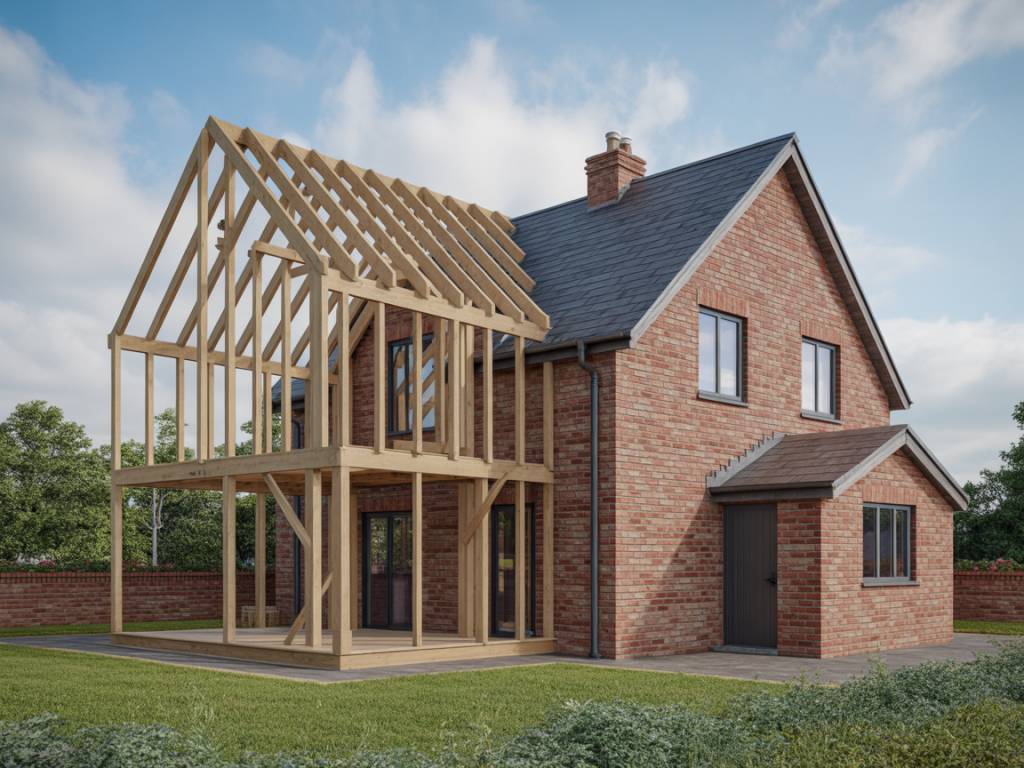
On a damp Tuesday in Yorkshire not long ago, I stood in the shell of a half-finished house, watching steam rise from mugs of tea while rain drummed on the temporary roof. One side of the plot was all neat brickwork, still smelling faintly of mortar; the other, a skeletal timber frame, pale and warm like fresh-cut bread. The builder turned to me and asked the question that quietly haunts so many self-builders and renovators in the UK:
“So then, Edwin, which one’s actually greener? Timber or brick?”
It’s a deceptively simple question. And in the current UK regulatory context – Part L, Future Homes Standard, tightening building control, and a growing focus on embodied carbon – the answer is not just academic. It affects how your home feels, what it costs to heat, how it will age, and how gently (or not) it will tread on the planet.
Let’s walk through it slowly, cup of tea in hand, and see where the evidence – and the regulations – quietly point us.
What does “greener” actually mean for a UK build?
Before we pick sides, we need to agree on what “green” means in 2025 Britain. For most projects, it comes down to two big pieces of the puzzle:
The current UK Building Regulations (especially Part L – Conservation of fuel and power) focus more heavily on operational energy. Your architect and energy assessor will wrestle with U-values, thermal bridges, airtightness tests and SAP calculations. Meanwhile, embodied carbon still sits mostly in the voluntary sphere: RIBA 2030 Climate Challenge, LETI guidance, councils asking for Whole Life Carbon Assessments on larger projects.
The twist? As building regs push new homes towards lower operational energy – and with the Future Homes Standard on the horizon – embodied carbon starts to loom much larger in the total footprint of a building. That’s where the timber-vs-brick debate becomes especially interesting.
Timber frame in the UK: light, fast and quietly low-carbon
Walk onto a modern Scottish building site and timber frame is almost a given; cross the border into England and it’s increasingly common, especially on volume developments. But what does it offer from a green perspective?
1. Embodied carbon: timber’s biggest trump card
Timber is a natural carbon store. As trees grow, they absorb CO₂, and that carbon stays locked inside the timber for as long as it remains in use.
Of course, not all timber is created equal. To keep the green halo intact, you want:
2. Thermal performance and compliance with Part L
From a regulatory perspective, timber frame makes hitting (and exceeding) Part L targets pleasantly straightforward:
Put simply, if you’re aiming for low energy bills, a comfortable internal climate and a Future Homes-ready envelope, a good timber design starts you on the front foot.
3. Speed of build, less disruption
There is also the gentle environmental benefit of time:
4. The common worries: fire, rot and durability
Ask a British neighbour what they think of timber frame and you may hear a familiar refrain: “But isn’t it a fire risk? Won’t it rot?”
Within modern UK regulations:
Timber is not forgiving of sloppy detailing. You win big on carbon and performance, but you have to take water and airtightness seriously. In the UK regulatory context, building control will look closely at these details – and so should you.
Brick and block: solid, familiar, but heavier on the planet
Walk through almost any UK town and the landscape is brick, brick, brick. There is a deep cultural comfort here: solidity, tradition, the reassuring sense that this house will still be standing when our grandchildren are complaining about the weather.
But when we place brick under the green microscope, a more nuanced picture appears.
1. Embodied carbon: the big stumbling block
Bricks are energy-intensive to produce. They are fired at high temperatures, typically using fossil fuels, which comes with a heavy carbon price tag. Concrete blocks, meanwhile, rely on cement – another major source of global CO₂ emissions.
If embodied carbon is a metric you care about – and if you’re designing for future regulation as well as today’s – this is where brick begins to lose ground.
2. Thermal mass and comfort
One often-touted strength of masonry is thermal mass. Brick and block can absorb heat during the day and release it slowly, smoothing temperature swings. In theory, this can be a boon in summer overheating scenarios.
In the mild but increasingly erratic UK climate, that benefit is subtle but real, especially in homes with large glazed areas. However:
3. Regulatory performance: still good, but bulkier
Brick and block can absolutely be designed to meet (and comfortably beat) Part L requirements, but you may need:
Masonry is slower to build, more weather-dependent and typically more labour-intensive. That doesn’t make it bad – just different in its resource footprint.
4. The emotional and planning argument
Here brick shines in ways that are hard to quantify in kilograms of CO₂:
From a sustainability standpoint, these are softer arguments, but in the real world of planning applications and mortgage offers, they matter.
Does the UK regulatory context favour timber or brick?
Step back from the materials themselves and look at the rules of the game. Where does UK regulation gently nudge us?
Part L and Future Homes Standard
Part L, recently tightened, and the coming Future Homes Standard push you towards:
Both timber frame and masonry can be engineered to meet these requirements, but timber systems often get there more simply and with fewer centimetres of wall thickness.
Planning and Whole Life Carbon
Some forward-thinking local authorities – particularly in London and larger cities – now request or require Whole Life Carbon assessments for major residential schemes. While this may not yet touch every small project, the direction of travel is clear: embodied carbon is stepping into the regulatory limelight.
On that front:
Fire regulations and tall buildings
Post-Grenfell, UK regulations have tightened around combustible materials in external walls of higher-rise buildings. For typical low-rise housing – the self-build in the countryside, the replacement dwelling at the end of a lane – well-designed timber frame remains fully permissible.
Where projects climb higher, or fall into specific building categories, you may see restrictions on timber in external walls. For a standard UK home of two or three storeys, this is rarely a show-stopper, but your designer will need to be literate in the evolving guidance.
Beyond carbon: comfort, sound and the texture of daily life
Regulations give us minimums; real life asks for more. How does each system feel once you’re actually living there – boiling the kettle, padding barefoot across the kitchen on a grey January morning?
Thermal comfort
Sound and solidity
There’s a particular comfort in the “thunk” of a door closing into a masonry wall. Timbers can be engineered for great acoustic performance, but it requires thought:
From the inside, though, much comes down to detailing: floor build-ups, door quality, services routing. Blaming the skeleton is often a little unfair.
Hybrid approaches: not timber or brick, but both
On that Yorkshire site, the answer to “timber or brick” turned out to be “yes”. Many of the greenest UK homes combine the two:
This hybrid arrangement lets you:
Alternatively, some go the other way: a structural masonry inner leaf with timber elements and bio-based insulation elsewhere. The palette is wide, and the greenest solutions are often the most nuanced.
So which is greener for your next UK build?
If we focus purely on carbon – both embodied and operational – a carefully detailed timber frame wins most of the time, particularly when:
Brick and block can remain part of a green strategy, but they usually need help:
In the current – and tightening – UK regulatory context, the direction of travel is clear: lighter, better-insulated, lower-carbon structures with robust, well-thought-out envelopes. Timber aligns naturally with that trajectory; brick can come along, but usually not alone.
The more interesting question, perhaps, is this: what story do you want your house to tell?
A timber frame whispers of forests, of managed woodland and carbon quietly stored in the bones of your home. Brick speaks of British streetscapes, of permanence and continuity. Neither is intrinsically immoral or virtuous; it’s how you use them, how carefully you design around them, and how well you respect the land and climate they’ll stand in.
On that rainy Yorkshire afternoon, the builder and I walked between the two halves of the plot – the brick shell and the timber skeleton – and paused where the future hallway would be. You could already feel the difference in air, in echo, in smell. Choosing between them isn’t just a technical decision; it’s emotional, cultural, even tactile.
But if the planet had a quiet vote in your planning meeting? It would almost certainly lean towards timber frame – particularly in a hybrid design that still honours the local brick vernacular. And somewhere between regulations, carbon spreadsheets and the way your future living room will catch the late autumn light, you’ll likely find your own answer, as individual as the house you’re about to build.