
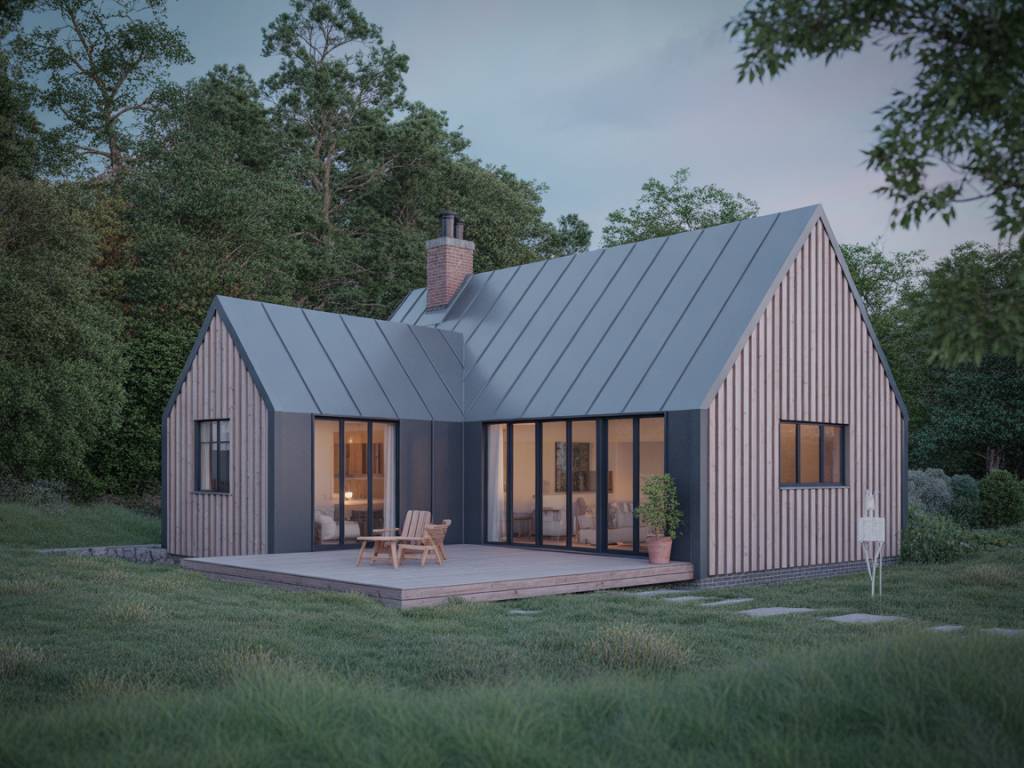
The quiet revolution inside old stone walls
There’s a particular kind of silence inside an old cottage. Not the empty kind, but the gentle hush of a place that has watched lives unfold for decades, sometimes centuries. Timber beams that have outlived fashions, stone walls that have weathered more storms than we ever will, a front door that still sighs the same way it did when coal was king.
How do you invite solar panels, heat pumps and high-performance insulation into this world without smothering its soul?
This is the question that surfaces again and again when I visit traditional cottages being reborn as eco-conscious retreats. Owners look around at uneven floors, limewashed walls and smoky old fireplaces and ask: Can I really make this place sustainable without turning it into a showroom?
The good news: you can. And done well, the process feels less like a makeover and more like a quiet, respectful conversation with the building itself.
Start by listening to the house
Every cottage has a logic of its own. Before talking products or paint charts, spend time simply observing how the house behaves.
Notice:
- Which rooms capture the morning sun, and which hold onto warmth in the evening
- Where the draughts sneak in under doors or around window frames
- Where condensation appears first on a cold morning
- How sound travels – the muffled creak of a stair, the echo in a stone hallway
These small details are your roadmap. Traditional cottages weren’t designed with U-values and SAP ratings in mind, but they were incredibly good at using what was available: thick walls for thermal mass, tiny north-facing windows to keep out the cold, deep window reveals that cradle you like a reading nook.
Rather than fighting these quirks, work with them. The most successful eco-renovations I’ve seen treat the cottage’s original “instincts” as an ally, not an obstacle.
Insulation that respects history
Insulation is the backbone of any eco-conscious retreat, but in a traditional cottage it needs to breathe as much as it needs to insulate. Many older buildings were designed to manage moisture naturally. Trap that moisture with the wrong materials and you invite damp, mould, and slow structural damage.
For stone or solid-brick walls, focus on breathable solutions:
- Internal wall insulation with natural materials such as wood fibre boards, cork, or hemp-lime. They regulate humidity, store heat, and feel in tune with the building’s age.
- Lime plaster instead of modern gypsum. Lime allows vapour to pass through, reducing condensation and preserving stone or brickwork. There’s also a subtle, velvety texture to lime that instantly feels “right” in an old cottage.
- Sheepswool or recycled cellulose in roof spaces. These are low-embodied-carbon options that sit quietly above the ceiling, doing their job without changing the cottage’s appearance.
The key is to think in layers. Instead of a single “thick and fast” fix, you introduce several sympathetic layers that each play a part: a breathable wall, a natural insulation board, a lime plaster finish, a mineral paint. Taken together, they quietly transform comfort levels without upsetting the house’s rhythm.
One owner I visited described the difference after insulating the roof and using wood fibre boards on the coldest external wall: “It feels like the cottage has finally exhaled. It’s warmer, but also calmer somehow.”
Heating, hot water and gentle tech upgrades
In old cottages, the fireplace is often the emotional centre of the home – but not necessarily the most sustainable. The aim is not to erase the hearth, but to rethink its role.
Consider this layered approach:
- Upgrade to a modern, efficient stove (ideally Ecodesign-ready) if you still want a flame. Pair it with sustainably sourced logs and use it as a supplementary heat source rather than the primary one.
- Explore a heat pump if your insulation levels are up to it. Air-source heat pumps, carefully positioned outside, can slip almost unnoticed into a cottage garden and quietly feed low-temperature radiators or underfloor heating.
- Retain or repurpose radiators rather than ripping everything out. Cast-iron radiators can work beautifully with low-temperature systems; they hold and release heat slowly, echoing the solid comfort of the building itself.
- Install smart controls with a light touch. A discreet thermostat, zoned heating, and simple app control can dramatically reduce energy waste without turning the cottage into a gadget showroom.
For hot water, pairing a heat pump with a well-insulated cylinder works well, but in snug cottages with limited space, consider:
- Solar thermal panels tucked onto an unobtrusive roof slope or outbuilding
- Smaller, highly insulated cylinders placed in eaves or under stairs, wrapped in additional insulation jackets
Think of technology here as a supporting cast, not the star of the show. The hardware can be modern; the feeling, when you curl up near the old inglenook with a book, remains timeless.
Natural light, windows and breathable finishes
Traditional cottages are rarely flooded with light; they tend instead towards intimacy – low ceilings, deep reveals, small-paned windows. The goal is to keep that cocooning quality while better harnessing natural light and improving efficiency.
Windows are often the most emotionally charged feature. Replacing them outright can feel like erasing the house’s face. Sometimes it’s necessary, but often there’s a middle path:
- Secondary glazing can dramatically cut heat loss while preserving original sashes or casements. Slimline systems hug the inside frame and are almost invisible from the outside.
- Repair, don’t replace where possible. Seasoned timber frames can often be repaired with splices and epoxy, then fitted with improved draught-proofing and slightly thicker glass.
- Use shutters and thick curtains, not as nostalgia props, but as active thermal tools. Closing them at dusk can almost feel like tucking the house in for the night.
On walls, swap plastic paints for breathable mineral or lime-based paints. They sit softly on the surface, allowing the building to regulate moisture while giving that gentle, chalky finish that flatters uneven plaster and imperfections rather than fighting them.
Allow the cottage to keep its scars – the hairline cracks, the slightly skewed architraves, the faint outline of a long-vanished staircase. Sustainability isn’t just about energy; it’s about resisting the urge to replace simply because something isn’t “perfect”.
Kitchens, bathrooms and the art of using less
Kitchens and bathrooms are where we tend to lose our nerve and default to shiny, new, and over-specified. But these rooms offer enormous scope for low-impact, characterful choices.
In the kitchen, think in terms of “edit and supplement” rather than full demolition:
- Retain existing carcasses if they’re solid, and replace only doors and worktops. A robust pine unit, sanded and re-oiled, will often outlive a brand-new chipboard kitchen.
- Choose worktops with low embodied carbon such as FSC-certified timber or recycled composite surfaces. Allow them to age gracefully; patina is a friend in a cottage kitchen.
- Opt for efficient appliances but tuck them behind panelled doors or into old chimney breasts or alcoves. Technology hums away quietly; the room still feels rooted in its past.
In bathrooms, water efficiency and longevity are key:
- Install low-flow taps and showers with good aeration, so the experience remains indulgent even as water use drops.
- Choose classic, repairable fixtures in timeless shapes – a simple white basin, a cast-iron or steel bathtub, brassware with replaceable cartridges. These age gracefully and avoid the churn of trend-led replacements.
- Use tiles sparingly, only where splash protection is really needed. Lime plaster and mineral paints do beautifully in well-ventilated bathrooms, reducing the need for energy-heavy floor-to-ceiling tiling.
There is a peculiar joy in stepping into a bathroom where a modern, water-saving shower is framed by an old beam, or where a reclaimed slate floor warms gently underfoot thanks to low-temperature underfloor heating. Old and new aren’t at war; they’re in conversation.
Furnishing with story-rich, low-impact pieces
Once the bones of the cottage are warm, dry and efficient, attention naturally turns to what lives inside it. This is where the building’s character can either be amplified or gently drowned out.
Let the house set the tempo. Chunky beams call for pieces with weight and honesty: solid wood, woven fibres, wool, linen. Think less about a matching “look” and more about a shared sincerity of materials.
- Prioritise second-hand and vintage – auction houses, charity shops, salvage yards. A slightly battered oak table that has seen a hundred Sunday lunches will sit more comfortably here than a brand-new, flatpack equivalent.
- Layer natural textiles – wool throws, linen cushions, jute or sisal rugs. These are renewable, repairable, and feel right under bare feet on a chilly morning.
- Choose fewer, better pieces. An armchair that truly supports you, a lamp with a warm, focused pool of light, a larder cupboard that swallows everyday clutter. You don’t need much; the cottage provides much of the atmosphere for you.
A low-consumption interior doesn’t feel sparse; it feels intentional. There’s breathing space between objects, room for the creak of the floorboard and the smell of the woodsmoke to be part of the décor.
Outdoor spaces: from cottage garden to climate-conscious sanctuary
The magic of a cottage rarely stops at the threshold. A small front garden with an unruly rose, a side path of uneven flagstones, a back yard with the vestiges of an old vegetable plot – these are not just aesthetic bonuses; they are assets in your sustainability story.
Think of the outdoor space as both habitat and infrastructure:
- Rainwater harvesting can be as simple as a well-placed water butt fed from a downpipe, or as ambitious as an underground storage system for garden and even greywater use.
- Planting for biodiversity – native hedges instead of hard fencing, flowering plants that span the seasons, a small wild corner left to its own devices. Cottage gardens, with their loose, overflowing planting, are naturally wildlife-friendly when pesticides are banished.
- Permeable surfaces – gravel, reclaimed brick, porous paving. These allow rainwater to return to the soil rather than rushing into overburdened drains.
- Solar panels with subtle placement – on a less visible roof pitch, on an outbuilding, or incorporated into a pergola or carport. The energy story of your cottage need not be written only on its main façade.
Even the compost heap becomes part of the narrative: kitchen scraps cycling back into the soil that feeds the herbs by the back door, which end up in the soup simmering on the stove you’ve just fed with locally grown logs.
A house that teaches you to live differently
Turning a traditional cottage into an eco-conscious retreat isn’t just a design project; it’s a shift in how you inhabit a space.
You begin to notice how quickly a room warms when the winter sun hits the stone. You become curious about how little hot water you actually need for a shower when the pressure and aeration are right. You get into the habit of closing shutters at dusk, of cooking with the residual warmth of the oven, of hanging laundry by the woodstove instead of running the tumble dryer.
The building, with all its quirks, becomes a kind of tutor. It encourages slower rhythms and smaller gestures:
- Opening opposite windows for a few minutes to flush out stale air instead of leaving one on the latch all day
- Using the naturally cooler north-facing room as a summer bedroom
- Letting the thick stone walls, once properly insulated, do the quiet work of smoothing out temperature swings
In the end, the most sustainable cottages I’ve visited are not the ones with the most cutting-edge kit, but the ones where each intervention has been made with care, with a long view, and with genuine affection for what was already there.
The beams still creak. The door still sighs. The kettle still whistles on a quiet morning. But somewhere in the background, a heat pump hums gently, solar panels soak up a pale winter sun, insulation holds the warmth long after the fire has faded. The character remains intact; the footprint quietly shrinks.
And as you sit at the old kitchen table with a mug of something hot, feeling the solid comfort of those thick walls around you, you realise that sustainability here doesn’t feel like sacrifice at all. It feels like the house – and you – finally breathing in time with the landscape that has always surrounded it.