
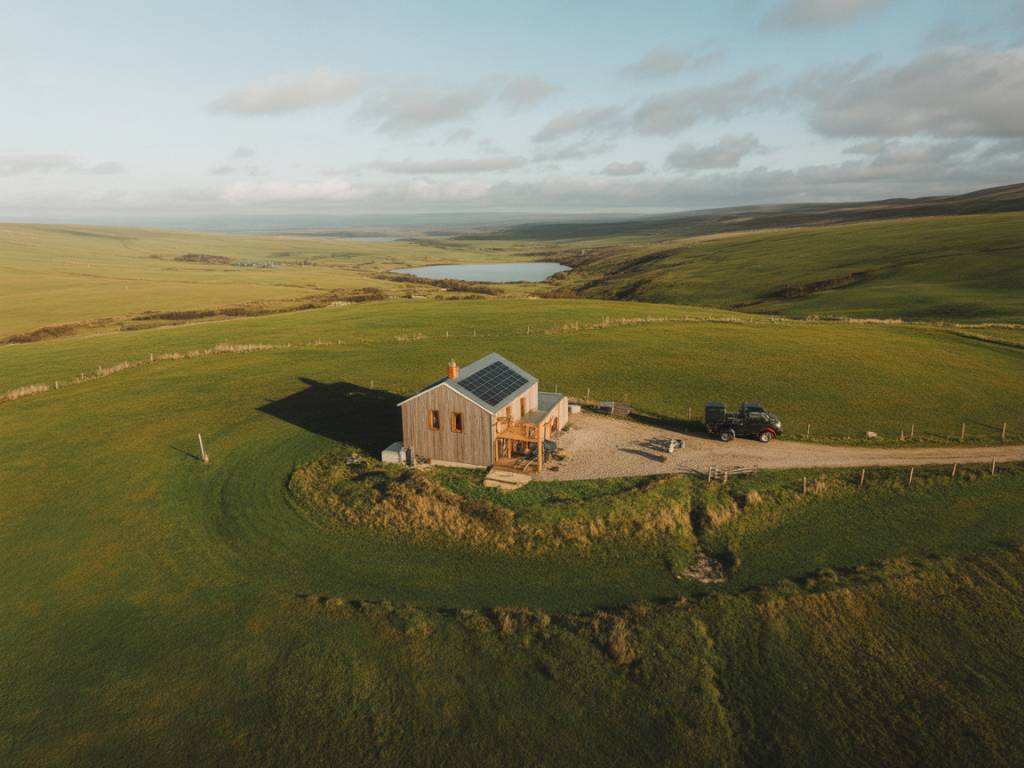
On a grey February morning in Northumberland, I stood in the middle of five acres of damp, tufted grass and felt something quietly shift inside me. No house, no road noise, just the distant cough of a tractor and the steady hiss of the wind across the hillside. It felt, in that instant, like freedom you could touch.
But then the farmer beside me pointed to the muddy track we’d just squelched along and said, almost apologetically: “Of course, you’ll need proper access if you’re putting anything here. Planning might not like it. And the council’s been funny about new tracks since the winter floods…”
Romance met reality in that single sentence – and that’s exactly where any off‑grid dream in the UK truly begins.
If you’re thinking of buying land for an off-grid project here – whether a tiny home, a low-impact cabin, or a fully self-sufficient homestead – the plot you choose will shape everything. Before you fall in love with a view on Rightmove or a “bargain” bit of woodland on Facebook Marketplace, there are some hard, slightly muddy truths worth understanding.
The dream vs the map: where in the UK are you actually looking?
Not all UK countryside is created equal when it comes to off-grid living. Law, planning culture and price vary wildly between regions, and it’s worth getting a feel for the landscape before you even start zooming in on parcels of land.
Broadly speaking:
- England – generally the strictest planning environment, especially in the South East and in green belt, Areas of Outstanding Natural Beauty (AONB) and National Parks. Land prices can be eye-watering near cities.
- Wales – more supportive of low-impact, rural living in principle (think of the One Planet Development policy), but that doesn’t mean a free-for-all. You still need to tick boxes, and not all areas are equally open to experimental projects.
- Scotland – often more space for your money and a slightly different planning mindset. But remoteness brings its own costs: track building, connecting to services (if you want to), and access in winter can all bite into your budget.
- Northern Ireland – its own planning system and dynamics; rural building can be possible, but local advice is vital.
Rather than asking “Where’s the cheapest land?”, a more useful first question might be: “Where do I realistically want to spend a winter?” The wild moor that looks romantic in August may feel very different when you’re hauling water through sleet.
Access: the first non-negotiable
Access is the quiet deal-breaker in so many off-grid projects. It’s the thing people assume will work itself out… until they’re faced with a £50,000 quote for a track or discover they don’t actually have a legal right to their own gate.
When you walk a piece of land, ask yourself three separate questions:
- Physical access – How do you actually get there?
- Legal access – Do you have the formal right to use that route?
- Practical access – Will it still be usable in the depths of winter or after a week of heavy rain?
Some specifics to look for:
- Track condition – Is it tarmac, hardcore, or just two muddy ruts in a field? Imagine a delivery truck, or an ambulance, in January.
- Right of way – Access “by agreement” with a friendly farmer is not enough. You want a documented right of way in the title deeds, ideally with vehicles explicitly mentioned.
- Ransom strips – That mysterious 1‑metre strip between your land and the public highway? It can be owned by someone else and used to demand money for access rights.
- Gradient – A steep, picturesque drive can turn into a skating rink in snow or frost.
- Planning for new access – New access points onto public roads often require planning permission and Highways approval, particularly on faster roads.
Off-grid doesn’t mean “off-road”. If you can’t safely and legally reach your land in all seasons, everything else becomes harder, from building materials to weekly food shopping.
Planning risk: how likely are you to get permission to live there?
You can buy land in the UK very easily. Living on it is another story entirely.
The UK planning system is designed around the principle that new homes should usually be built in or near existing settlements, not scattered across open countryside. That doesn’t mean off-grid projects are impossible; it does mean they need to be carefully framed, justified and located.
When you look at a plot, think in terms of planning risk – a spectrum from “fairly realistic with a good case and patience” to “you’ll probably be politely (or firmly) refused forever.”
Key factors include:
- Current land use – Is it agricultural, woodland, garden, brownfield? A new dwelling on pure agricultural land in open countryside will face heavy scrutiny.
- Designations – Is it in a National Park, AONB, green belt, conservation area, SSSI (Site of Special Scientific Interest) or flood zone? Each brings tighter rules.
- Local plan policies – Every council has a Local Plan that sets out where development is acceptable. Some are more open to rural exception housing or low-impact development than others.
- Existing buildings – Converting or replacing an existing, lawful building is often easier than creating something from scratch on a bare field.
- Visibility and impact – A tucked-away corner behind a hedgerow is very different (in planners’ eyes) from a cabin on an open ridge.
Before you fall for a plot, it’s wise to:
- Check the council’s online planning portal – See what has been approved or refused on nearby land. Patterns emerge quickly.
- Read the Local Plan policies on rural housing – Dry documents, yes, but you’ll start to see what the council encourages or resists.
- Consider a pre-application enquiry – Many councils offer this (for a fee). You submit an outline of your idea and get informal feedback from a planning officer.
- Talk to a planning consultant – Especially one with specific experience of off-grid or low-impact projects in that region.
There’s also a persistent myth that “temporary” structures, yurts, or “moveable” tiny homes on wheels magically bypass planning. They don’t. If you’re using them as your main place of residence, they almost always count as development in planning terms.
Water: the quiet foundation of off‑grid life
You can improvise on many things off grid. Water is rarely one of them.
For each plot, ask: Where will our drinking water come from, and how resilient is that source?
Common options include:
- Existing mains connection – Not very romantic, but very reliable. Even off-grid homes often keep mains water if it’s available.
- Springs and streams – Potentially wonderful, but variable. You’ll need filtration and often treatment. A spring that trickles in May might be a torrent in December.
- Boreholes – A viable long-term option, but drilling and testing can be expensive, and you don’t always find what you expect underfoot.
- Rainwater harvesting – Excellent as part of a broader system, but rarely your only source in the UK climate, especially through a dry summer.
Also consider:
- Abstraction licensing – Large-scale water abstraction from rivers or boreholes may require permission from the Environment Agency (or equivalent).
- Drainage and wastewater – Where will greywater and sewage go? Will you use a septic tank, a packaged treatment plant, or composting toilets? These interact not just with planning, but sometimes with Building Regulations too.
- Flooding – That lovely, flat riverside meadow? Check the flood maps. Living with water is charming; living in it is less so.
Sun, wind, soil: is the land itself on your side?
Part of the pleasure of walking a potential plot is paying attention to what the land quietly tells you.
Stand still and notice:
- Aspect – Which way does the slope face? South-facing land in the UK gets more sun and often feels like a different microclimate.
- Shelter – Are there hedgerows, trees, or contours that break the wind? A fully exposed hilltop can be brutal in winter, even if the views are extraordinary.
- Soil – Is it heavy clay, peaty, sandy, thin over rock? If you dream of growing food, this matters. Take a small spade and have a look.
- Drainage – Are there rushes (a classic sign of waterlogged ground)? Puddles that never quite go away? Boggy gateways?
- Existing ecology – Ancient hedgerows, old trees, wildflower meadows and wetlands are treasures. They’re also often protected, which is good for biodiversity but can limit where you can build.
An off-grid project that works with these characteristics rather than against them will be more comfortable to live in and easier to argue for in planning terms. A house nestled into a natural fold of the land, oriented to the sun and tucked out of the prevailing wind, has an elegance that planners, and neighbours, often appreciate.
Power and connectivity: off-grid doesn’t mean off-everything
Many people approach off-grid living with a gleeful sense of cutting ties. No gas bill, no electricity bill, no more utility companies on the phone. But the practical reality is subtler.
You’ll want to think honestly about:
- Electricity – Solar PV is now the obvious starting point, but ask: how much winter generation will you realistically get on this plot? Is there wind potential? Space for a battery bank? A backup generator for long gloomy spells?
- Heating – Will you rely on wood from your land? Is it actually capable of sustainably supplying that? Are there nearby suppliers if not?
- Connection options – Even if you plan to be off-grid, get a quote for grid connection. Sometimes it’s surprisingly reasonable; other times the cost runs into tens of thousands.
- Internet and phone signal – Can you get 4G or 5G? Is there line of sight to a wireless broadband provider? Working remotely or doing online schooling from an internet dead zone is its own kind of isolation.
Off-grid, in the 2020s, often looks less like a proud disconnection from everything and more like a thoughtful, resilient mix: your own generation where possible, smart demand management, and just enough connectivity to keep you in touch with work, family and emergency services.
Legal checks: what’s hidden in the small print?
A field is rarely “just” a field in legal terms. Beneath the grass there may be centuries of rights, restrictions and oddities quietly sitting in the deeds.
Before committing to a purchase, your solicitor should check for:
- Title clarity – Who actually owns what? Are the boundaries clear? Is the land registered with the Land Registry?
- Rights of way – Footpaths, bridleways, access tracks for neighbours, farm rights. Public rights of way can bring walkers close to your front door; private rights can give others the right to drive across your land.
- Restrictive covenants – Legal promises that restrict what you can do. Common examples: “no residential buildings”, “no caravans”, or limits on additional structures.
- Overage / uplift clauses – The seller (or a previous owner) may have reserved a right to a share of any increase in value if you gain planning permission for a dwelling.
- Mineral rights – Sometimes owned separately, occasionally with the theoretical right for someone to access them.
- Environmental designations – SSSI, scheduled monuments, ancient woodland status, protected species habitats. These matter for how and where you can build or alter land.
- Flood, contamination, and drainage – Standard searches can flag some of these, but it’s often worth additional environmental or structural surveys on more complex sites.
It’s tempting, particularly on cheaper plots, to skimp on legal work. But unknown covenants or ransom access can make a “bargain” unusable for the project you had in mind.
Neighbours and the quiet politics of place
In rural communities, news of “someone buying that top field” travels faster than fibre broadband. How you step into that story matters, both for your day-to-day life and your chances with planning.
As you explore areas and potential plots, try to:
- Talk to neighbours early – Not with grand declarations, just gentle curiosity. “We’re thinking of something low-impact here, very small scale, and we’d love to understand what matters to people locally.”
- Listen more than you explain – What are people worried about? Traffic? Holiday lets? Noise? Visual impact? Your design can often respond to these.
- Understand local history – Has there been a long-running dispute about that track? Did someone try, and fail, to build in this field before?
- Consider how you’ll contribute – Off-grid doesn’t mean apart-from. Will you use the village shop? Join local groups? Offer skills or tools? Community tends to flow both ways.
Many planning objections revolve not just around policy, but around fear: of strangers, of change, of “development” that feels imposed rather than woven into local life. Your project can be the opposite: rooted, thoughtful, and quietly generous to its surroundings.
Hidden costs and realistic budgeting
It’s easy to focus on the ticket price of the land and forget the quieter numbers waiting in the wings. A simple mental exercise: whatever you think the land and basic build will cost, add a healthy margin for the things you haven’t thought of yet.
Common extra costs include:
- Access improvements – Track building, gates, drainage, visibility splays for road safety.
- Surveys – Topographical, ecological, tree surveys, ground investigation for foundations and drainage.
- Planning and professional fees – Planning consultants, architects, structural engineers, application fees, building control.
- Water supply – Borehole drilling, filtration systems, storage tanks, rainwater systems.
- Wastewater – Septic tank or treatment plant installation, soakaways, percolation tests.
- Power systems – Solar panels, inverters, batteries, backup generator, wiring.
- Legal fees and taxes – Solicitor’s costs, Land Registry fees, and potentially Stamp Duty Land Tax depending on the purchase price and your circumstances.
None of these are reasons not to proceed; they are simply part of the full picture. A realistic budget can make the difference between an off-grid life that feels steady and one that feels like a permanent scramble.
A simple due diligence ritual for any plot
Standing in a promising field or woodland, with skylarks spiralling overhead and the smell of damp earth in your nose, it’s easy to go soft around the edges and say “Yes” with your heart. Keep that feeling. It’s important. But bring a small, practical ritual with you too.
For every plot you seriously consider, you might:
- Walk every boundary slowly, noting access points, neighbours, hedgerows and water flows.
- Visit at different times of day and, if possible, in different seasons: misty dawn, wet afternoon, winter dusk.
- Check mobile reception on different networks using friends’ phones.
- Look up planning history on the council website before your second visit.
- Talk to at least one neighbour, however briefly.
- Sketch a rough layout in a notebook: where could a small dwelling sit, where would you park, where might solar panels go, where are the wet spots to avoid?
- Note what your body tells you: Do you feel at ease here? Can you imagine stacking logs for winter, mending fences in the rain, watching a long sunset after a hard day’s work?
Off-grid living in the UK isn’t a loophole or an escape hatch from ordinary life; it’s a different kind of relationship with place, one that demands attention to law, landscape, and community in equal measure.
If you can hold the poetry of that Northumberland hillside in one hand and a stack of planning documents, access plans and water tests in the other, you’re already some distance along the path. The land you choose will ask questions of you; knowing what to ask of it, in return, is where the adventure truly begins.