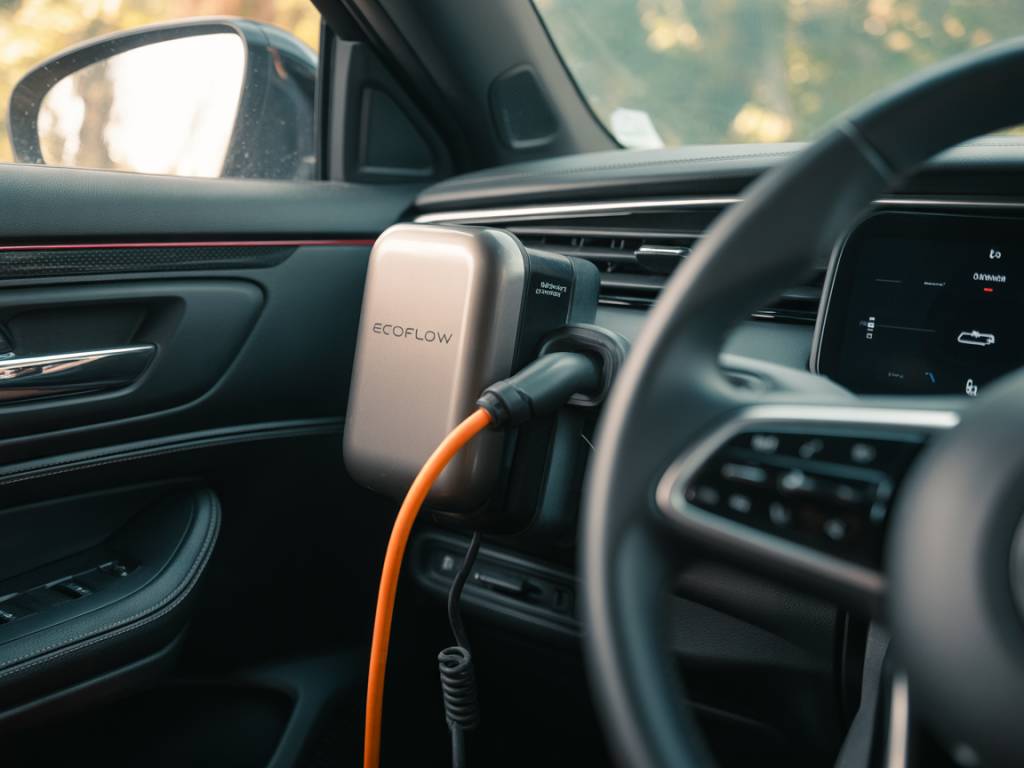
There is a quiet kind of luxury in watching the battery percentage creep upwards while the road unwinds under your wheels. No generator grumbling in the background, no frantic search for a sunny spot big enough to fit your panels. Just the low, constant hum of the engine and the knowledge that, as you move, your home-on-wheels is quietly refuelling its own heart.
This is precisely where the EcoFlow 800W Alternator Charger changes the game for off-grid travellers. It turns the most basic, overlooked part of your vehicle – the alternator – into a fast, mobile charging station for your EcoFlow power station.
Why charging while you drive matters for off-grid life
If you’ve spent any time living in a van, tiny house on wheels or remote cabin with a vehicle nearby, you already know the three classic ways we charge off-grid power stations:
Solar is elegant and poetic… when the weather cooperates. But clouds, short winter days, tree cover and tight parking spots can turn that poetry into a logistical headache. You park in the most beautiful forest you’ve ever seen – and discover your solar input is basically zero.
Charging while driving neatly sidesteps this. You’re already burning fuel to move; why not harvest some of that energy flow to charge your EcoFlow battery bank at the same time? It’s like transforming every drive into a quiet, useful ritual: miles become watt-hours.
What the EcoFlow 800W Alternator Charger actually does
The EcoFlow Alternator Charger is essentially a smart DC-to-DC charger designed specifically to feed EcoFlow power stations using your vehicle’s alternator. Installed between your starter battery and your EcoFlow unit, it pulls power safely and efficiently while the engine is running.
At a glance, it offers:
In plain terms: you plug the charger into your EcoFlow power station, wire it to your vehicle battery, start the engine and let the alternator do what it was designed to do – provide power – but now with purpose.
How it changes an off-grid day on the road
Imagine a typical travel day. You wake up in a small gravel lay-by, tucked just out of sight of the main road. The night before was cold, and your 12V fridge and heater have eaten into your EcoFlow battery. You’re down to, say, 25%.
In the past, you’d face a choice:
With the 800W Alternator Charger, you simply start the engine and get on with your journey. Over a couple of hours of driving, that same battery can climb rapidly back towards full. The exact numbers will depend on your EcoFlow model and settings, but going from “mild anxiety” levels to “comfortably topped up” over the course of a morning’s drive becomes the norm.
By lunchtime, you pull into a lakeside spot. The wind floats across the water, the kettle hums on the induction hob, your laptop charges on the table. Solar can now be a welcome bonus, not the sole lifeline.
The efficiency and sustainability angle
There’s an interesting, less obvious benefit here: using your alternator well can be more sustainable than it first appears.
When you’re already driving, the engine is turning regardless. The alternator is spinning regardless. Tapping into that existing motion to charge your EcoFlow unit doesn’t require an additional engine, extra fuel or a separate noisy generator. You’re maximising what’s already in motion, rather than adding another system to burn fuel just for electricity.
That means:
In a sense, the alternator charger is a bridge technology: it lets you go deeper off-grid while still living inside the reality that many journeys, goods and people still move by combustion engine. If you must burn fuel, at least harvest as much useful energy as possible from it.
EcoFlow ecosystem: how it fits with your existing gear
EcoFlow’s strength has always been in its ecosystem: power stations, solar panels, smart batteries, home backup systems. The Alternator Charger is designed to drop into that ecosystem rather than sit awkwardly beside it.
Depending on the model, it can work with many of the popular EcoFlow units (such as DELTA series and others), and it typically plugs into existing high-power DC input ports. That means:
Used together, these three inputs give you an energy strategy that feels almost over-prepared. Grey, rainy week in the mountains with dense forest cover? Drive a couple of hours down the valley, explore a town, and return with a full battery bank. It’s resilience by design.
Who benefits the most from an 800W alternator charger?
Not every lifestyle needs this kind of charging muscle. But if you recognise yourself in any of these, it’s worth a close look:
The common thread is movement. If your lifestyle already includes hours on the road or water, you’re literally surrounded by unused energy every time the engine turns.
What does 800W feel like in real life?
Technical numbers on paper don’t always translate easily into lived experience. So let’s place that 800W into practical terms.
Assuming you can sustain something close to the maximum (the actual figure will depend on your alternator, vehicle system and settings), then:
What does 2–3 kWh mean in human terms?
Suddenly, long driving days stop feeling like a drain on your lifestyle and become opportunities. The hours between point A and B turn into quiet, invisible refuelling time.
Installation: what it involves (and what it doesn’t)
If the words “vehicle electrics” make you think of tangled wires and mysterious fuses, you’re not alone. The good news is that the EcoFlow Alternator Charger is designed to be more plug-and-play than a full custom 12V build, but there are still a few realities to face.
In broad strokes, installation typically involves:
Many van builders and competent DIYers can do this with the right tools and care, but if you’re uncertain, involving an auto-electrician is rarely a bad idea. Protecting the starter battery and ensuring the alternator isn’t overstressed are not just technical details; they’re what stand between you and an unplanned night stranded in a supermarket car park.
Key advantages compared to “traditional” solutions
When people design off-grid systems for vehicles, they often compare several charging strategies. The 800W Alternator Charger stands out in a few specific ways:
Things to consider before jumping in
No piece of hardware exists in a vacuum, and the 800W Alternator Charger is no exception. A few points are worth weighing calmly over a cup of coffee:
A day on the road with quiet, invisible power
There is a very particular joy in parking wherever the landscape moves you, without the quiet, nagging voice of “Will the panels get enough sun here?” shaping every decision.
You roll into a shaded glen because it feels right. The trees filter the afternoon light into green-gold motifs across the ceiling of your van. You open the side door and the smell of damp earth and wood drifts in. The EcoFlow unit sits under the bench, quietly humming at a comfortable state of charge. You worked on your laptop that morning while the kilometres slipped by, and in doing so, charged the very battery that’s now powering your lights and music.
Outside, the only sound is wind and birds and the occasional rustle of a curious animal in the undergrowth. No generator. No desperate reshuffling to “catch more sun.”
This is what the EcoFlow 800W Alternator Charger ultimately offers: not just watts and percentages and cables, but a subtle rearrangement of how you move through the world. Your vehicle stops being merely transport and becomes part of a closed loop – motion feeding energy, energy feeding comfort, comfort enabling more intentional journeys.
In the long, gentle negotiation between freedom and dependence that defines off-grid life, having one more reliable, quiet way to refill your batteries while you drive feels less like a gadget and more like an ally.